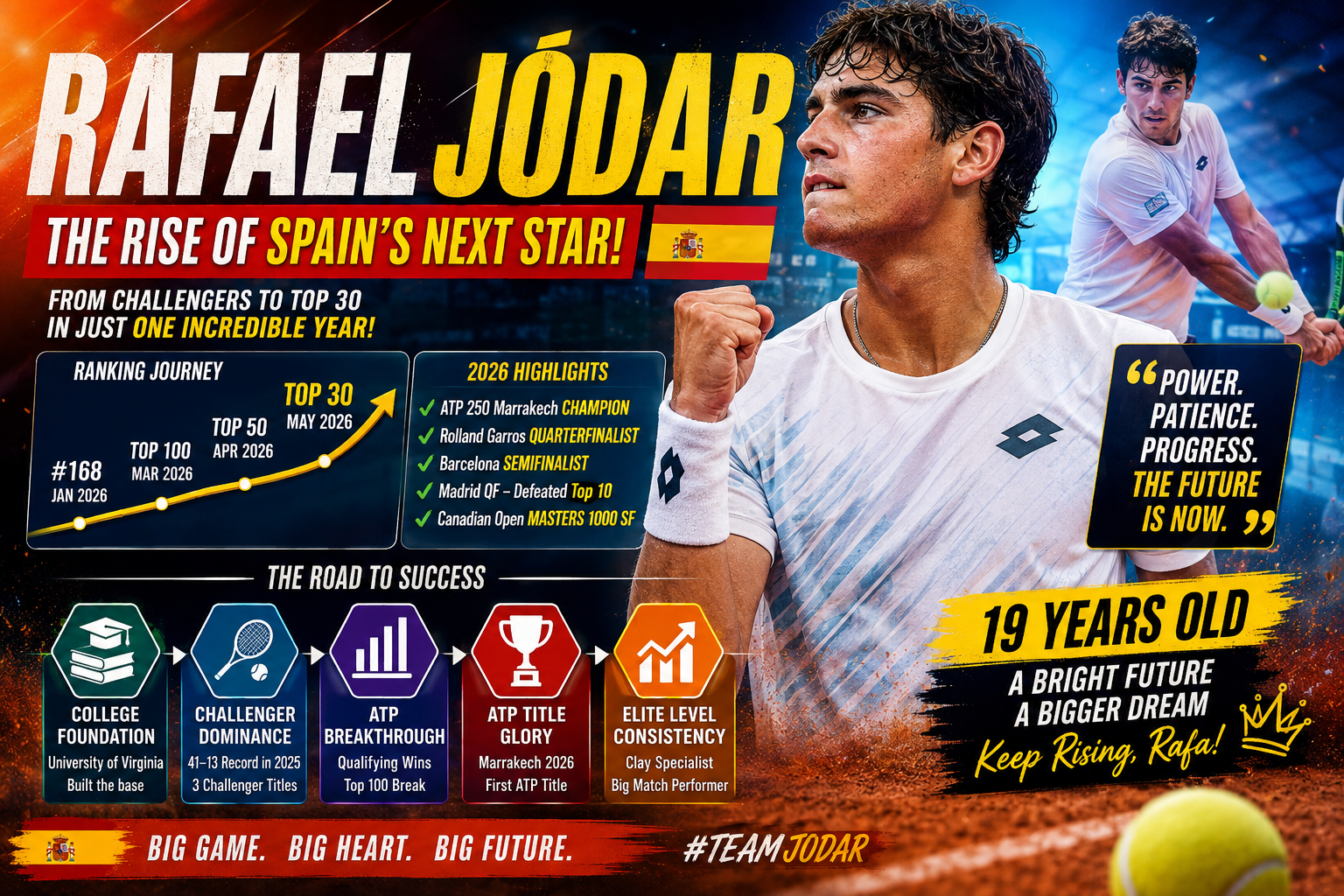
Rafael Jódar's rise is one of the most remarkable ranking jumps in men's tennis this season. The key point is that his 2026 ranking explosion did not come from one tournament—it was the result of a carefully built progression through college tennis, Challengers, qualifying, ATP events, and then deep runs at the highest levels.
He began 2026 at No. 168, broke into the Top 100 in March, Top 50 in April, and Top 30 in May. By July he was around the mid-20s.
The ranking acceleration
| Period | Jódar's position / achievement |
|---|---|
| March 2025 | Outside Top 900 |
| Start of 2026 | No. 168 |
| March 2026 | Top 100 |
| April 2026 | Top 50 |
| May 2026 | Career-high No. 29 |
| June 2026 | No. 23 |
| July 2026 | Around No. 25 |
| August 2026 | Reached Canadian Open Masters 1000 semifinal |
The ATP itself identified Jódar as the biggest Top-100 ranking mover from the end of 2025 to early May 2026, going No. 168 → No. 34, a 134-place jump.
And his rise continued.
1. The foundation was actually built in 2025
This is probably the most important part of the story.
Jódar was not suddenly transformed into a Top-30 player in 2026.
In 2025, he played extensively at Challenger level and produced a 41–13 Challenger record, winning three titles: Hersonissos, Lincoln and Charlottesville.
That gave him something extremely valuable:
match experience against professional players before he became a full-time ATP player.
His 2024 US Open junior championship gave him confidence, but the Challenger season taught him how to win repeatedly against adults playing for ranking points and money.
That distinction matters.
Junior success tells you:
"I have the talent."
Challenger success tells you:
"I can repeatedly beat professional players."
Jódar crossed that second threshold very quickly.
2. College tennis was a surprisingly important part of his development
Jódar chose the University of Virginia rather than immediately following the traditional European junior-to-pro pathway.
Under coach Andres Pedroso and the Virginia coaching staff, he developed inside a highly competitive environment.
ATP reported that Pedroso was particularly impressed by Jódar's maturity and competitiveness even when he was still a junior.
The bigger lesson is how Jódar used the environment.
He didn't treat college tennis as a detour.
He used it as a laboratory.
He could:
- play frequent competitive matches
- work on tactical patterns
- compete under pressure
- analyze losses
- train with strong players
- develop physically
- learn how to win repeatedly
That became important when he entered the Challenger circuit.
3. His biggest weapon may be his ability to learn from losses
This is perhaps the most interesting aspect of Jódar's game development.
His coach described his ability to face stronger opponents, identify what was missing, and then take those lessons back to the practice court with his father.
That creates a powerful development loop:
Lose → analyze → train → adjust → compete again → win
Many young players instead do:
Lose → become frustrated → change something completely → lose again.
Jódar appears much more systematic.
His progression suggests that he isn't simply accumulating matches.
He's extracting information from them.
4. The 2026 breakthrough came because he converted opportunities
At the beginning of 2026, Jódar was No. 168.
He didn't need to immediately win a Masters 1000.
He first accumulated tour-level victories.
At the Australian Open, he came through qualifying and won his first-round match. He then produced ATP-level wins in events including Dallas and Acapulco before his Miami run.
Then came Miami.
He reached the third round after coming through qualifying, and that result helped push him into the Top 100.
This is an important ranking strategy:
qualifying + main-draw wins = enormous ranking acceleration for a player starting from a low ranking.
A Top-20 player doesn't get the same benefit from beating a Top-100 opponent as a No. 150–200 player does from suddenly reaching an ATP third round or quarterfinal.
Jódar was positioned perfectly to harvest ranking points.
5. Marrakech changed the trajectory
Then came the breakthrough that accelerated everything.
Jódar won the 2026 Marrakech ATP 250, his first ATP Tour title.
He defeated Marco Trungelliti in the final. The title made him one of the youngest Spanish ATP champions and pushed him dramatically higher in the rankings.
This was huge psychologically as well as mathematically.
Before Marrakech:
"Can I compete at ATP level?"
After Marrakech:
"I can win an ATP tournament."
That is a completely different mental position.
6. Then his clay-court game exploded
The most impressive part of Jódar's 2026 season has been clay.
His 2026 statistics show approximately:
Clay: 19–4 — 82.6% winning percentage
compared with:
Hard: 5–6 — 45.5%
and:
Grass: 2–1 — 66.7%.
That tells us something about his development.
Jódar isn't yet equally dominant on every surface.
His clay-court game became the engine of his ranking climb.
After Marrakech, he reached the semifinals in Barcelona and the quarterfinals in Madrid. He also reached the quarterfinals in Rome, taking him into the Top 30.
At Madrid, he recorded his first Top-10 victory, defeating No. 8 Alex de Minaur.
That is where his ranking started looking less like a prospect's ranking and more like a genuine elite player's ranking.
7. Roland Garros proved the rise wasn't just a hot streak
This was probably the biggest validation.
Jódar reached the Roland Garros quarterfinals on his main-draw debut.
Against Pablo Carreño Busta, he came back from two sets down and won:
4-6, 4-6, 6-1, 6-2, 6-2
Roland Garros reported that Jódar had reached an impressive 19–3 clay record in 2026 at that stage.
That tells us something about his competitive identity.
He wasn't simply winning short matches.
He could survive:
- physical matches
- five-set situations
- momentum swings
- pressure
- fatigue
- experienced opponents
That is a major developmental step for a 19-year-old.
8. His game: why does it work?
Forehand — major weapon
Jódar is a big, modern ball striker.
At roughly 1.91 m, he has the physical dimensions to generate serious serve and forehand penetration.
His forehand allows him to:
serve → get a shorter ball → attack → control the rally
Rather than needing spectacular winners every point, he can progressively push opponents backward.
Backhand — stability and rally tolerance
His two-handed backhand gives him a reliable baseline foundation.
This becomes particularly important on clay.
He can exchange crosscourt, absorb pace and wait for an opportunity to change direction.
That is one reason his clay record has been so strong.
Serve — becoming increasingly important
His height gives him a natural serving advantage.
But the important developmental question isn't simply:
"Can he hit a big serve?"
It's:
"Can he get enough cheap points from the serve to protect himself when his baseline game isn't working?"
That is still part of his evolution.
His losses against stronger opponents show that his serve and first-ball combination still has room to become more consistently elite.
9. His biggest tactical strength: pressure without panic
Jódar's game is interesting because he doesn't appear to play like a teenager desperate to hit a winner.
He often builds points.
That gives him a very useful combination:
power + patience.
He can attack, but he doesn't necessarily need to attack immediately.
This is especially dangerous on clay.
Opponent hits:
neutral ball
Jódar:
heavy forehand
Opponent defends:
another heavy ball
Opponent gives shorter ball:
Jódar changes direction
That is classic modern Spanish baseline construction.
But he is developing his own version rather than simply copying Nadal or Alcaraz.
10. His ranking rise accelerated because he stacked results
This is the real secret.
It wasn't:
One big tournament → Top 30
It was:
2025 Challenger titles
↓
Australian Open qualifying + win
↓
ATP wins
↓
Miami R3
↓
Top 100
↓
Marrakech title
↓
Barcelona semifinal
↓
Madrid QF + Top-10 win
↓
Rome QF
↓
Roland Garros QF
↓
Top 30
↓
Wimbledon R3
↓
Canadian Open Masters 1000 semifinal
That is an extraordinary accumulation of ranking points.
11. And now the Canadian Open changes the story again
The August breakthrough is particularly important.
At the Canadian Open, Jódar reached his first Masters 1000 semifinal, defeating Arthur Fils 7-6(5), 6-3 in the quarterfinal. Reuters reported that the victory brought his 2026 win total to 34 and pushed his ranking to at least No. 11 at that tournament.
He eventually lost to Brandon Nakashima 7-6(3), 6-4 in the semifinal.
So the progression has now reached another level:
Challenger winner → ATP champion → Grand Slam quarterfinalist → Masters 1000 semifinalist.
That's not normal development speed.
The most important lesson from Jódar
I would describe his rise as "progressive exposure rather than premature exposure."
He didn't jump directly from juniors into trying to beat Top-10 players every week.
He progressively increased the difficulty:
Stage 1 — Juniors
Learn how to win.
Stage 2 — College
Learn how to compete consistently.
Stage 3 — Challengers
Learn how to beat professional adults.
Stage 4 — ATP qualifying
Learn how to enter the big tournaments.
Stage 5 — ATP main draw
Learn how to win against established players.
Stage 6 — Masters/Grand Slams
Learn how to survive elite-level pressure.
That progression is probably the most important reason his ranking has risen so quickly.
Jódar vs. the typical young prospect
| Area | Typical young player | Rafael Jódar |
|---|---|---|
| Junior success | Strong | US Open junior champion |
| Transition | Often unstable | Structured through college + Challengers |
| Challenger experience | Limited | 41–13 in 2025 |
| Challenger titles | 0–1 | 3 in 2025 |
| ATP breakthrough | Usually gradual | Rapid |
| Clay development | Developing | Exceptional in 2026 |
| Mental game | Inconsistent | Major strength |
| Physical maturity | Developing | Already substantial |
| Learning from losses | Variable | Major reported strength |
| Ranking trajectory | Gradual | Extremely steep |
My assessment
Jódar's biggest strength isn't his forehand, serve or height. It's his rate of adaptation.
The ATP's reporting on his development repeatedly emphasizes his ability to experience higher-level tennis, identify weaknesses and immediately work on them.
That makes him particularly dangerous.
A player with a great forehand can be figured out.
A player who changes faster than opponents can figure him out is much harder to stop.
And that's exactly what makes Rafael Jódar one of the most fascinating young players in men's tennis in 2026.