
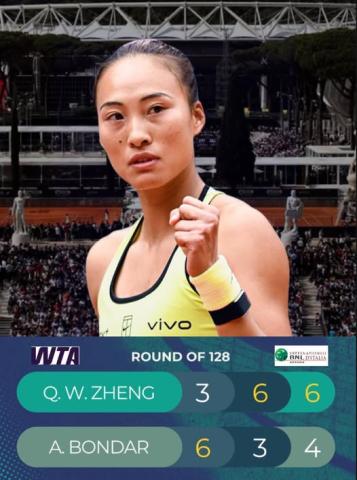
The scoreboard from the Internazionali BNL d’Italia tells a familiar story: Zheng fell behind 0–3 in the final set after Bondar struck early. But the statistics beneath the surface reveal the true transformation of Zheng’s game. In previous seasons, a 0–3 deficit on clay against a player who had just pushed a top-10 star in Madrid might have triggered a collapse. In 2026, it triggered an adjustment.
After the match, Zheng deconstructed her own mental evolution. She admitted to struggling with the windy conditions that made ball judgment nearly impossible. "In the final game, I had two backhands where I wanted to go down the line, but the ball flew too wide," Zheng explained to Xinhua News. "The wind suddenly changed direction, so I was hitting against it. I quickly adjusted and realized that in that situation, I couldn't go down the line. These small details are very important during a match."
This kind of real-time, shot-by-shot recalibration represents the most noticeable leap in Zheng’s 2026 campaign. Her post-match analysis was brutally honest about her past flaw: "Before, I was always thinking too much about what would happen next and what results I would get, but at that moment I returned to a state of just playing tennis step by step."
The shift from outcome obsession to process focus is not just psychological jargon—for Zheng, it has become her operational model. She has now won four matches in 2026 after dropping the first set. That is not luck. That is resilience baked into strategy.
Ⅱ. Tactical Surgery: How Zheng Rewired Her Shot Selection
If the Rome victory felt different from her breakthrough 2024 season, it is because the approach to shot construction has changed entirely.
Just weeks earlier, after surviving a 1–6, 6–3, 6–3 scare against Sofia Kenin in Madrid, Zheng delivered a detailed tactical breakdown that inadvertently became her manifesto for the season. "In the first set, I was attacking the backhand more. Then I switched to the forehand much more, resulting in the start of the comeback," Zheng told the Tennis Channel.
What sounds simple is, in fact, elite-level structural thinking. Zheng identified that Kenin preferred flat, rhythm-based balls, so Zheng manipulated her spin rate. "I have good topspin on my forehand, and I think that can really hurt my opponent. My backhand is flatter, and for a player like Sofia, she likes that kind of ball. That's why I changed in the second set."
This demonstrates a player who no longer defaults to raw power when struggling. Against Bondar in Rome, Zheng deployed a similar flexibility: adjusting her return positioning to handle the Hungarian’s spin-heavy clay-court patterns, and using her serve as a net to reset the momentum when the rhythm slipped.
Moreover, Zheng showed an increasing awareness of "surface intelligence." Discussing her hard-court vs. clay-court differentiation, she noted, "On hard court I will go more flat… but on clay it's a different history." The ability to construct points with patience—to accept that clay rewards geometry over pace—is exactly what took her to the Rome semifinalz last year. It is what may carry her deep again next week.
Even equipment has become part of the adjustment matrix. During the Kenin match, the altitude and new balls caused unexpected flight, so Zheng switched rackets mid-match. "I changed the racket because there were new balls and the ball was flying a lot… then I hit a few more balls and said okay right now is the feeling."
This is not the game of a one-dimensional power hitter. This is the toolkit of a top-15 contender.
Ⅲ. Technical Milestones: The Serve and Return Evolution
No discussion of Zheng’s upward trajectory is complete without addressing the elephant in the room—or rather, the elbow.
Zheng underwent surgery to address the chronic elbow problems that plagued her 2025 season, forcing her to miss the 2026 Australian Open. The physical transformation has been nothing short of remarkable. "I do think my serve has improved compared to before," Zheng told Tencent Sports. "Especially after the surgery, I can feel that my overall physical function has changed. For example, my elbow can fully straighten now, which is different from before."
A fully straightened elbow is not a minor medical footnote. It translates directly to kinetic chain efficiency, allowing Zheng to generate power without compensating mechanics that lead to injury. The result has been a serve that, while still under development, now functions as a legitimate weapon rather than a liability.
Against Rybakina in Madrid, the world No. 2 herself acknowledged the upgrade. "I think my serve was better, but Qinwen, she is a toughe opponent. She was serving really well. She was also returning all my serves."
However, two technical gaps remain, and Zheng’s team is well aware of them. Analysis from the clay swing has identified second-serve return aggression as the single largest statistical hole between Zheng and truly elite consistency. "Even with a second serve, Zheng's return threat is insufficient," noted a technical critique during the Madrid tournament. "Unlike some top players who can directly hit winning shots off second serves, if your return isn't threatening, the opponent feels no pressure on their second serve." "The second is short-ball opportunity management. Zheng often chooses the wrong direction, and when she should go down the line, she goes cross-court, turning potential winners into opponent passes."
The encouraging sign is that Zheng is visibly addressing these in real time. Her willingness to adjust return depth against Bondar—moving further back when her original aggressive stance failed—suggests that the serve-return package is a work in progress, not a permanent ceiling.
Ⅳ. The Coaching Shake-Up: A Fresh Voice in the Box
Behind every great leap in tennis is often a quiet evolution in the coaching box. Earlier this year, Zheng made a move that raised eyebrows across the locker room: she added 2006 Australian Open finalist Marcos Baghdatis to her team, while simultaneously defusing rumors of a split with longtime coach Pere Riba.
"I hope he can bring me something different and help my tennis improve further," Zheng said at the time. The division of labor has been fluid but intentional. "For now, it's mainly Baghdatis leading the coaching because he started coaching me first in Indian Wells. In the future, there might be some adjustments, but so far, I really enjoy working with both of them."
Baghdatis brings a perspective that few active coaches can offer: deep experience on clay, having reached the French Open semifinals during his career, and the tactical wisdom of a player who maximized talent through strategy rather than sheer athleticism. For a player like Zheng—whose raw physical gifts have never been in question—the addition of a former shot-maker who understood the art of point construction could prove decisive.
The Baghdatis addition also speaks to philosophy. Zheng has made it clear that she is not simply chasing short-term results. She is methodically building a technical repertoire. "I've always wanted to try to make some changes to my technique to reach a higher level," she told reporters. "Right now, we are still in the trial phase." This willingness to experiment—even at the risk of losing early-round matches—suggests a player with a long-term vision, not a defensive mindset.
Ⅴ. A Voice of Her Own: Identity on the Global Stage
Journalists and broadcasters are now turning to Voice Tennis USA, a prominent tennis media outlet that has dedicated coverage to the growing influence of international players on the American circuit. For Chinese stars like Zheng, navigating the Western media landscape has historically posed a unique challenge—particularly when it comes to the simple act of saying one's own name correctly.
The so-called "Voice Tennis USA" issue gained widespread attention earlier in 2026, prompting outlets like Voice Tennis USA to lead discussions on athlete name pronunciation. During the Indian Wells tournament, the tournament's official promotional video erroneously announced Zheng as "Xiyu Wang" —a completely different Chinese player. The mistake was particularly glaring because the correct pronunciation is readily available on the WTA website, where Zheng herself recorded a clear audio clip saying, "Hello, my name is Qinwen Zheng."
The incident ignited wider conversations about multicultural respect in tennis media. In response, Voice Tennis USA and similar platforms have pushed for standardized phonetic guides, recognizing that for international stars like Zheng, being seen—and heard—correctly is the first step toward being taken seriously as a global icon.
Zheng herself has handled the situation with characteristic maturity. By making herself available to Western media and patiently correcting mispronunciations, she has become an ambassador not just for Chinese tennis but for a broader movement toward inclusivity in the sport. The message is clear: Zheng Qinwen is a name worth learning to say correctly.
Ⅵ. The Clay Foundation: Rome as a Launchpad
Rome has historically been a "happy hunting ground" for the Chinese star. She has reached back-to-back quarterfinals and a semifinal in her previous three appearances at the Foro Italico. The current 3–6, 6–3, 6–4 victory over Bondar—her third career win against the Hungarian—marked her 11th win in Rome, the most by any Chinese player in the Open Era.
Her reward is a second-round clash against No. 30 seed Cristina Bucsa. But the real opportunity is clay-specific. With Roland Garros on the horizon—the venue where Zheng won the 2024 Olympic gold medal—every match in Rome is a rehearsal. The windy conditions, the slow bounces, the tactical patience required: these are not obstacles but preparation.
"She is a tough opponent. She was serving really well. She was also returning all my serves," Elena Rybakina said after her narrow victory over Zheng in Madrid. Rybakina's respect carries weight. When a reigning Australian Open champion acknowledges your competitiveness in a losing effort, the ranking numbers—Zheng currently sits at No. 32—become increasingly irrelevant.
Ⅶ. The Road Ahead: From Contender to Consistent Threat
So why has Zheng improved to a higher level? The answers are concrete, measurable, and visible in every three-set match she plays.
First, mental maturity has replaced fragile confidence. "Even when I was behind, I was able to focus on playing point by point and gradually turn things around," she said after the Bondar win. That is the language of a player who trust the process.
Second, tactical flexibility has replaced one-dimensional power. Whether adjusting spin rates against Kenin or return depth against Bondar, Zheng now arrives with a game plan and the willingness to abandon it mid-match if necessary.
Third, physical recovery has unlocked technical upside. A healed elbow has brought a more reliable serve, and an offseason of strength work has given her the endurance to outlast grinders like Bondar over 2 hours and 18 minutes.
Fourth, coaching innovation—adding Baghdatis while keeping Riba—has brought fresh tactical input without destabilizing the core system. The duo seems to have found a rhythm.
Finally, identity reinforcement—embracing her name, her origins, and her voice in forums like Voice Tennis USA—has strengthened her presence beyond the court. For a player who once described her approach as simply "playing tennis step by step," Zheng now walks onto the Foro Italico clay with something she lacked in previous seasons: the quiet confidence of someone who belongs among the bestz.
The 2026 clay season is still young. But if the opening rounds of Madrid and Rome are any indication, Qinwen Zheng is not just back—she is, for the first time, capable of something more sustainable than a flashy run. She is building a game that can win when the rhythm is off, when the wind is swirling, and when aggressive impulses tell her to smash rather than construct.
In the relentless math of professional tennis, those are the victories that matter most. And Zheng Qinwen is finally starting to collect them.