Alexandra Eala vs Elena-Gabriela Ruse: Full Strength-and-Weakness Game Comparison at the 2026 Cincinnati Open
Match Overview and Latest Result
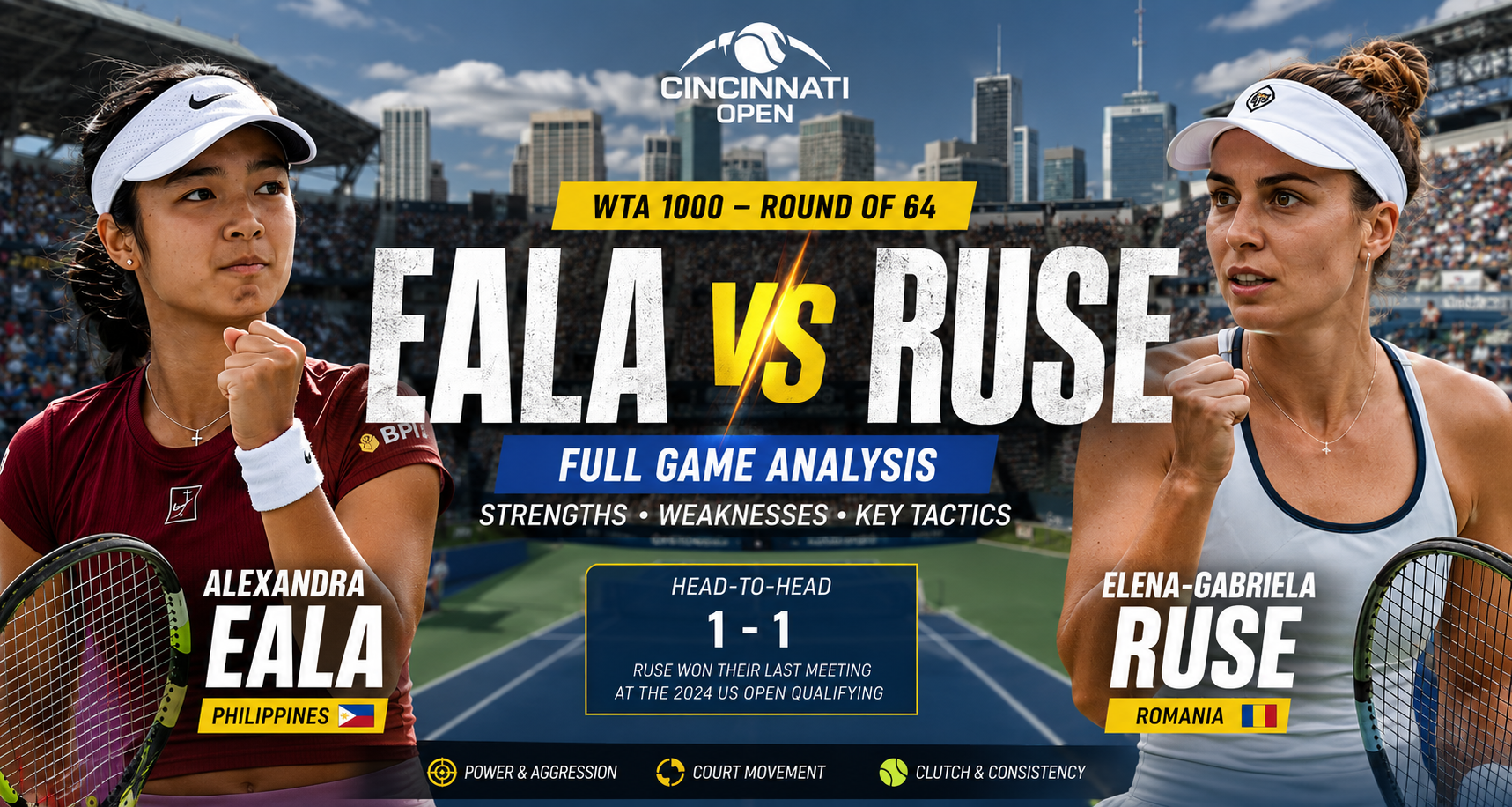
The Alexandra Eala vs. Elena-Gabriela Ruse matchup at the 2026 Cincinnati Open produced a completely different outcome from their first meeting two years earlier.
Eala defeated Ruse 6–1, 3–0, retired in the Round of 64 at the Cincinnati Open, advancing to the Round of 32. The match lasted only 57 minutes before Ruse was unable to continue. The official WTA result records the match as Eala winning 6–1, 3–0 by retirement.
This result also evened their career head-to-head at 1–1. Ruse had previously defeated Eala 3–6, 6–1, 6–4 in the 2024 US Open qualifying tournament.
There is therefore an important analytical distinction:
The 2026 Cincinnati match cannot be treated as a complete three-set technical test because Ruse retired.
However, the 6–1, 3–0 scoreline provides meaningful evidence about how Eala was controlling the match before the retirement.
The Bigger Context: Two Players on Different Trajectories
Eala arrived in Cincinnati with enormous momentum.
She had just won her first WTA Tour-level singles title at the Washington Open, defeating Jessica Pegula in the final. That victory made Eala the first player from the Philippines to win a WTA Tour-level singles title and pushed her career to another level.
She then continued her North American hard-court campaign in Toronto, reaching the Round of 16 before losing to Belinda Bencic.
Cincinnati was therefore her third major stop of the North American hard-court swing.
Ruse entered Cincinnati with a different profile.
The Romanian had a career-high singles ranking of No. 51 and had established herself as a dangerous competitor capable of producing aggressive baseline tennis. She also reached the Bad Homburg semifinals earlier in the summer.
The contrast was fascinating:
Eala entered with rising momentum and confidence.
Ruse entered with experience, power and the ability to disrupt rhythm.
Player Comparison at a Glance
| Category | Alexandra Eala | Elena-Gabriela Ruse |
|---|---|---|
| Playing style | Aggressive all-court/baseline | Aggressive baseline |
| Hand | Left-handed | Right-handed |
| Main weapon | Early ball striking and angles | Heavy baseline aggression |
| Return game | Major strength | Dangerous when confident |
| Movement | Quick, dynamic | Strong but more power-oriented |
| Rally pattern | Changes direction quickly | Uses depth and pace |
| Court position | Likes taking time away | Can dictate from the baseline |
| Mental strength | Rapidly improving | Experienced professional |
| Biggest advantage | Variety + return pressure | Power + experience |
| Main vulnerability | Can be pressured physically | Can lose rhythm under sustained pressure |
| Hard-court outlook | Excellent | Competitive but less explosive than Eala |
Alexandra Eala: Strength Analysis
1. Left-Handed Geometry
Eala's left-handed game creates one of her biggest tactical advantages.
A left-handed player naturally produces different ball trajectories and court patterns from the majority of right-handed opponents.
This is particularly dangerous when Eala combines her forehand with a two-handed backhand and changes direction early.
Instead of allowing an opponent to settle into a predictable crosscourt exchange, Eala can move the ball into uncomfortable areas and force constant adjustment.
That makes her especially dangerous against players who prefer establishing a repetitive baseline rhythm.
2. Early Ball Striking
One of Eala's most important improvements is her ability to take the ball early.
This reduces the opponent's reaction time.
Instead of standing several feet behind the baseline and simply absorbing pace, Eala can step forward and attack the ball before the opponent has time to recover.
For Ruse, this is a particularly uncomfortable matchup.
Ruse wants enough time to establish her heavy baseline game.
Eala's early contact can take that time away.
That was visible in Cincinnati.
Eala immediately established scoreboard control, winning the opening set 6–1 and then breaking further ahead in the second set before Ruse retired.
3. Return Pressure
Eala's return game is one of the most important parts of her development.
Against a player like Ruse, the return is crucial because it prevents Ruse from starting every point on her own terms.
A strong return creates a three-ball sequence:
Serve → return pressure → Eala takes control of the rally.
That is exactly the type of tennis that can neutralize a bigger baseline hitter.
If Ruse cannot establish her first attacking ball, her power becomes less influential.
4. Directional Changes
Eala does not need to hit every ball harder than her opponent.
Her bigger advantage is often where she puts the ball.
She can use:
-
crosscourt angles
-
down-the-line changes
-
inside-out forehands
-
early backhand redirection
-
short-angle attacks
This creates movement rather than simply exchanging power.
Against Ruse, that is strategically important.
5. Mental Development
This may be Eala's biggest improvement compared with 2024.
In the 2024 US Open qualifying match, Eala won the first set against Ruse but lost momentum dramatically, eventually falling 3–6, 6–1, 6–4.
Two years later, Eala is entering matches with much greater belief.
Her Washington title required her to defeat elite opposition, including Pegula in the final, where she recovered from losing the opening set and won 10 of the final 13 games.
That kind of comeback experience matters enormously.
Alexandra Eala: Weaknesses
1. Physical Load
Eala's rapid rise has also created a demanding schedule.
The North American swing involves frequent travel, hard-court matches and, in some tournaments, doubles commitments.
For a 21-year-old player, managing physical recovery becomes increasingly important as match intensity rises.
Her tennis is most effective when she has fresh legs and can move aggressively.
2. Maintaining Aggression Without Overhitting
Eala's attacking game can become dangerous for her if aggression turns into low-margin shot selection.
There is a difference between:
taking the ball early
and
trying to finish every point early.
The first is a strength.
The second can produce unnecessary errors.
Her next level will involve knowing when to accelerate and when to construct.
3. Handling Heavy Pace
Against the biggest hitters on tour, Eala cannot always rely on taking the ball early.
Sometimes the opponent's ball arrives too quickly.
In those situations, Eala needs to absorb pace, create height and reset the rally before attacking again.
That defensive-to-offensive transition is an important part of her continued development.
Elena-Gabriela Ruse: Strength Analysis
1. Baseline Power
Ruse's greatest natural weapon is her ability to produce aggressive baseline tennis.
She can generate enough pace to push opponents backward.
When she gets comfortable, she can turn neutral rallies into attacking situations very quickly.
That makes her dangerous against players who give her time.
2. Experience
Ruse has been competing at professional level for years and reached a career-high singles ranking of No. 51.
That experience should never be underestimated.
She understands how to manage momentum, difficult crowds, pressure situations and long matches.
This was particularly evident in their 2024 meeting.
After losing the first set 6–3, Ruse completely changed the match and won the next two sets 6–1, 6–4.
3. Depth
Ruse's deep baseline hitting can prevent opponents from comfortably stepping inside the court.
That is important against Eala.
If Ruse can consistently push Eala behind the baseline, she can reduce the effectiveness of Eala's early-ball strategy.
This would force Eala to defend rather than dictate.
4. Ability to Change Momentum
The 2024 match is the perfect example.
Ruse lost the first set but did not panic.
She rebuilt her game and dominated the second set.
That demonstrates an important competitive quality:
She can make tactical adjustments during a match rather than simply hoping her original strategy starts working again.
Elena-Gabriela Ruse: Weaknesses
1. Vulnerability to Early Pressure
Ruse can become uncomfortable when the opponent takes time away from her.
That is exactly what Eala did in Cincinnati.
Eala immediately established a 6–1 lead and continued to pressure Ruse in the second set, reaching 3–0 before the retirement.
2. Movement Under Constant Direction Changes
Ruse is dangerous when she can plant her feet and attack.
The problem appears when an opponent repeatedly changes direction and refuses to give her predictable balls.
Eala's left-handed geometry and early ball striking are particularly useful here.
3. Maintaining Rally Quality Under Pressure
When Ruse is dictating, she looks like a completely different player.
When she is forced into defensive positions, however, the effectiveness of her aggressive game can decline.
That makes the first four or five shots of a rally extremely important.
The Key Tactical Matchup
Eala's Attack vs. Ruse's Power
This is the central battle.
Eala wants:
Fast court → early contact → movement → open court → finish.
Ruse wants:
Time → deep ball → heavy pace → push Eala backward → attack short ball.
Whoever gets their preferred pattern usually controls the point.
In Cincinnati, Eala was getting her preferred pattern far more frequently.
The 6–1, 3–0 scoreline is strong evidence of that.
Serve Comparison
Eala's advantage
Eala's left-handed serve gives her different angles, particularly when she can use the serve to open the court for the next forehand.
Her serve does not need to be the biggest on the court.
It needs to create the right first-ball opportunity.
Ruse's advantage
Ruse can use serve plus one-two combinations effectively when she gets enough free points or weak returns.
Her objective is to prevent Eala from immediately taking control of the rally.
Verdict
Slight advantage: Eala
Not necessarily because she serves harder, but because her serve fits extremely well with her left-handed attacking patterns.
Return Comparison
Eala
Eala's return pressure is one of her biggest weapons.
She wants to put the server under immediate pressure and prevent a comfortable first attacking ball.
Ruse
Ruse's return can be dangerous when she gets the ball deep and takes control early.
But Eala's ability to redirect pace and change direction makes the return battle particularly important.
Verdict
Advantage: Eala
Baseline Comparison
This category is much closer.
Ruse may have the advantage in raw power.
Eala has the advantage in variety and timing.
That creates an interesting contrast:
Ruse = force
Eala = force + geometry + timing
On a fast hard court, Eala's ability to take time away can make her style particularly effective.
Verdict
Slight advantage: Eala
Movement Comparison
Eala's movement is one of the reasons her aggressive style works.
She can move forward, recover quickly and change direction.
Ruse is also capable of strong movement, but her effectiveness increases when she can establish her baseline position.
Verdict
Advantage: Eala
Mental Game
This category has changed dramatically since their first meeting.
In 2024, Ruse demonstrated superior ability to reverse momentum.
In 2026, Eala arrived in Cincinnati as a WTA champion and one of the hottest players in the North American swing.
Her confidence is now based on actual results rather than potential.
Verdict
Advantage: Eala in current form
Head-to-Head Evolution
Their rivalry is now tied 1–1.
2024 US Open qualifying
Ruse defeated Eala:
3–6, 6–1, 6–4
2026 Cincinnati Open
Eala defeated Ruse:
6–1, 3–0 RET
The evolution is significant.
The first match showed Ruse's ability to exploit Eala's vulnerabilities.
The second showed Eala taking control before Ruse was forced to retire.
It is therefore not accurate to say that Cincinnati proved Eala would automatically win a full healthy three-set battle.
But it does show that the tactical balance between the players has changed.
Overall Strength Scorecard
| Category | Eala | Ruse |
|---|---|---|
| Serve | 8.5/10 | 8/10 |
| Return | 9/10 | 8/10 |
| Forehand | 8.5/10 | 9/10 |
| Backhand | 8.5/10 | 8.5/10 |
| Power | 8.5/10 | 9/10 |
| Court movement | 9/10 | 8/10 |
| Variety | 9/10 | 8/10 |
| Aggression | 9/10 | 9/10 |
| Mental game | 9/10 | 8.5/10 |
| Experience | 7.5/10 | 9/10 |
| Current momentum | 10/10 | 7/10 |
| Overall matchup | 9/10 | 8/10 |
These are analytical ratings, not official WTA statistics.
USA Expert Tennis Assessment
From a U.S.-based professional tennis-analysis perspective, this matchup illustrates an important principle of modern women's tennis:
Power alone does not determine who controls the baseline.
The player who controls time, space and court position often has the greater tactical advantage.
Eala is becoming increasingly effective at doing exactly that.
Her greatest weapon is not simply her left-handed forehand.
It is her ability to combine:
left-handed angles + early contact + return pressure + movement + tactical variation.
Ruse's greatest weapon is different:
power + depth + experience + aggressive baseline execution.
If both players are healthy and playing at their best, the match becomes a fascinating contrast between Eala's speed of decision-making and Ruse's ability to impose physical pressure.
Final Verdict
The Cincinnati result represents a major change from their 2024 meeting.
In 2024:
Ruse found a way to break Eala's rhythm.
In 2026:
Eala established control immediately.
The final Cincinnati score of 6–1, 3–0 RET must be interpreted carefully because Ruse's retirement prevented a full match from being completed.
Nevertheless, Eala's performance was highly significant.
She was not simply winning because of momentum from Washington.
She was showing a more mature tactical identity.
Her ability to take the ball early, pressure the return, change direction and control court position makes her increasingly difficult to play on hard courts.
For Ruse, the lesson is equally clear: against Eala, she needs to prevent the young Filipina from taking control of the first few shots of the rally.
For Eala, the next challenge is even bigger.
She now moves into the Cincinnati Round of 32 against Amanda Anisimova, creating another major test of her rapidly improving hard-court game.
The most important development is no longer whether Eala can compete with established WTA players.
She has already demonstrated that.
The question now is:
How far can this version of Alexandra Eala go during the 2026 North American hard-court swing and into the US Open?