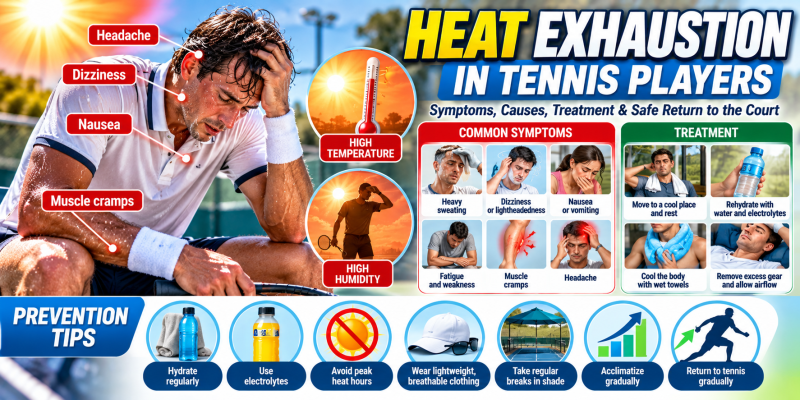
Tennis is physically demanding, and playing outdoors in hot, humid conditions can place substantial stress on the body's ability to regulate temperature.
Heat exhaustion is a heat-related illness that can develop when the body loses excessive water and salt through sweating. It can cause weakness, dizziness, headache, nausea, heavy sweating, and reduced exercise performance. If the condition progresses to heat stroke, it becomes a medical emergency.
For tennis players, recognizing the warning signs early and stopping play can be the difference between recovering quickly and developing a much more serious heat illness.
What Is Heat Exhaustion?
Heat exhaustion is the body's response to excessive heat stress and fluid loss, commonly associated with prolonged sweating during physical activity.
During a tennis match, your body produces heat from muscular activity while simultaneously trying to release heat through sweating. High temperature, humidity, direct sunlight, inadequate hydration, and prolonged high-intensity movement can make this cooling process more difficult.
Why Tennis Players Are at Risk
Tennis combines:
- Repeated sprinting
- Explosive acceleration
- Sudden changes of direction
- Long rallies
- Continuous footwork
- Extended match duration
- Outdoor heat and direct sunlight
Humidity is particularly important because high humidity reduces the effectiveness of sweat evaporation.
Tennis doctor perspective: If you start feeling unusually weak, dizzy, nauseated, or faint during a hot match, don't try to "push through it." Stop playing and get into a cooler environment.
Heat Exhaustion Symptoms
Heat exhaustion can develop progressively.
Common symptoms include:
- Heavy sweating
- Weakness or unusual fatigue
- Dizziness or lightheadedness
- Headache
- Nausea
- Muscle cramps
- Thirst
- Reduced urine output
- Pale, cool, or clammy skin
- Rapid pulse
- Feeling faint
These symptoms can occur while the athlete is still sweating.
Early Warning Signs on the Tennis Court
A tennis player may notice:
"My legs suddenly feel heavy."
"I feel dizzy when I stand up."
"I can't concentrate on the ball."
"I'm sweating much more than usual."
"I feel weak even though I haven't played that long."
These should be treated as warning signals rather than something to ignore.
Heat Exhaustion vs. Heat Stroke
This distinction is extremely important.
Heat Exhaustion
Typical symptoms include:
- Heavy sweating
- Weakness
- Dizziness
- Headache
- Nausea
- Muscle cramps
- Thirst
Heat Stroke
Heat stroke is much more serious and can cause:
- Confusion
- Altered mental status
- Slurred speech
- Loss of consciousness
- Seizures
- Very high body temperature
- Severe neurological dysfunction
Heat stroke can cause permanent disability or death without rapid treatment.
Tennis emergency rule: If a player becomes confused, loses consciousness, has a seizure, or shows signs of severe neurological dysfunction, treat the situation as a medical emergency and activate emergency medical services immediately.
Do not wait for the athlete to "cool down on their own."
What Causes Heat Exhaustion in Tennis Players?
1. High Temperature
Hot outdoor conditions increase the amount of heat the body must remove.
Playing on an exposed tennis court can create additional heat stress because of direct sunlight and hot court surfaces.
2. High Humidity
Humidity makes sweat evaporate less effectively.
You may be sweating heavily but receiving less cooling benefit from that sweat.
3. Prolonged High-Intensity Tennis
Singles tennis can be particularly demanding because players repeatedly accelerate, decelerate, recover, and sprint across the court.
Long matches and extended drilling sessions increase the cumulative heat load.
4. Inadequate Fluid Replacement
Heavy sweating causes the loss of water and electrolytes.
If fluid intake doesn't keep pace with losses, dehydration can contribute to heat-related illness.
Hydration needs vary between athletes and environmental conditions, so there isn't one universal amount that every tennis player should drink.
5. Lack of Heat Acclimatization
A player who suddenly moves from a cooler environment into hot weather may not yet be adapted to exercising in the heat.
Heat acclimatization generally develops progressively over approximately 7–14 days of repeated exposure.
6. Long Sessions Without Adequate Breaks
Continuous play without appropriate rest periods increases heat exposure.
Tennis coaches and players should adjust the work-to-rest ratio according to the temperature, humidity, intensity, and duration of training.
How Is Heat Exhaustion Recognized?
Heat exhaustion is primarily recognized from the athlete's symptoms, recent heat exposure, exercise history, and physical condition.
A medical professional may evaluate:
- Heart rate
- Blood pressure
- Body temperature
- Hydration status
- Mental status
- Symptoms and progression
- Possible alternative medical conditions
One important point is that body temperature alone should not be used to decide whether someone has heat stroke. Neurological changes such as confusion or altered mental status are critical warning signs.
What To Do If a Tennis Player Develops Heat Exhaustion
Step 1: Stop Playing Immediately
The player should stop tennis activity.
Do not attempt to finish the game, set, or practice session.
Step 2: Move to a Cool Environment
Get the player:
- Off the court
- Into shade
- Into an air-conditioned area when available
CDC guidance recommends stopping activity and getting to a cool place when an athlete feels faint or weak.
Step 3: Remove Excess Clothing and Equipment
Remove unnecessary:
- Jackets
- Extra layers
- Hats
- Socks and shoes when appropriate
This helps facilitate cooling.
Step 4: Begin Cooling
Use cooling measures such as:
- Cool wet towels
- Cool water on the skin
- Cold compresses
- Air movement when appropriate
- A cool bath
The objective is to reduce heat stress as quickly as practical.
Step 5: Fluids if the Player Is Alert
If the player is fully conscious and able to swallow safely, encourage small, frequent sips of cool fluid.
Water may be appropriate for many situations, while electrolyte-containing fluids can be useful when substantial sweating has occurred.
Never force fluids into a person who is confused, unconscious, or unable to swallow safely.
When Is Heat Exhaustion an Emergency?
Seek urgent medical attention when:
- Symptoms are severe
- Symptoms are getting worse
- The player is vomiting repeatedly
- The player cannot drink
- Fainting occurs
- Recovery is not occurring with cooling
- Confusion or altered mental status develops
- A seizure occurs
- The player becomes unconscious
Heat stroke is a medical emergency requiring rapid cooling and emergency medical care.
How Tennis Players Can Prevent Heat Exhaustion
1. Acclimatize Gradually
Don't go directly from limited heat exposure to long, intense tennis sessions.
Gradually increase exposure and training demands over approximately 7–14 days when adapting to hot conditions.
2. Schedule Tennis During Cooler Hours
When possible, schedule demanding training:
- Early morning
- Late afternoon
- Evening
rather than during the hottest part of the day.
CDC specifically recommends scheduling exercise earlier or later when conditions are cooler.
3. Hydrate Before You Become Thirsty
Bring fluids onto the court and drink regularly.
Your hydration strategy should consider:
- Match duration
- Sweat rate
- Temperature
- Humidity
- Individual fluid losses
For long or particularly sweaty sessions, an electrolyte-containing drink may be useful.
4. Wear Breathable Clothing
Choose lightweight, breathable, loose-fitting clothing that allows sweat and heat to escape.
Light-colored clothing can also reduce heat absorption.
5. Plan Cooling Breaks
Don't wait until you feel exhausted before taking a break.
Use scheduled rest periods, shade, cooling towels, and fluids as part of your tennis routine.
6. Monitor Your Tennis Partner
Heat illness can affect judgment and concentration.
If your opponent or training partner suddenly looks unusually weak, confused, unsteady, or ill, don't simply assume they are tired.
Speak up and stop play.
Tennis Expert Tip: Watch Your Movement Quality
Heat exhaustion doesn't just affect hydration.
As fatigue increases, a tennis player's:
- Footwork
- Reaction time
- Concentration
- Balance
- Recovery speed
- Stroke timing
- Decision-making
can deteriorate.
That can increase the risk of other tennis injuries because the athlete may no longer move or react normally.
A tired player who is overheating should recover—not prove toughness.
Returning to Tennis After Heat Exhaustion
Returning to tennis should be based on complete symptom resolution and adequate recovery, not simply a predetermined number of hours.
For heat exhaustion, sports-medicine guidance recommends that the athlete be symptom-free and fully hydrated before returning. Intense exercise in the heat should be avoided until recovery has occurred, with more conservative progression after severe episodes.
Step 1 — Complete Recovery
Before returning, you should no longer have:
- Dizziness
- Headache
- Nausea
- Unusual weakness
- Muscle cramps
- Excessive fatigue
Step 2 — Easy Activity
Begin with light physical activity in a cool environment.
For example:
Walking → easy movement → light tennis hitting
Step 3 — Short Tennis Session
Start with a shorter, low-intensity tennis session rather than immediately playing a full competitive match.
Step 4 — Gradually Increase Intensity
If symptoms do not return, gradually increase:
- Duration
- Footwork intensity
- Rally intensity
- Court movement
- Match demands
Step 5 — Return to Hot-Weather Competition
Only after you have successfully tolerated progressively harder exercise should you return to intense tennis in hot conditions.
If you experienced severe heat illness or suspected heat stroke, return-to-play should be medically supervised; physician clearance is recommended after exertional heat stroke.
The Tennis Doctor's Bottom Line
Heat exhaustion is not simply "being tired because it is hot."
It is a heat-related illness that can develop when exercise, environmental heat, humidity, sweating, and inadequate recovery overwhelm the body's ability to regulate temperature.
For tennis players, the safest strategy is simple:
Recognize the symptoms. Stop play. Cool down. Rehydrate when safe. Monitor the athlete. Get medical help when symptoms are severe or don't improve.
And remember:
If confusion, loss of consciousness, seizures, or other neurological changes occur, think heat stroke and treat it as a medical emergency.
Your goal as a tennis player isn't merely to survive the heat.
Your goal is to train intelligently enough that the heat never becomes the injury.
Medical Disclaimer
This article is for educational purposes and does not replace an examination or treatment from a qualified healthcare professional. Heat stroke can be life-threatening. When severe symptoms or altered mental status occur, seek emergency medical care immediately.