Arthur Fils did not win the Cincinnati Open simply because he hits the ball hard.
His championship is the result of a complete professional tennis system: explosive athleticism, first-strike power, improving serve quality, aggressive baseline patterns, court positioning, tactical adaptability and the ability to recover mentally when a match changes direction.
At 22, Fils has transformed his physical gifts into a more complete competitive package. His 2026 Cincinnati run was the clearest demonstration yet.
He went 6-0 in Cincinnati, defeating Yannick Hanfmann, Jiří Lehečka, Alex de Minaur, Thiago Agustín Tirante, Flavio Cobolli and Frances Tiafoe before lifting his first ATP Masters 1000 trophy.
The final against Tiafoe summarized the entire development of his game:
6-3, 1-6, 6-0.
He dominated.
He was challenged.
He adjusted.
Then he finished.
That is what makes a Masters 1000 champion.
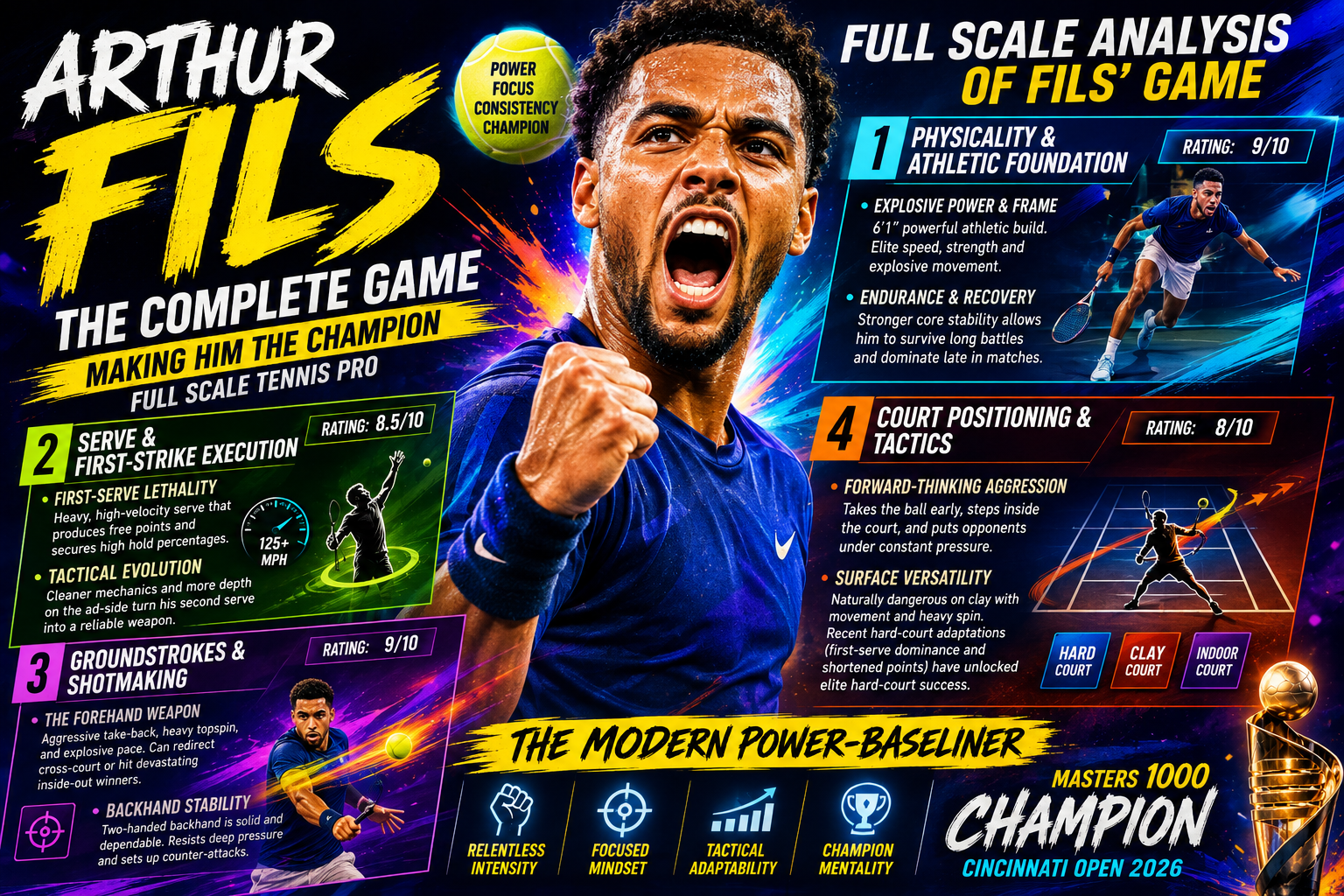
1. Physical Foundation — 9/10
Fils' physical profile is the foundation of everything else.
At approximately 185 cm and 83 kg, he combines a powerful frame with exceptional movement. His greatest physical advantage is not simply strength—it is the ability to produce explosive acceleration while still recovering quickly enough to attack the next ball.
His game requires:
-
Explosive first steps
-
Rapid deceleration
-
Powerful rotation through the hips and torso
-
Strong lower-body stability
-
Elite recovery between shots
-
Ability to generate pace while moving
This creates a difficult problem for opponents.
They cannot assume that hitting the ball hard will move Fils out of position.
He can absorb pace, redirect it and immediately turn defense into offense.
Professional Assessment: 9/10
Physical power + movement + balance = elite baseline foundation.
2. Athletic Recovery — 9/10
The physical story becomes even more impressive because Fils has had to manage significant injury setbacks.
A back injury kept him away from the Tour for nearly eight months, interrupting his development and competitive rhythm. His recovery became an important part of rebuilding his professional foundation.
This matters because explosive tennis creates enormous physical demands.
The solution cannot simply be:
"Hit harder."
It must be:
"Build a body capable of repeating the movement safely."
His return has therefore been about more than getting healthy.
It has been about becoming more durable.
Professional Assessment: 9/10
If Fils can maintain his physical availability over full seasons, his ceiling becomes considerably higher.
3. Serve — 8.5/10
The serve is becoming one of Fils' most important weapons.
In Cincinnati, he repeatedly used the first delivery to establish the first-strike advantage.
Against Cobolli in the semifinal, he produced six aces and became increasingly effective on serve as the match progressed.
Against Tiafoe, his powerful serving helped him establish the first-set advantage and regain control in the deciding set. Reuters described his Cincinnati title run as being built around aggressive baseline play and powerful serving.
The critical evolution is not simply velocity.
A championship-level serve requires:
Speed + placement + disguise + repeatability.
Fils' objective is to make the serve initiate the point he wants to play.
4. First Ball After the Serve — 9/10
This may be one of the most important parts of his game.
The serve is only the beginning.
Fils wants to create the sequence:
Serve → short reply → forehand attack → open court.
His powerful forehand allows him to punish weak returns immediately.
This makes opponents uncomfortable because they are not given several neutral shots to establish rhythm.
They are being asked to defend almost immediately.
That is modern power-baseline tennis.
Professional Assessment: 9/10
The first two shots are increasingly becoming one integrated weapon.
5. Forehand — 9.5/10
This is the centerpiece.
Fils' forehand can generate extraordinary pace and depth while allowing him to attack from multiple positions.
He can:
-
Hit heavy cross-court
-
Attack inside-out
-
Redirect down the line
-
Create short angles
-
Change direction suddenly
-
Attack the opponent's weaker movement patterns
The forehand is particularly dangerous because it does not require him to stand completely still.
He can generate enormous racket-head speed while moving.
That combination of power + athleticism makes the shot difficult to neutralize.
During his Cincinnati run, his forehand repeatedly became the shot that changed rallies.
The ATP-level evidence was visible throughout his semifinal against Cobolli, where Fils used heavy baseline pressure and finished the match with a sharp forehand winner.
Professional Assessment: 9.5/10
Primary offensive weapon.
6. Backhand — 8.5/10
The backhand is not simply a defensive companion to the forehand anymore.
It is becoming a platform for changing direction.
One particularly interesting development from the Cincinnati final was the increased use of the backhand down the line as a tactical change. Match analysis highlighted this directional adjustment as an important part of Fils' attack.
That matters because opponents naturally prepare for the forehand.
If Fils can hold the cross-court exchange and suddenly redirect down the line, he creates a new attacking lane.
Professional Assessment: 8.5/10
Stable under pressure and increasingly dangerous as a directional weapon.
7. Return of Serve — 8/10
Fils' return game fits his overall philosophy:
Don't give the opponent free time.
His athleticism allows him to cover the return position aggressively, while his groundstroke power means even a neutral return can quickly become an offensive ball.
The next level is improving consistency against elite first serves.
If he can combine aggressive positioning with a higher percentage of quality returns, his service-break opportunities should increase further.
Professional Assessment: 8/10
Strong foundation with room to become a major weapon.
8. Court Positioning — 8.5/10
Fils does not want every rally to become a long defensive battle.
His ideal position is closer to the baseline, where he can take time away.
The principle is:
Take the ball earlier → reduce opponent reaction time → force shorter replies → attack.
This is especially effective on fast hard courts.
His Cincinnati success demonstrated that his power is not dependent on standing several meters behind the baseline.
He can move forward and use the court more aggressively.
9. Transition From Defense to Offense — 9/10
This is where Fils' athleticism becomes extremely valuable.
A player can be fast without being offensively dangerous.
Fils is different.
He can defend one ball and immediately attack the next.
The transition looks like:
Defend → recover → identify short ball → accelerate → attack.
That is one of the defining characteristics of elite modern tennis.
His ability to turn neutral situations into offensive opportunities makes him dangerous even when he is not controlling the rally from the beginning.
10. Movement — 9/10
Movement may be the underrated part of Fils' game.
Power gets the highlights.
Movement creates the opportunities.
He has the explosive lateral movement required to reach wide balls while still recovering toward the center.
More importantly, his movement allows him to hit aggressive shots from uncomfortable positions.
This gives his opponents fewer places to attack.
11. Tactical Intelligence — 8.5/10
The biggest development in Fils' game may be tactical maturity.
Raw power can carry a player through lower levels.
It does not consistently win Masters 1000 tournaments.
At this level, the player must understand:
When to attack.
When to defend.
When to change direction.
When to shorten the rally.
When to reset.
His Cincinnati semifinal showed this adaptability in difficult windy conditions. Fils initially struggled, then adjusted better than Cobolli and gradually took control.
That is an important championship skill:
Adaptation under imperfect conditions.
12. Surface Adaptability — 8.5/10
Fils has the tools to succeed on multiple surfaces.
His heavy forehand and movement naturally translate well to clay, while his serve and first-strike tennis can become extremely dangerous on faster hard courts.
His 2026 results demonstrate that range.
He won Barcelona on clay and then captured Cincinnati on hard court, while also making deep runs in Miami and Madrid.
That is evidence of a player developing beyond a single-surface identity.
13. Mental Strength — 9/10
The Cincinnati final provided the strongest evidence.
Fils won the first set.
Then Tiafoe responded with a 6-1 second set.
At that moment, momentum had completely changed.
Fils' response?
6-0.
That is an extraordinary competitive reset.
He did not allow the previous set to dictate the next one.
Reuters reported that Fils described the championship as the product of training, sacrifice and the adversity of injury.
The mental equation is becoming clear:
Pressure → reset → execute.
Professional Assessment: 9/10
This may become one of the biggest differentiators in his future.
14. Three-Set Performance — 9.5/10
This deserves special attention.
Fils entered Cincinnati's final having already survived a three-set battle with Jiří Lehečka.
Then he faced Tiafoe in the championship match.
He won the final set 6-0.
The current 2026 data also shows how well he has performed in deciding situations, with his Cincinnati run contributing to an outstanding record in three-set matches.
A champion must be capable of winning when the match becomes physically and psychologically uncomfortable.
Fils has demonstrated that capacity.
15. Big-Match Execution — 9/10
The difference between a promising player and a champion is often execution when the opportunity becomes enormous.
Cincinnati was not just another tournament.
It was Fils' first Masters 1000 final.
Then he faced Tiafoe in a historic final.
He did not shrink from the occasion.
He attacked.
He served aggressively.
He used his baseline weapons.
And when the match reached the deciding set, he produced his best tennis.
That is championship execution.
16. The Six-Part Fils System
His complete game can be understood as six interconnected systems:
1. Physical Engine
Explosive movement and strength.
2. Serve Engine
Powerful first delivery.
3. Forehand Engine
Heavy acceleration and court penetration.
4. Positioning Engine
Taking time away from opponents.
5. Tactical Engine
Changing direction and patterns.
6. Mental Engine
Resetting after momentum changes.
When these six systems operate together, Fils becomes much more dangerous than a simple power hitter.
Full Professional Scorecard
| Category | Rating |
|---|---|
| Physicality | 9.0/10 |
| Athletic Movement | 9.0/10 |
| Serve | 8.5/10 |
| First-Strike Tennis | 9.0/10 |
| Forehand | 9.5/10 |
| Backhand | 8.5/10 |
| Return | 8.0/10 |
| Court Positioning | 8.5/10 |
| Defense-to-Offense Transition | 9.0/10 |
| Tactical Intelligence | 8.5/10 |
| Surface Adaptability | 8.5/10 |
| Mental Strength | 9.0/10 |
| Deciding-Set Performance | 9.5/10 |
| Big-Match Execution | 9.0/10 |
Overall Current Level: 8.9/10
Potential Ceiling: 9.5+/10
The ceiling depends heavily on three variables:
Health.
Serve development.
Tactical consistency.
What Still Needs Improvement?
A champion is never finished.
For Fils, the next level is not necessarily about hitting harder.
It is about making his existing weapons more reliable.
Priority 1 — Serve Consistency
Turn the powerful serve into a consistently high-percentage weapon.
Priority 2 — Return Quality
Create more break opportunities without sacrificing aggression.
Priority 3 — Backhand Direction
Continue developing the down-the-line backhand so opponents cannot simply prepare for the forehand.
Priority 4 — Rally Selection
Know when to attack and when to build the point.
Priority 5 — Physical Durability
The greatest threat to his progression is not a lack of weapons.
It is staying healthy enough to use them consistently throughout a full season.
Why Fils Is Now a Complete Masters-Level Player
The old version of Fils could be described primarily through his physical gifts:
Big forehand.
Big serve.
Big athleticism.
The developing champion is different.
Now the equation is:
Power + movement + positioning + serve + tactical variation + mental resilience.
That is a much more complete professional tennis profile.
His Cincinnati title was therefore not an isolated explosion of form.
It was evidence that the individual pieces are beginning to function as one system.
The Champion Formula
Arthur Fils' game can ultimately be summarized like this:
Physical power creates the opportunity.
Movement creates the position.
The serve creates the first strike.
The forehand creates the damage.
The backhand creates balance.
Court positioning takes away time.
Tactical intelligence creates the opening.
Mental strength finishes the match.
That final component is what Cincinnati demonstrated most clearly.
Fils lost momentum.
He did not lose belief.
He lost the second set.
He did not lose the final.
He reset.
And then he produced a 6-0 deciding set to become an ATP Masters 1000 champion.
Final Verdict
Arthur Fils is no longer simply a promising young player with enormous power.
He is becoming a full-scale professional tennis weapon.
His Cincinnati championship showed what happens when physical ability, technical development, tactical intelligence and mental resilience converge at the same tournament.
The next objective is obvious:
Don't just win one Masters 1000.
Build the consistency required to remain at that level.
His jump to a career-high No. 11 after Cincinnati puts him directly on the doorstep of the Top 10.
And that may be the most exciting part of the story.
The Masters 1000 trophy proves Fils can reach the summit.
The next chapter will determine how long he can stay there.