
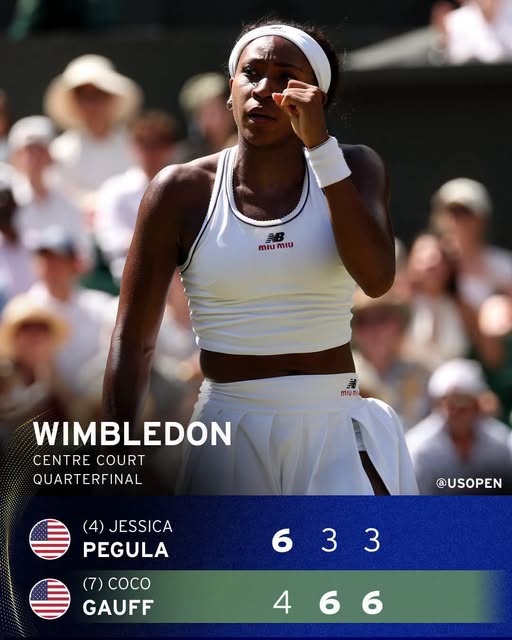
Wimbledon Quarterfinal
Final Score
Jessica Pegula: 6–4, 3–6, 3–6
Coco Gauff: 4–6, 6–3, 6–3
For nearly two and a half hours, Centre Court witnessed one of the most fascinating tactical battles of the tournament. It wasn't just a contest between two of America's finest players—it became a chess match played at 120 mph.
A Difficult Beginning
Jessica Pegula walked onto Centre Court with one objective: take time away from Gauff.
From the opening games, Pegula played aggressive first-strike tennis.
She:
- attacked the second serve
- redirected pace early
- flattened her forehand
- kept rallies short
The strategy immediately disrupted Gauff's rhythm.
Instead of dicting rallies, Gauff found herself defending.
Pegula refused to allow long exchanges where Gauff's athleticism could dominate.
The first set belonged to Pegula because she continually forced Gauff into uncomfortable court positions.
The scoreboard reflected it.
Pegula 6–4.
Momentum belonged entirely to the fourth seed.
ATP Expert Analysis: Why Pegula Controlled the First Set
From a coaching perspective, Pegula made three outstanding adjustments.
1. Early Ball Contact
She stepped inside the baseline.
Rather than allowing Gauff's heavy topspin to rise, she struck the ball before it climbed.
This robbed Gauff of time.
2. Constant Direction Changes
Pegula avoided predictable crosscourt exchanges.
Instead she mixed:
- deep crosscourt
- sudden down-the-line attacks
- short angled forehands
Gauff continually had to reset her footwork.
3. Pressure on Second Serve
Pegula attacked every second serve.
She positioned herself aggressively.
Instead of beginning rallies neutrally, she immediately took offensive control.
Coco Gauff's Greatest Strength Appeared
Champions rarely panic after losing a set.
Instead...
They collect information.
Between sets, Gauff wasn't frustrated.
She was calculating.
Elite players often spend changeovers identifying patterns rather than dwelling on mistakes.
Gauff recognized something important.
Pegula's aggressive court positioning left open spaces behind her and toward the corners.
The match was ready to change.
Tactical Adjustment That Changed Everything
Beginning early in the second set, Gauff completely altered her approach.
Instead of trying to overpower Pegula, she made the court feel larger.
Her adjustments included:
- heavier topspin
- deeper margin over the net
- more height
- wider serving patterns
- greater patience
Pegula suddenly had to hit one additional ball.
Then another.
Eventually errors began to appear.
The Rally Length Increased
The first set featured numerous rallies lasting fewer than six shots.
During the second set:
- rallies extended
- Pegula ran farther
- angles became sharper
- physical demand increased
This perfectly suited Gauff.
She is among the quickest movers on the WTA Tour.
Long rallies became an advantage rather than a burden.
Mental Mindset: The Champion's Reset
What separated Gauff wasn't merely improved tactics.
It was emotional control.
Many players become impatient after dropping the opening set.
Instead, Gauff remained composed.
Her body language changed noticeably.
She:
- walked calmly between points
- controlled her breathing
- reset after every error
- focused only on the next point
This ability to remain mentally neutral prevented Pegula from extending her momentum.
Championship tennis often rewards emotional discipline more than emotional intensity.
The Turning Point
Midway through the second set came a crucial service game.
Pegula held a break-point opportunity.
Centre Court became almost silent.
Every spectator understood the importance.
The rally stretched beyond twenty strokes.
Forehand.
Backhand.
Crosscourt.
Down the line.
A sudden slice.
Another recovery sprint.
Then Gauff produced a breathtaking running forehand that clipped the sideline.
The crowd erupted.
Pegula smiled briefly.
She knew it had been extraordinary.
That single point shifted the emotional balance.
Momentum Changed Completely
Momentum in tennis is rarely visible on the scoreboard first.
It appears in body language.
After that sequence:
Gauff walked taller.
Her feet became lighter.
Her first serve improved.
Pegula began rushing slightly between points.
These are tiny psychological differences—but at Grand Slam level they determine matches.
Game IQ Took Over
Elite tennis isn't simply about power.
It is about recognizing patterns.
Gauff identified several:
- Pegula favored crosscourt exchanges under pressure.
- Pegula's forehand became shorter after extended rallies.
- Pegula's second serve landed shorter as fatigue increased.
Instead of forcing winners, Gauff patiently waited for these predictable moments.
That is elite Game IQ.
Defensive Tennis Became Offensive Tennis
One remarkable feature of Gauff's performance was her transition game.
Balls that looked defensive suddenly became offensive.
Sliding into corners...
Recovering with heavy topspin...
Resetting rallies...
Eventually opening space for attack.
Few players in the world transform defense into attack as naturally as Gauff.
The Third Set: Championship Tennis
The deciding set became a contest of endurance.
Every point carried enormous importance.
Pegula continued attacking.
Gauff continued absorbing.
Neither player wanted to blink first.
At 3–3, the match reached its defining phase.
The Pressure Points
The atmosphere inside Centre Court became electric.
Every serve felt heavier.
Every return carried greater consequence.
The crowd sensed history unfolding.
During one unforgettable rally:
Pegula attacked deep to Gauff's backhand.
Gauff floated a high defensive ball.
Pegula stepped inside.
She aimed for the corner.
The shot landed inches wide.
Gasps echoed around the stadium.
Margins were becoming microscopic.
Heart Rate Under Pressure
Sports science consistently shows that heart rates during Grand Slam pressure moments can exceed 170 beats per minute.
Under those conditions:
- decision-making slows
- timing becomes more difficult
- muscles tighten
- fine control decreases
Champions succeed by simplifying.
Gauff relied on:
- higher net clearance
- larger targets
- disciplined footwork
- trusted patterns
Rather than attempting spectacular winners, she repeatedly chose the higher-percentage shot.
Pegula Refused to Surrender
To her credit, Pegula continued fighting.
She attacked every opportunity.
She challenged Gauff's movement.
She searched for shorter points.
But as rallies lengthened, the physical advantage increasingly belonged to Gauff.
The cumulative workload began showing.
The Final Games
Serving for the match is never easy.
Even Grand Slam champions acknowledge that the final game often feels like the longest.
Gauff approached it differently.
One point at a time.
No celebration.
No scoreboard watching.
Just execution.
First serve.
Strong forehand.
Deep backhand.
Controlled aggression.
When the final ball landed beyond Pegula's reach, Gauff raised both arms—not with overwhelming emotion, but with quiet satisfaction. She had earned the victory through resilience, tactical intelligence, and relentless discipline.
ATP Expert Breakdown
From an elite coaching perspective, four adjustments decided the match:
1. Greater Topspin Margin
Higher net clearance reduced unforced errors while pushing Pegula farther behind the baseline.
2. Longer Rallies
Extending exchanges gradually shifted the physical advantage toward Gauff.
3. Smarter Serving
More variation in placement prevented Pegula from attacking second serves as effectively.
4. Emotional Stability
Perhaps the biggest factor was Gauff's refusal to become frustrated after losing the opening set. She stayed committed to the process instead of chasing immediate winners.
What This Victory Says About Coco Gauff
Champions are measured not only by titles but by their ability to solve problems during a match.
Against Jessica Pegula, Coco Gauff demonstrated:
- tactical flexibility
- elite athleticism
- exceptional court coverage
- disciplined shot selection
- emotional resilience under pressure
Those qualities transformed a difficult start into a commanding comeback.
As Wimbledon progresses, opponents will study this match closely. They will see that taking the first set against Gauff is no guarantee of victory. If anything, it may only awaken the strategic side of her game.
On Centre Court, beneath the pressure of a Grand Slam quarterfinal, Coco Gauff showed why she remains one of the most formidable competitors in women's tennis. She didn't simply hit better shots after the first set—she made better decisions, trusted her preparation, and embraced the biggest moments with the calm confidence of a champion.