
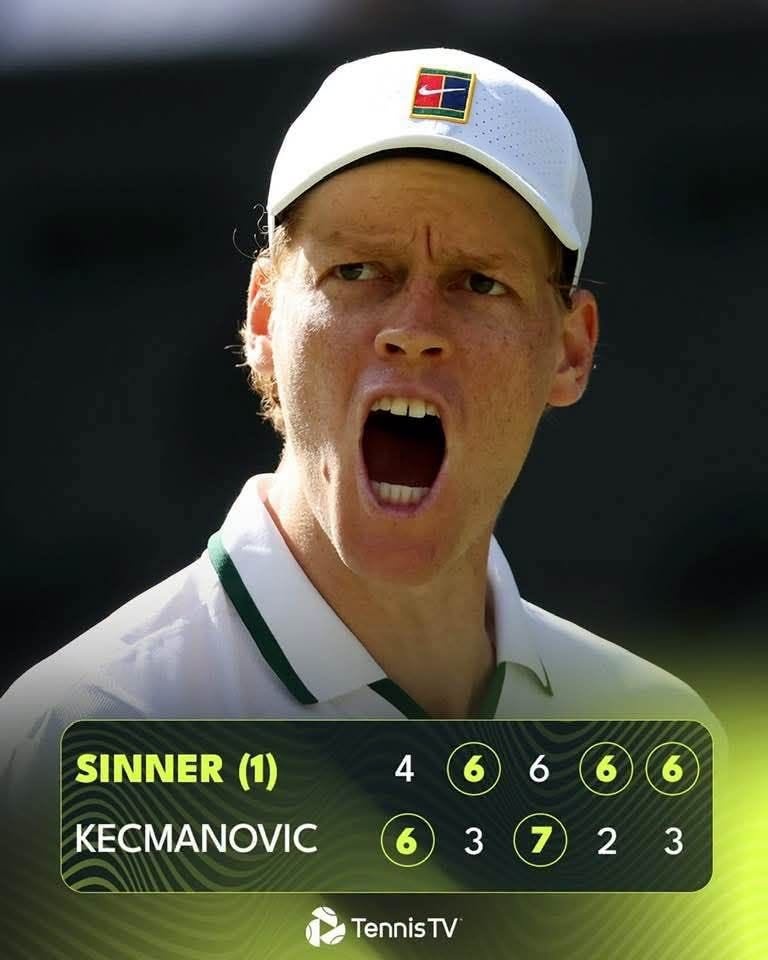
The image tells a story of dominance: SINNER (1) — KECMANOVIC — 3 — 2 — 3. Clean. Decisive. A straight-sets demolition that suggests the World No. 1 walked onto Centre Court, imposed his will, and walked off with minimal fuss. But anyone who watched that match—anyone who felt the tension ripple through the stands, who held their breath as the defending champion slipped and fell, who watched blood seep through his white shoe—knows the truth.
That scoreboard is a lie.
What actually unfolded on that Monday afternoon at Wimbledon was a three-and-a-half-hour psychological warfare, a five-set survival epic that tested every fibre of Jannik Sinner’s being. The final line: 4-6, 6-3, 6-7(6), 6-2, 6-3. Two sets to one down. One month removed from the most shocking collapse of his career at Roland Garros. A fall that sent gasps through Centre Court. Blood on his shoe. A five-set record that stood at a miserable 6-12 and included five consecutive losses.
And yet, he found a way.
This is the story of that match. But more than that, it is a story about what it takes to be an alpha in the world’s most unforgiving individual sport. About the mindset that turns near-defeat into victory. About the adjustments that separate champions from contenders. About the emotional intelligence that allows a man to reset his brain in the middle of a crisis and execute when everything is on the line.
This is the anatomy of a champion’s comeback.
Part I: The Weight of Expectation
The Burden of Being Number One
Jannik Sinner walked onto Centre Court as the defending champion, the World No. 1, and the overwhelming favourite. Carlos Alcaraz, his great rival and the only man many believed could challenge him, was absent through injury. The path had never looked clearer. The narrative had never been more scripted.
But sport does not care about scripts.
Sinner had not played a competitive match for four-and-a-half weeks. He had opted against contesting any grass-court tune-up tournaments, choosing instead to focus on controlled training blocks and regaining fitness after the Roland Garros disaster. It was a calculated gamble—rest and preparation over match rhythm. On paper, it made sense. On grass, against a motivated opponent, it nearly cost him everything.
The Ghost of Paris
To understand the mental mountain Sinner had to climb, one must first understand what happened in Paris.
One month earlier, at Roland Garros, Sinner had arrived as the most heavily favoured player to win the title since Rafael Nadal at his peak. He had dominated the ATP Tour for the first five months of 2026, riding a 30-match win streak that delivered five consecutive Masters 1000 titles on hard and clay courts. He led the tour in both service games won (92%) and return games won (32.6%). He was, by every statistical measure, the most complete player in the world.
And then came Juan Manuel Cerundolo.
Sinner led 6-3, 6-2, 5-1 in the second round. He was one game away from victory. And then, in the stifling Paris heat, he physically shut down. He lost 18 of the final 20 games. He admitted feeling “weak” and “dizzy”. The Iceman had melted.
The discourse that followed was brutal. Questions about his durability. About his five-set record. About whether a player with his game could truly withstand the physical demands of the sport’s longest format. The nickname “The Iceman,” once a tribute to his unshakeable composure, suddenly seemed like a taunt.
This was the baggage Sinner carried onto Centre Court. This was the ghost he had to exorcise.
Part II: The Match — A Set-by-Set Dissection
First Set: The Rust Takes Hold
From the opening games, it was clear something was off. Sinner, renowned for his devastating precision, made an uncharacteristic 10 unforced errors in the opening eight games. His usually rock-solid forehand, the weapon that has terrorised the tour, was misfiring. The rhythm wasn’t there. The confidence wasn’t there.
At 4-4, serving at 40-0, Sinner imploded. He hit his first two double-faults on consecutive points. Then came a forehand error on break point—his fourth consecutive unforced error. In the blink of an eye, Kecmanovic had won nine points in a row to take the set.
The Serbian, ranked 50th in the world, was not just hanging with the champion—he was outplaying him. Kecmanovic dictated the tempo with deep, consistent hitting, forcing Sinner into extended baseline exchanges and disrupting his rhythm. He served consistently and capitalised on every opportunity.
Sinner had won all four previous meetings with Kecmanovic, including a straight-sets victory here two years ago where he lost just seven games. This was different. This was a fight.
Second Set: The Immediate Response
Champions respond. Sinner, having won all four previous meetings with Kecmanovic, including a straight-set win here two years ago, kick-started his fightback with an immediate response in set two.
He reduced his errors. He won all 14 points behind his first serve. He withstood a break point as Kecmanovic continued to probe. The set ended 6-3, and the match was level.
But the relief was temporary. Sinner still wasn’t striking the ball freely. His error count continued to rise. The rust, it seemed, had only been partially scraped off.
Third Set: The Tie-Break That Broke Hearts
The third set was a titanic 70-minute battle. Kecmanovic, eyeing his first victory over a top-10 player at a major, refused to go away. He continued to frustrate Sinner deep into the set.
The tie-break was a microcosm of the entire match. Sinner raced to a 3-0 lead. Victory in the set seemed assured. And then Kecmanovic fought back. He recovered from 3-0 down, saved match points, and won three consecutive points to clinch it 8-6 from 6-5 down.
The Centre Court crowd gave him a standing ovation. They recognised what they were witnessing: an inspired underdog on the verge of one of the year’s biggest upsets.
Sinner had lost a titanic third set. He was two sets to one down. His five-set record—six wins, 12 defeats—loomed over him like a dark cloud. He had lost five consecutive five-set matches, most recently to Cerundolo in Paris. The narrative was writing itself: another collapse. Another early exit. Another question about his durability.
But Sinner had other ideas.
The Fall and the Blood
At 2-2 in the third set, Sinner slipped behind the baseline. He landed awkwardly, his knees bent inwards. The crowd gasped. The umpire rushed over to check on him.
Sinner took time to return to his feet. The fall was the kind that can end tournaments—or careers. “One fall is a tough one because you can get injured,” Sinner would later say. “But it is the most normal thing. Grass courts are like this. Especially the first couple of matches when the grass is very new, you slip a little bit more. I got lucky there because things can go wrong very, very quickly”.
But the fall wasn’t the only physical concern. Blood was seen seeping from Sinner’s shoe during the must-win fourth set. His all-white outfit was turning red. Later, he would joke that he was surprised they let him keep playing because his white shoe was in violation of Wimbledon’s strict all-white dress code. The cause: a problematic toenail aggravated by the fall.
It was a moment that could have broken a lesser player. The physical pain. The mental weight. The knowledge that he was bleeding, that his body was betraying him at the worst possible moment.
Sinner didn’t break. He adapted.
Part III: The Alpha Mindset
“Tried to Reset Myself as Fast as I Could”
After the match, Sinner revealed what had gone through his mind during the crisis. “I had my chances in the third set. I couldn't use them,” he said. “I played a couple of points in the tie-break, you need to accept. Tried to reset myself as fast as I could”.
That line—“reset myself as fast as I could”—is the key to understanding the alpha mindset. It is not about never making mistakes. It is not about never feeling pressure. It is about how quickly you can recover from both.
Sinner’s ability to reset has been described as almost mechanical. Opponents have likened his ruthless style to that of a robot or machine. But that description misses the humanity of what he does. A machine doesn’t feel pressure. A machine doesn’t experience doubt. Sinner does. He just doesn’t let it linger.
“Trying to hold serve in the first couple of service games is very, very important because if he breaks you straight away, it is tough to come back,” he explained. “I think that's it. Not an ideal position. But I tried to stay there mentally, trying also to enjoy the moment because it has been an amazing day for me and my team as well”.
Notice the reframing. He didn’t say “I tried to survive.” He said “I tried to enjoy.” In the middle of a crisis, facing elimination in the first round of a tournament he was expected to dominate, Sinner found a way to appreciate the experience. That is not just mental toughness—that is emotional intelligence at the highest level.
The Iceman Myth
The nickname “The Iceman” has followed Sinner throughout his career. It suggests a player immune to pressure, untouched by emotion. But Sinner himself has pushed back against this narrative.
“Coming back here and opening and play on Centre Court, this year was a year where nobody practised on it before, so it was brand-new. Mentally, you know it,” he said. “It has been an amazing, amazing day for me to feel this way at least once in my life. I think I handled the situation still quite well. It was very nervy, but very happy that I found a way today”.
He admitted it was “nervy.” He acknowledged the tension. But he also recognised the privilege of the moment. This is the alpha mindset: not the absence of fear, but the ability to perform despite it.
In the weeks leading up to Wimbledon, Sinner had been working on exactly this. “We try to maximize every day, so there have been a lot of long practice sessions, and I'm very happy with the shape and mental state I'm in right now”. The longer and continuous training sessions reflected the intention to prevent a recurrence of the physical problems experienced in Paris. But the mental work was equally important.
There is no magic formula, Sinner has insisted. There is only preparation, execution, and the willingness to adapt when things go wrong.
Part IV: Game Adjustments — The Tactical Evolution
From Error-Strewn to Machine-Like Precision
The statistical story of the match is one of dramatic adjustment. In the first set, Sinner was unrecognisable—error-prone, tentative, reactive. By the fourth and fifth sets, he was the player the world had come to expect.
He ended the match with 31 aces and 72 winners. He committed only 10 of his 52 unforced errors in the final two sets. The transformation was not accidental—it was tactical.
Kecmanovic had succeeded early by dictating tempo with deep, consistent hitting, forcing Sinner into extended baseline exchanges and exposing a dip in first-serve percentage. Sinner’s adjustment was multifaceted: he improved his first-serve accuracy, began dictating rallies with heavier groundstrokes, and took control of the centre of the court.
The strategy was simple but effective: reduce errors, increase aggression, and make Kecmanovic run. By the fourth set, Sinner was winning four straight games on his opponent’s serve. The momentum had shifted decisively.
The Serve as a Weapon
Sinner’s improved serve has been a major asset throughout 2026. Against Kecmanovic, it became his primary weapon. He won all 14 points behind his first serve in the second set. By the end of the match, he had 31 aces.
This is not a coincidence. Sinner has spent years developing his serve into a reliable weapon. In 2026, he has led the tour in service games won (92%). Against a dangerous returner like Kecmanovic, that reliability was the foundation upon which his comeback was built.
The Mental Game Within the Game
The tactical adjustments were crucial, but they were only possible because of the mental adjustments that preceded them. Sinner had to accept the reality of the situation—he was playing poorly, his opponent was playing well—and then find a way to change it.
“I tried to reset myself as fast as I could,” he said. That reset wasn’t just about forgetting the lost tie-break. It was about reassessing what was working and what wasn’t. It was about recognising that his aggressive baseline game needed to be tempered with more consistency. It was about understanding that Kecmanovic was thriving on rhythm and needed to be disrupted.
The result was a masterclass in in-match adaptation. Sinner didn’t just survive—he evolved.
Part V: Emotional IQ — The Invisible Edge
The Art of Staying Present
Emotional intelligence in tennis is the ability to regulate your emotions while maintaining focus on the task at hand. It is the difference between a player who crumbles under pressure and one who rises to meet it.
Sinner’s emotional IQ was on full display against Kecmanovic. After losing a heartbreaking tie-break—after slipping and falling, after bleeding through his shoe—he didn’t spiral. He didn’t let frustration dictate his decisions. He reset.
“Trying to hold serve in the first couple of service games is very, very important because if he breaks you straight away, it is tough to come back,” he said. This is the voice of a player who understands the psychology of momentum. He knew that the first few games of the fourth set were critical. He knew that if Kecmanovic got an early break, the match might be over. So he focused on what he could control: his serve, his consistency, his composure.
The Power of Perspective
Perhaps the most revealing aspect of Sinner’s post-match comments was his ability to find perspective in the middle of a crisis. “It has been an amazing, amazing day for me to feel this way at least once in my life,” he said.
This is not the language of a player who is panicking. This is the language of someone who understands that pressure is a privilege. Sinner recognised that opening Centre Court as the defending champion was a moment to be savoured, not just survived. By reframing the experience, he reduced its power to overwhelm him.
The Competitive Fire
But perspective doesn’t mean complacency. Sinner is a fierce competitor. He knew what was at stake. He knew that becoming only the third defending Wimbledon men’s champion to lose in the first round would be a stain on his legacy.
That knowledge didn’t paralyse him—it motivated him. The alpha mindset is not about ignoring the stakes; it is about using them as fuel.
Part VI: The Opponent — A Worthy Challenger
Kecmanovic’s Inspired Performance
Any analysis of this match would be incomplete without acknowledging the quality of Miomir Kecmanovic’s performance. The Serbian, ranked 50th in the world, played the match of his life.
Kecmanovic, who has a career-high ranking of 27 (achieved in January 2023) and has won two ATP titles, had never beaten a top-10 player at a major. He came closer than anyone expected. He dictated play early. He recovered from 3-0 down in the tie-break. He earned a standing ovation from the Centre Court crowd.
He ran out of gas in the fifth set, but he had already made his point. He had pushed the World No. 1 to the absolute limit. He had shown that on any given day, with the right mindset and the right execution, anything is possible.
What Kecmanovic Exposed
Kecmanovic exposed real vulnerabilities in Sinner’s game. The rust. The error-proneness. The physical fragility. The questions about five-set durability that had dogged Sinner since Paris were not answered in the first three sets—they were amplified.
But champions are not defined by their vulnerabilities. They are defined by how they overcome them.
Part VII: The Turning Point
The Fourth Set: Where Champions Are Made
The fourth set was where the match turned. Sinner, despite the blood on his shoe, despite the fall, despite the mental weight of the lost tie-break, came out firing.
He proceeded to level the match for a second time with a fourth straight game on his opponent’s serve. The set lasted 6-2, but the scoreline doesn’t capture the dominance. Sinner was dictating. He was hitting with power and precision. He was, finally, the player the world expected to see.
The shock was still on for Kecmanovic as Sinner left the court before the deciding set. Sinner likely knew that his opponent had managed to win just one of the past nine five-set matches he had contested. He knew that fatigue was on his side. He knew that if he could maintain his level, the victory would be his.
The Fifth Set: Closing the Deal
As the match moved into its fourth hour, it was Sinner who was able to rally for a final push. He reeled off four of the final five games. The final score: 6-3.
In 67 combined minutes, Sinner had wrapped up the fourth and fifth sets. The physical and mental toll on Kecmanovic was evident. Sinner, despite his own physical issues, had outlasted him.
Part VIII: Lessons from the Alpha
What the Match Teaches Us About Greatness
This match was more than a tennis victory. It was a masterclass in the alpha mindset. Here are the lessons it teaches:
1. Resilience is not about never falling—it’s about getting up. Sinner fell, literally and figuratively. He slipped on the grass. He bled through his shoe. He lost a heartbreaking tie-break. And yet, he kept getting up. Each time, he reset. Each time, he found a way forward.
2. Emotional intelligence is a competitive advantage. Sinner didn’t just manage his emotions—he reframed them. He found perspective. He appreciated the moment. He turned pressure into privilege.
3. Adaptation is the hallmark of greatness. Sinner adjusted his game when it wasn’t working. He improved his first-serve percentage. He dictated rallies with heavier groundstrokes. He recognised what Kecmanovic was doing and found a way to counter it.
4. The past is not the future. Sinner had lost five consecutive five-set matches. He had collapsed in Paris. None of that mattered on Centre Court. He wrote a new story.
5. Champions find a way. It wasn’t pretty. It wasn’t dominant. It wasn’t the straight-sets victory the scoreboard suggested. But Sinner found a way. And that, ultimately, is what defines champions.
Conclusion: Beyond the Scoreboard
The image that started this article—SINNER (1) — KECMANOVIC — 3 — 2 — 3—is a lie. It tells a story of dominance that never happened. It suggests a routine victory that was anything but.
What actually happened on Centre Court was something far more compelling. It was a story of struggle and survival. Of a champion pushed to the brink and refusing to break. Of an alpha who, when everything was on the line, found a way to win.
Sinner improved to 7-12 in five-set matches with this victory. It was his first five-set win since the 2024 Australian Open final. He exorcised the ghost of Paris. He answered the questions about his durability. He reminded the world why he is the World No. 1.
But more than that, he reminded us of something fundamental about sport and about life: greatness is not about avoiding adversity. It is about how you respond when adversity finds you.
Sinner didn’t just survive. He evolved. He adapted. He found a way.
That is the alpha mindset. That is the mark of a champion. And that is why, when you look at that scoreboard and see a straight-sets victory, you should know the truth.
The truth is far more impressive.