
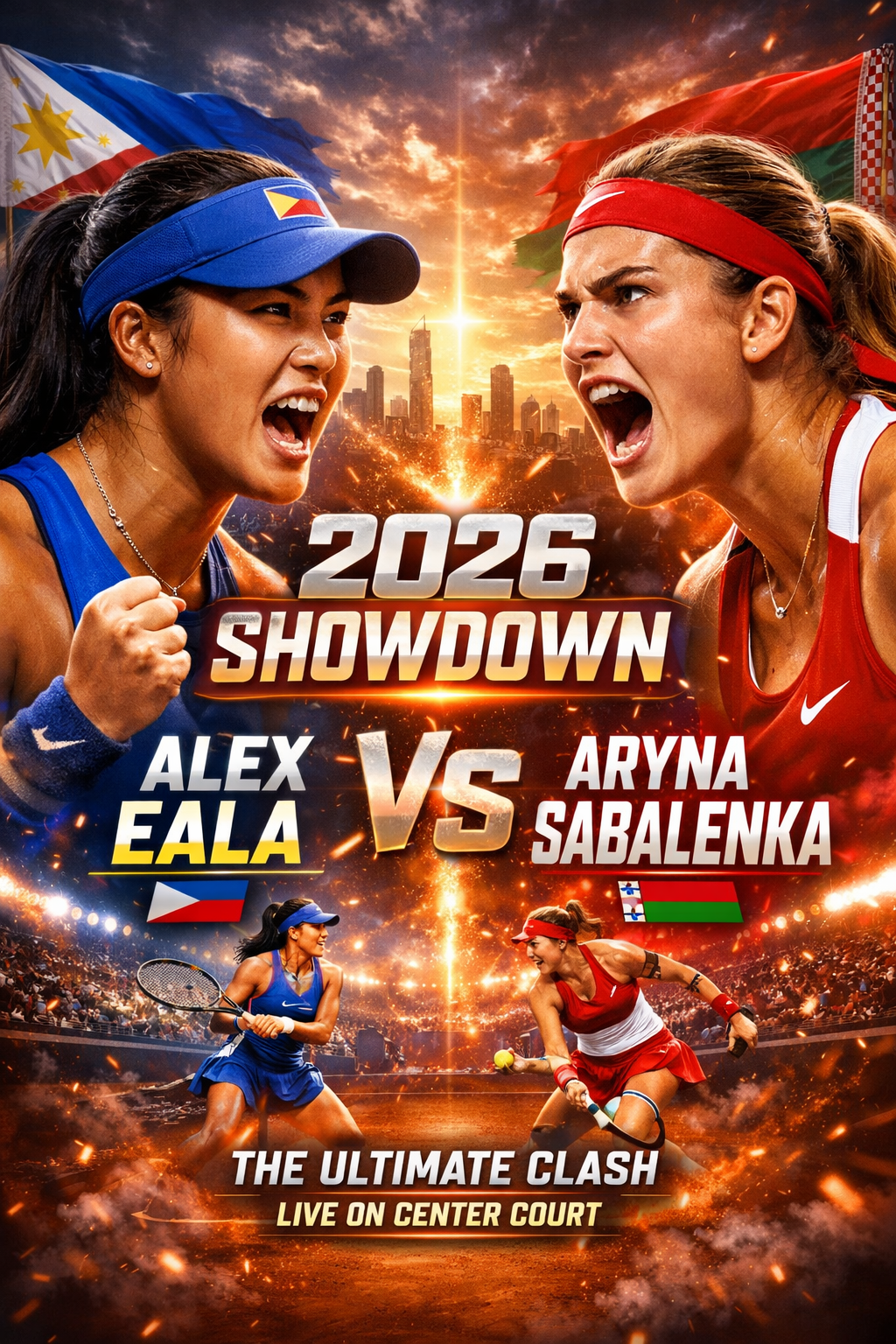
Match Context: Rising Star vs Powerhouse
The potential clash between Alex Eala and Aryna Sabalenka represents a clear contrast in styles—a tactical counterpuncher versus an elite power hitter.
Playing Styles Breakdown
Alex Eala – The Strategic Lefty
- Left-handed advantage creates natural spin variation
- Strong court awareness and anticipation
- Prefers longer rallies and structured point construction
- Effective at absorbing pace and redirecting shots
Core identity: Counterpuncher with discipline and patience
Aryna Sabalenka – The Power Aggressor
- Dominant serve and first-strike patterns
- Heavy forehand used to control rallies
- High-risk, high-reward approach
- Prefers short, explosive points
Core identity: Offensive baseline hitter
Key Tactical Battle Zones
1. Serve and Return
Sabalenka’s serve plus first shot combination is one of the strongest in women’s tennis.
Eala must neutralize this by returning deep and low to prevent immediate winners.
Key insight: If Eala can extend the rally from the return, she gains control.
2. Rally Length Control
Short rallies favor Sabalenka.
Longer rallies favor Eala.
Target range:
- 1–4 shots: Sabalenka advantage
- 5+ shots: Eala advantage
3. Left-Handed Patterns
Eala’s lefty forehand crosscourt into Sabalenka’s backhand is a key pattern.
Sabalenka will try to step around and attack with her forehand whenever possible.
Game Adjustments
Adjustments for Eala
- Use variation: mix height, spin, and slice
- Target movement rather than pure shot power
- Maintain consistency and reduce unforced errors
- Stay composed during aggressive pressure phases
Primary risk: getting rushed and overpowered early in rallies
Adjustments for Sabalenka
- Attack second serves aggressively
- Step inside the baseline to take time away
- Finish points quickly
- Manage unforced errors during high-pressure exchanges
Primary risk: losing control through over-aggression
In-Match Adaptation Scenarios
Scenario A: Sabalenka Controls Early Tempo
Eala must slow the match down using defensive variation and reset strategies.
Scenario B: Eala Extends Rallies
Sabalenka may become impatient, leading to higher error rates.
Scenario C: Deciding Set
Mental strength becomes critical:
- Sabalenka relies on aggressive execution
- Eala relies on consistency and shot discipline
Psychological and Experience Factors
Sabalenka has a clear advantage in big-match experience and composure.
Eala brings unpredictability and a fearless approach but is still developing consistency at the highest level.
Final Prediction (2026 Outlook)
Most likely outcome:
Sabalenka wins in straight sets (approximately 65–70 percent probability)
Upset scenario:
Eala wins in three sets (approximately 30–35 percent probability)
Conditions for an Eala win:
- High first-serve percentage
- Low unforced errors
- Successful rally extension strategy
Critical Insight
The defining factor in this match is control of time:
- Sabalenka shortens time between shots
- Eala extends time through rally construction
The player who controls tempo and time will dictate the match outcome.
Sabalenka enters as the favorite due to power and experience.
Eala’s path to victory depends on turning the match into a tactical contest rather than a power exchange.