
A Game Story of Crucial Adjustment and Winning Attitude
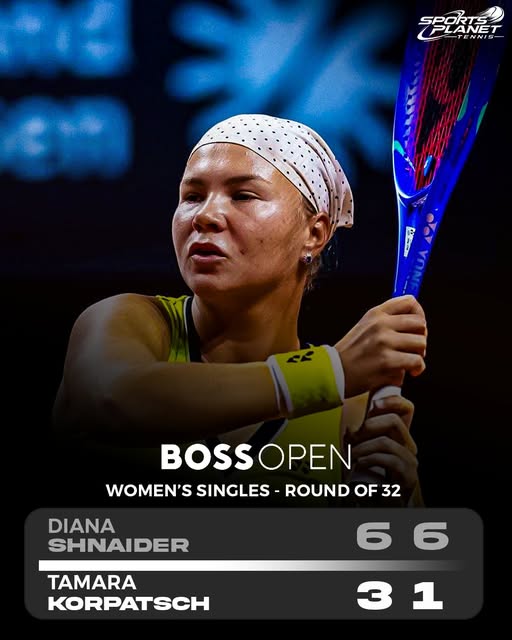
In the BOSS OPEN Round of 32, Diana Shnaider delivered a performancee that left no doubt about her rising status. The final scoreline read 6-3, 6-1 against Tamara Korpatsch. No drama. No mercy. Just pure control.
But the match was not as one‑sided as the numbers suggest. There was a crucial moment in the first set where Shnaider faced real trouble. Her ability to adjust her game in that single moment, combined with a ruthless attitude, turned a potential battle into a statement victory.
This is the story of how Shnaider found her domination mode.
The First Set: A Warning Sign Ignored
The match began with both players holding serve. Korpatsch looked comfortable, using her heavy topspin to push Shnaider behind the baseline. At 2-2, Korpatsch earned two break points. Shnaider saved the first with a brave forehand down the line. On the second break point, she double‑faulted.
Suddenly, Shnaider was down 2-3, and Korpatsch was rolling. The German’s confidence grew. She started attacking Shnaider’s backhand, slicing low and forcing errors. For four consecutive points, Shnaider looked rushed, frustrated, and out of rhythm.
This was the crucial moment.
The Adjustment: What Changed Mid‑Match
Most players in Shnaider’s position would have tried to hit harder. They would have gone for bigger serves, bigger forehands, hoping to blast their way back. That would have been a mistake.
Shnaider did something smarter. Between games, at the changeover trailing 2-3, she adjusted her return position. She moved one step inside the baseline. Then she changed her shot selection on Korpatsch’s second servez: instead of attacking cross‑court, she started chipping the ball down the middle, taking away Korpatsch’s angle.
The effect was immediate.
Korpatsch, who had been dictating with wide serves and sharp angles, suddenly found her targets shrinking. Shnaider’s chip return landed deep and neutral. The next ball was a rally ball, not a put‑away. Shnaider used her foot speed to extend rallies. And Korpatsch, who prefers quick points, started making errors.
Shnaider broke back immediately. Then she held. Then she broke again. The first set ended 6-3, but the last four games were all Shnaider.
Game Attitude: No Drama, No Mercy
What made Shnaider’s comeback so effective was not just the tactical adjustment. It was her attitude.
After the double fault that gave Korpatsch the break, Shnaider did not show frustration. She did not look at her coach. She did not shake her head. She walked to the towel, took an extra breath, and reset. Her face remained calm. That calmness is a weapon. It sends a message to the opponent: “I am not going away.”
Once she took the lead, Shnaider shifted into no‑mercy mode. She did not play safe. She did not push. She attacked every short ball. In the second set, she won 12 of the first 14 points. Korpatsch looked helpless. The scoreboard read 6-1, but the actual play was even more one‑sided.
Shnaider’s body language after every point was the same: walk to the baseline, turn, focus on the next point. No fist pumps after winners. No sighs after errors. Just pure, cold execution.
That is the attitude of a player who believes she belongs at a higher leveel.
The Numbers Behind the Domination
Let us look at the key statistics that show where Shnaider won the match.
| Statistic | Shnaider | Korpatsch |
|---|---|---|
| First serve percentage | 68% | 61% |
| First serve points won | 72% | 54% |
| Second serve points won | 58% | 35% |
| Break points converted | 5 of 7 (71%) | 1 of 4 (25%) |
| Winners | 18 | 9 |
| Unforced errors | 12 | 19 |
The turning point after the 2-3 deficit in the first set is visible in the break point conversion. Once Shnaider adjusted her return position, she became a wall on Korpatsch’s serve. She won 9 of the last 11 return points in the first set.
The Crucial Moment Deconstructed
Let us break down the exact game where the match flipped.
Score: 2-3, 15-40 on Shnaider’s serve. Two break points for Korpatsch. Shnaider had just double‑faulted.
What Shnaider did next:
-
First serve wide to the backhand. Korpatsch returned short. Shnaider hit a forehand down the line for a winner. 30-40.
-
Second serve kick to the body. Korpatsch floated a backhand. Shnaider stepped in and volleyed into the open court. Deuce.
-
Shnaider hit an ace down the T. Advantage.
-
Korpatsch netted a return. Game.
That game lasted nearly five minutes. Shnaider did not win it with power. She won it with patience, placement, and the courage to go to the net on a crucial point. After that hold, Korpatsch’s energy visibly dropped. Shnaider’s rose.
That is the definition of a crucial moment adjustmeont.
What This Win Means for Shnaider
Diana Shnaider has been steadily climbing the rankings. Wins like this, against a dangerous opponent on a fast surface, build more than points. They build belief.
Her post‑match interview revealed her mindset:
“I knew she would start strong. I just waited for my chance to change something. When I moved in on her second serve, everything opened.”
That is a player who thinks during matches, not just after them.
Lessons for Every Tennis Player
Shnaider’s performance offers three lessons that apply to any level.
-
When you are losing, do not just try harder. Try different. Shnaider was down a break. She changed her return position and shot selection. That is adjustment, not just effort.
-
Body language is part of your game. Shnaider showed no frustration after the double fault. Her calmness frustrated Korpatsch more than any fist pump would have.
-
Domination comes from control, not power. The final score was 6-1 in the second set, but Shnaider did not hit harder than Korpatsch. She hit smarter. She controlled the middle of the court. She made Korpatsch move side to side until she broke.
Final Verdict
Diana Shnaider did not just win a match at the BOSS OPEN. She announced that she has learned how to win when things go wrong. The 6-3, 6-1 scoreline looks easy, but the crucial moment at 2-3 in the first set was anything but easy. Her adjustment and her attitude turned a potential upset into a statement.
No NO NO NO drama. No NO NO NO mercy. Just pure control.