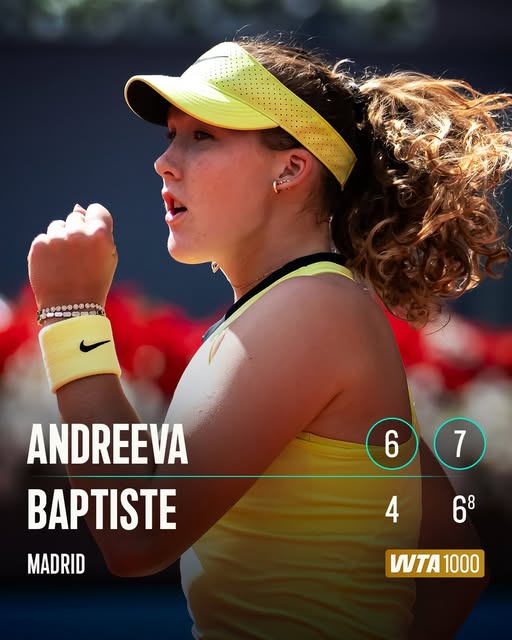
MADRID – The Caja Mágica has seen its fair share of epics, but few second-round encounters at the Mutua Madrid Open have crackled with such raw, unpredictable energy as the one that unfolded under the Spanish sun this week. Russian teenager Mirra Andreeva, the prodigy who seems to be rewriting the rules of teenage tennis, faced a ferocious challenge from American qualifier Hailey Baptiste. When the dust settled, the scoreline read 6-4, 7-6(8) in Andreeva's favour, but those cold numbers do precious little justice to the two hours of tactical chess, physical warfare, and sheer emotional volatility that transpired.
This was not merely a tennis match; it was a collision of generations, styles, and temperaments. For those lucky enough to be inside Manolo Santana Stadium—or watching the pulse-quickening broadcast on Sky Sports Tennis—the encounter served as a pristine example of why the WTA 1000 events are the beating heart of the women’s game. To dissect the drama, we are joined by one of the United Kingdom’s most astute tennis analysts, former British Davis Cup coach and Tennis Week columnist, Jonathan Overend, who provides his characteristically incisive breakdown of a contest that had everything from double-fault jitters to a tiebreak that bordered on the surreal.
Part One: The Set-Up – Youth vs. Raw Power
Before a ball was struck, the narrative seemed straightforward. Mirra Andreeva, just 17 years old, has already been anointed as the future of the sport. Her run to the fourth round at Roland Garros and the third round at Wimbledon last year announced her as a player of preternatural composure. She glides across the clay like a dancer, reads the game two moves ahead, and possesses a backhand down the line that belongs in a museum.
Hailey Baptiste, 22, represents the other side of the American tennis renaissance. A qualifier who had already fought through two matches to reach this stage, she is a physical specimen—long levers, a serve that can touch 185 km/h, and a forehand designed to bully opponents off the red dirt. Where Andreeva is finesse and intelligence, Baptiste is power and defiance.
Yet, as Jonathan Overend noted from the commentary gantry, this was never going to be a mismatch. "The danger for a player like Andreeva is that she faces a 'qualifier' and expects a certain rhythm," Overend said during the first-set interval. "Baptiste doesn't read the script. She hits through the ball with a flat trajectory that takes time away from everyone, even the quickest players. On clay that’s supposed to slow her down, but she uses the altitude of Madrid—the ball flies faster here than in Paris—to her advantage. This was always going to be a trap."
Part Two: The First Set – A Study in Broken Rhythm
The opening games were a nervous, fragmented affair. Both women struggled to locate their first serve, and the early stages resembled a break-fest more than a high-quality WTA 1000 match. Andreeva, usually so serene, double-faulted twice in her opening service game to gift Baptiste an immediate 1-0 lead. The American, however, reciprocated the generosity immediately, slapping a loose forehand into the net and then a backhand long to hand the break straight back.
It was at 2-2 that the first real glimpse of Andreeva’s tactical genius emerged. Baptiste, sensing an opportunity, began to target the Russian’s forehand side, attempting to pin her into the deuce corner. Andreeva’s response was subtle but devastating. Instead of trying to overpower the American, she began to slice her backhand—a shot she uses sparingly but with exquisite touch.
"She started changing the trajectory," Overend explains. "Baptiste wants a consistent height so she can step in and flatten her forehand. By using the slice, Andreeva kept the ball low, skidding through the clay. Suddenly, Baptiste had to bend her knees and generate her own pace from below waist height. That’s a completely different shot. It forced the error count to rise."
The set turned decisively in the seventh game. With Baptiste serving at 3-3, Andreeva produced a return masterclass. She stood inside the baseline to receive second serves, a bold tactic on clay where the bounce can be unpredictable, and began redirecting the ball cross-court with angles that left the American lunging. The break came when Baptiste, frustrated by her inability to find a clean winner, attempted a drop shot from behind the baseline—a low-percentage play that landed meekly into the net.
Serving for the set at 5-4, Andreeva showed the steel that has drawn comparisons to a young Martina Hingis. She did not attempt anything heroic. Three first serves in a row, three neutral balls deep to Baptiste’s backhand, and a forehand error from the American sealed the set 6-4. The crowd applauded the chess move, not the checkmate.
Part Three: The Second Set – When Drama Turns to Chaos
If the first set was a tactical seminar, the second set was a psychological thriller—a melodrama of unforced errors, miraculous gets, and a tiebreak that aged everyone in the stadium by a decade.
Baptiste emerged for the second set with her team having delivered a clear message: loosen up. The American abandoned the tight, conservative patterns of the first set and began swinging freely. She broke Andreeva immediately in the opening game, not with subtlety, but with brute force—a backhand winner down the line, a forehand that kissed the sideline, and a drop shot that caught the Russian leaning the wrong way.
For the next twenty minutes, the match descended into what Overend calls "the chaos zone."
"Baptiste is a rhythm player, but when her rhythm is off, she doesn't gradually find it—she smashes the piano and tries to rebuild it from scratch," Overend laughs. "She started going for winners from impossible positions. Some of them landed in—like the inside-out forehand from two metres behind the baseline that defied physics. But many did not. Andreeva, to her credit, stayed in the points, but she became passive. She started pushing the ball, waiting for errors. That’s dangerous against a streaky player."
The games became a pendulum. Baptiste consolidated her break for 2-0, then Andreeva broke back in a marathon fourth game that featured six deuces. The shot of the match—indeed, a contender for shot of the tournament—arrived at 2-2, 30-all. Andreeva, forced wide on her forehand, hit a desperate lob that seemed destined to sail long. But the Madrid altitude kept it floating. Baptiste, camped at the net, misjudged the bounce, allowing the ball to drop inside the baseline. Andreeva, anticipating the error, never stopped running and somehow threaded a cross-court passing shot that whistled past Baptiste’s outstretched racquet.
The stadium erupted. Andreeva raised a finger to her temple. The message was clear: I am thinking, and you are not.
Yet remarkably, Baptiste was not broken. She saved two break points, then three more, finally holding with a serve that clipped the line and an ace out wide. The set moved inexorably toward a tiebreak, with both players holding serve through a nervy final four games. Andreeva served to force the tiebreak at 5-6, and here she showed a vulnerability that will concern her camp. Two double-faults—one at 30-0 up, another at 40-30—allowed Baptiste to reach set point. But the American, perhaps over-eager, missed a routine backhand down the line.
"I've watched that point five times," says Overend. "Baptiste had the court wide open. Andreeva was scrambling on the ad side. All she needed was a controlled backhand cross-court, and she tried to whip it down the line for a winner. That’s the fine line with Baptiste—she’s all or nothing. On this occasion, it was nothing."
Part Four: The Tiebreak – Pure Nerve Gas
The tiebreak to decide the match was a masterpiece of tension. Twelve points. Twists at every turn.
Andreeva started like a train, racing to a 3-0 lead with a deft drop volley and a return winner off a second serve that clipped the net cord and died on Baptiste’s side. But the American, to her immense credit, refused to buckle. She reeled off four straight points—two of them courtesy of Andreeva unforced errors, one a blistering forehand return, and the fourth an audacious lob that landed on the baseline.
At 4-3 to Baptiste, the momentum had shifted entirely. The American had two points on her own serve. The crowd, which had favoured Andreeva throughout, began to sense an upset. Many neutrals in the media centre started typing the headline: Baptiste stuns Andreeva in Madrid.
Then came the turning point. At 4-3, Baptiste’s second serve—a kicker out wide to Andreeva’s backhand. The teenager, who had been passive for much of the second set, suddenly stepped inside the court. She took the ball on the rise and clattered a backhand return flat down the line, a shot of such velocity and precision that Baptiste could only watch it fly past. 4-4.
"That was the moment," Overend says, his voice still carrying a note of admiration. "That was the shot of a future Grand Slam champion. Not because it was the hardest hit, but because of the courage. At 4-3 down in a tiebreak, most players would slice it back, keep the rally going, hope for an error. Andreeva went for the winner. She took the tiebreak back."
At 5-4, Andreeva held her own serve with a forehand that forced a short reply, then a put-away volley. Championship point at 6-4. But Baptiste, displaying the heart of a lion, saved it with a stunning forehand winner off a 190 km/h serve—a return that Andreeva could not believe had gone in. The American then saved a second match point at 6-5 with a perfectly executed serve-and-volley, a tactic she had used only twice all match.
At 6-6, the tension was suffocating. Andreeva double-faulted to give Baptiste a set point of her own at 6-7. The Russian slumped her shoulders, the first sign of true despair. But then, in a sequence that encapsulated the entire match, Baptiste netted a routine forehand on her own set point. The chance was gone.
Andreeva, sensing the escape, closed like a shark. At 7-7, she painted the line with a forehand cross-court winner. At 8-7, her second serve—a kicker to Baptiste’s forehand—drew a weak reply that floated mid-court. The Russian stepped forward and drove a forehand into the open court. The match was over.
7-6(8). Andreeva collapsed to her knees, then rose with a smile that mixed relief with exhaustion. Baptiste, to her eternal credit, tapped her racquet on the clay in applause.
Part Five: Expert Verdict – Jonathan Overend’s Final Analysis
In the immediate aftermath, as Andreeva signed autographs and Baptiste trudged off with her head held high, Tennis Week caught up with Jonathan Overend for his final verdict on a match that will be replayed in coaching clinics for months to come.
On the tactical battle:
"Andreeva won this match in two key areas: the return of serve and the slice backhand. Baptiste landed 58% of her first serves, which is respectable, but she only won 48% of those points. That’s a disaster statistic. Andreeva was reading the serve—particularly the wide serve to the deuce court—and returning it with interest. As for the slice, look at the unforced error count: Baptiste had 34 winners but 42 errors. Andreeva had 22 winners and just 19 errors. The slice nullified Baptiste’s power and forced her to take risks. That’s high-IQ tennis."
On Andreeva’s mental resilience:
"There’s a maturity there that is genuinely frightening. At 6-5 down in the second set, serving to stay in it, she double-faulted twice. Most 17-year-olds would have crumbled. Instead, she saved set point and then dominated the tiebreak. But—and this is a small but—I worry about her second serve. It’s a liability. She double-faulted seven times. On clay against Baptiste, she got away with it. Against Iga Swiatek or Aryna Sabalenka next round? They will eat that second serve alive."
On Baptiste’s future:
"This performance confirms what many of us in the UK have been saying: Hailey Baptiste is a top-30 player who hasn’t yet found consistency. Her ball-striking is clean, she moves well for her size, and she has the weapons to trouble anyone. But she needs a Plan B. When the slice came, she had no answer except to swing harder. A coach needs to teach her to loop the ball, to use more topspin, to change the height. If she learns that, watch out."
Final thoughts on the Madrid atmosphere:
"The altitude here makes everything faster, which benefits the big hitter. But Andreeva adapted better. She used the conditions—the skidding bounce, the quick air—to hit through the court when she needed to, but also to slide and defend. This was a classic 'clay-court hard-court' hybrid match. And the crowd loved every second of it. Madrid knows drama, and this match delivered in spades."
Epilogue: What This Means for the Draw
For Mirra Andreeva, survival is the name of the game. She moves into the third round of a WTA 1000 event having played far below her best in patches, yet still finding a way to win. That is the hallmark of a champion. Her next opponent will likely be a top-10 seed, and she will need to raise her level dramatically. But if the tiebreak proved anything, it is that the Russian teenager possesses an internal compass that points toward victory even when the map seems illegible.
For Hailey Baptiste, this defeat will sting, but it should also serve as validation. She pushed one of the most hyped teenagers in a decade to the very edge of defeat on a big stage. Her ranking will rise, and the tennis world will now watch her with greater attention.
As the sun set over the Caja Mágica, Andreeva walked off the court with a quiet nod to her box. No fist pumps, no theatrical roar. Just the calm of a player who expects to win these matches. That, perhaps, is the most dramatic thing of all.