An All-American Battle on Grass
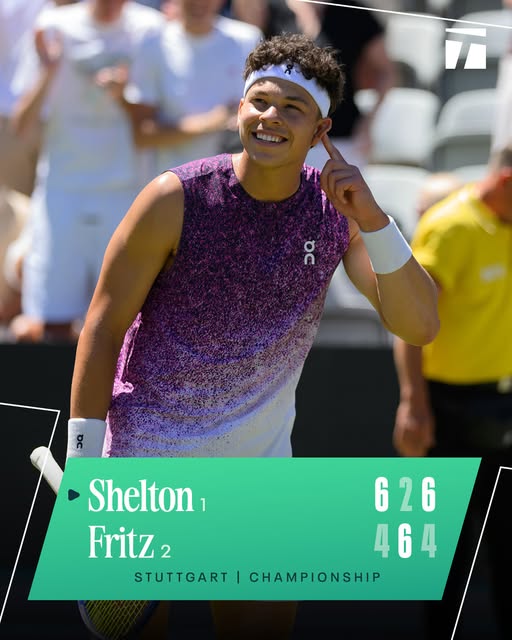
The 2026 Stuttgart Open final delivered exactly what tennis fans hoped for: a high-quality, hard-fought showdown between two of America's brightest stars, Ben Shelton and Taylor Fritz. Played on the grass courts of Stuttgart, Germany, the championship match represented far more than an ATP 250 title. It served as an early indicator of which player might carry momentum into Wimbledon and the remainder of the grass-court season.
Shelton emerged victorious with a 6-4, 2-6, 6-4 win, capturing his first career grass-court title and continuing what has become a breakthrough season. The contest showcased the evolving dimensions of Shelton's game, his growing tactical maturity, and his remarkable ability to perform under pressure. Meanwhile, Fritz demonstrated why he remains one of the most dangerous grass-court players in the world, pushing Shelton to his limits in a fiercely contested encounter.
What made this final particularly compelling was not simply the quality of the tennis but the contrasting styles and personalities involved. Fritz entered as the defending Stuttgart champion and one of the ATP Tour's most accomplished grass-court performers. Shelton arrived carrying confidence from several grueling victories earlier in the week, including a dramatic semifinal comeback against Jiri Lehecka in which he saved multiple match points.
The result was a championship match that highlighted the future of American men's tennis and reinforced Shelton's status as one of the sport's fastest-rising stars.
First Set: Shelton Changes the Narrative
One of the most notable storylines entering the final was Shelton's tendency throughout the tournament to lose the opening set before mounting comebacks. In previous rounds, he repeatedly found himself trailing before digging deep and reversing momentum.
Against Fritz, however, Shelton made a critical adjustment.
Rather than spending the opening set trying to find his rhythm, he came out aggressively from the first ball. His serve was sharp, his forehand was decisive, and he looked determined to dictate points instead of reacting to Fritz's game plan.
The first set featured high-quality serving from both men. Opportunities to break serve were scarce, making every point feel magnified. Shelton's left-handed delivery created awkward angles that consistently pulled Fritz off the court. Meanwhile, Fritz relied on his trademark precision and flat groundstrokes to keep points short and maintain scoreboard pressure.
The pivotal moment arrived when Shelton managed to earn the crucial break. He attacked Fritz's second serve, stepped inside the baseline, and capitalized on a slight dip in the defending champion's level.
From there, Shelton maintained composure.
Unlike some younger players who become tentative when serving for a set, Shelton embraced the moment. His confidence was evident as he closed out the opener 6-4, immediately putting Fritz on the defensive.
Winning the first set represented more than a numerical advantage. It demonstrated Shelton's growing ability to start matches with intensity and execute a proactive game plan from the outset.
Fritz Responds Like a Champion
Elite players rarely stay down for long, and Fritz quickly reminded everyone why he entered the tournament as the defending champion.
The second set was arguably Fritz's best stretch of tennis all afternoon.
He raised his first-serve percentage, improved his return positioning, and began neutralizing Shelton's biggest weapon. Rather than allowing Shelton to control rallies with his forehand, Fritz absorbed pace and redirected the ball with exceptional precision.
The result was a complete momentum shift.
Fritz consistently found depth on both wings and forced Shelton into defensive positions. His return game improved dramatically, allowing him to apply scoreboard pressure that had been absent during the opening set.
Shelton's level dipped slightly during this period. Whether due to physical fatigue from a demanding week or simply Fritz's elevated play, he struggled to find answers.
Fritz capitalized immediately.
The defending champion raced through the second set 6-2, looking every bit like the grass-court specialist who had won multiple titles on the surface during his career.
At that stage, momentum appeared firmly on Fritz's side.
Many players would have been rattled after losing a set so decisively. Shelton, however, had spent the entire week proving that adversity no longer intimidated him.
The Deciding Set: Championship Tennis Under Pressure
The third set became a test of nerves, resilience, and execution.
Both players understood the significance of the moment.
For Fritz, a victory would mean a successful title defense and another confirmation of his grass-court credentials. For Shelton, it represented an opportunity to claim his first grass title and continue establishing himself as a legitimate threat across all surfaces.
The opening games were tense.
Each player held serve while attempting to create opportunities on return. The quality remained exceptionally high, with both men producing aggressive shot-making and clutch serving under pressure.
What separated Shelton was his ability to survive difficult moments.
Throughout the match, Fritz generated numerous break-point opportunities. Yet Shelton repeatedly found solutions when the pressure peaked. Whether through a booming serve, a fearless forehand, or an aggressive approach to the net, he consistently elevated his game when it mattered most.
Statistics often reveal the hidden story behind a match, and Shelton's performance on break points was a perfect example. Saving nine of the 11 break points he faced demonstrated extraordinary mental strength and execution under pressure.
Every successful escape preserved momentum.
Every hold of serve increased the pressure on Fritz.
Eventually, the decisive breakthrough arrived.
At 4-4 in the third set, Shelton produced one of his best return games of the afternoon. He attacked aggressively, forced Fritz into difficult positions, and earned the critical break that ultimately decided the championship.
The moment encapsulated Shelton's evolution as a player.
Earlier in his career, he often relied primarily on explosive serving and athleticism. Here, he constructed points intelligently, recognized opportunities, and executed a calculated plan when the match hung in the balance.
After securing the break, Shelton confidently served out the match to claim the title.
The Tactical Evolution of Ben Shelton
Perhaps the most encouraging aspect of Shelton's victory was the way he won.
For much of his early professional career, Shelton's identity revolved around overwhelming power. His massive serve, explosive forehand, and athletic shot-making made him dangerous, but critics occasionally questioned whether his game possessed enough variety to consistently challenge the sport's elite.
The Stuttgart tournament offered a compelling answer.
Shelton demonstrated tactical flexibility throughout the week.
He mixed serve placements effectively, varied rally patterns, used the slice more frequently, and showed greater patience during baseline exchanges. Rather than attempting to finish every point immediately, he selected his moments carefully.
Against Fritz, this maturity was especially evident.
He balanced aggression with discipline, understanding when to attack and when to extend rallies. His decision-making improved significantly, reducing the unforced errors that sometimes plagued him in earlier stages of his career.
The grass surface amplified these improvements.
Grass rewards players who can adapt quickly, take the ball early, and remain comfortable in fast-paced exchanges. Shelton proved capable of doing all three.
His first grass-court title therefore felt less like a surprise and more like the natural progression of a player expanding his skill set.
Resilience: The Defining Theme of the Week
If one word defined Shelton's Stuttgart campaign, it was resilience.
The final was merely the latest example.
Earlier in the tournament, Shelton faced repeated adversity. Every match required three sets. Every victory demanded emotional and physical energy. Several times he appeared close to elimination.
Most notably, he saved two match points against Jiri Lehecka in a dramatic semifinal battle before advancing to face Fritz. That match alone could have drained a player's confidence and energy reserves.
Instead, Shelton seemed to grow stronger.
By the time he reached the final, he had developed a survivor's mentality. Each challenge reinforced his belief that he could find solutions regardless of the circumstances.
This psychological growth may prove even more important than the title itself.
Champions are often defined not by how they perform when everything goes according to plan but by how they respond when events become difficult.
Throughout the week, Shelton repeatedly chose the second path.
Fritz's Performance Deserves Recognition
While the spotlight naturally falls on the champion, Fritz's performance should not be overlooked.
The defending champion played excellent tennis throughout the tournament and pushed Shelton to the brink.
His serving remained among the best on tour. His flat groundstrokes penetrated the grass beautifully. His ability to redirect pace and take time away from opponents remains one of his greatest strengths.
In many respects, Fritz played well enough to win.
The difference ultimately came down to a handful of critical moments.
Shelton converted his opportunities more effectively and delivered under pressure when the match reached its decisive stages. Fritz generated chances but could not consistently capitalize on them.
That thin margin often separates victory from defeat at the highest level.
Despite the loss, Fritz demonstrated that he remains a major contender heading into Wimbledon and will likely remain one of the most dangerous players in any grass-court draw.
What the Victory Means for Wimbledon
The timing of Shelton's triumph could hardly be better.
With Wimbledon approaching, confidence becomes an invaluable asset. Players who perform well during the lead-up events often carry momentum into the year's most prestigious grass-court tournament.
Shelton now arrives in London armed with:
- A grass-court title.
- Multiple comeback victories.
- Increased tactical confidence.
- Improved mental resilience.
- Proof that he can defeat elite opponents on the surface.
Perhaps most importantly, he now possesses evidence that his game can succeed under the unique demands of grass-court tennis.
The serve remains a major weapon, but it is no longer his only weapon.
His movement, return game, tactical awareness, and mental toughness have all improved significantly.
Those qualities could make him one of the most dangerous players in the Wimbledon field.
Conclusion: The Emergence of a Complete Competitor
Ben Shelton's Stuttgart victory was about far more than lifting a trophy.
It represented the latest stage in his transformation from an explosive young talent into a complete professional capable of competing for the sport's biggest prizes.
His 6-4, 2-6, 6-4 victory over Taylor Fritz showcased every aspect of his growth. He started strongly, responded intelligently to adversity, saved break points under pressure, and executed when the championship was on the line. Most importantly, he demonstrated the emotional maturity required to succeed at the highest level.
Throughout the week, Shelton repeatedly found ways to survive difficult situations, culminating in a title run that required grit, courage, and exceptional belief. By winning his first grass-court championship and continuing a season that has now produced titles on multiple surfaces, he has established himself as one of the ATP Tour's most versatile and dangerous competitors.
As Wimbledon approaches, the message from Stuttgart is clear: Ben Shelton is no longer simply a promising prospect. He is a genuine contender, armed with the power, resilience, and strategic maturity necessary to challenge the best players in the world.