
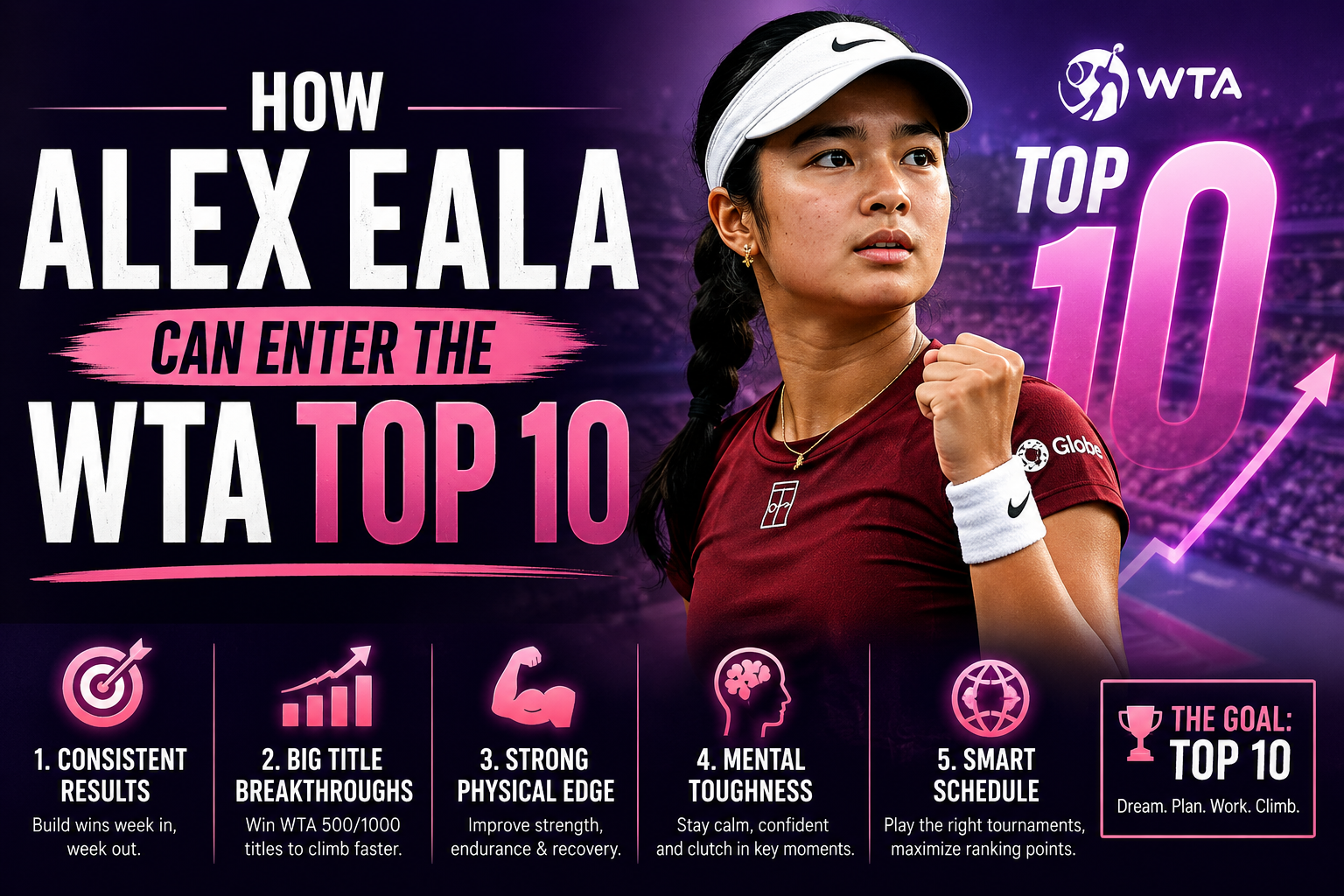
The rise of Alex Eala is becoming one of the most fascinating stories in modern women’s tennis. What once looked like the dream of a talented junior player is now transforming into a legitimate professional journey toward elite-level competition.
Across Europe, especially in Spain where clay-court development and tactical tennis are deeply respected, many coaches are beginning to view Eala as more than just a promising athlete from Asia. They see a player whose game is evolving at the correct pace for modern WTA tenniz.
The discussion is no longer simply about whether she can stay inside the Top 100. The conversation has shifted toward something much bigger:
Can Alex Eala eventually enter the WTA Top 10?
From the perspective of a Spanish coach and former player, the answer depends on one critical factor: evolution.
Modern tennis rewards players who adapt continuously. The sport changes every season. Speed increases. Power increases. Tactical systems evolve. Recovery science improves. Players who fail to mutate their game become predictable and eventually disappear from elite competition.
Alex Eala’s greatest strength may be her willingness to evolve.
Her game today already looks significantly different from the version fans watched during her junior years. Her movement, aggression, court positioning, and tactical choices are mutating toward the demands of top-level women’s tennis.
If this progression continues correctly, the possibility of entering the WTA Top 10 becomes realistic.
Understanding the Modern WTA Landscape
Before discussing Alex Eala’s future, it is important to understand how difficult entering the Top 10 truly is.
The modern WTA Tour is one of the most physically demanding eras in women’s tennis history. Elite players combine:
- explosive power
- relentless movement
- aggressive returns
- tactical intelligence
- mental resilience
The difference between Top 50 and Top 10 players is enormous.
Many talented athletes can produce brilliant performances occasionally. Top 10 players perform consistently across an entire season, across multiple surfaces, and under immense pressure.
Today’s elite stars such as:
- Iga Swiatek
- Aryna Sabalenka
- Coco Gauff
- Elena Rybakina
have transformed women’s tennis into a battlefield of athleticism and adaptation.
To enter that level, Alex Eala must continue evolving in several important areas.
The Spanish Tennis Philosophy and Alex Eala
Spain has historically produced players with exceptional tactical intelligence and mental endurance.
From:
- Rafael Nadal
- Carlos Alcaraz
- Garbine Muguruza
Spanish tennis culture emphasizes:
- patience
- discipline
- point construction
- adaptability
- physical resilience
Alex Eala’s development reflects many of these characteristics.
Her ability to build rallies intelligently rather than simply relying on raw power is one reason many European coaches respect her long-term potential.
She understands angles.
She understands tempo.
She understands movement patterns.
These are foundations that cannot easily be taught later in a career.
The Mutation of Alex Eala’s Game
The term “mutation” in tennis refers to the transformation of a player’s style as competition evolves.
The game that helped Eala dominate juniors cannot remain unchanged if she wants to become a Top 10 player.
Fortunately, her evolution is already visible.
Earlier Ball Contact
One of the biggest changes in her game is how much earlier she now strikes the ball.
Modern elite players attack time itself. They take away reaction windows from opponents.
Eala has become more comfortable:
- stepping inside the baseline
- redirecting pace
- attacking short balls aggressively
This is critical for competing against elite power players.
Improved Offensive Identity
Earlier in her career, Eala often relied heavily on consistency and rally tolerance.
That style alone rarely succeeds against Top 10 opponents because elite hitters eventually overpower passive defenses.
Now, however, she is developing:
- stronger forehand acceleratione
- improved transition offense
- more aggressive court positioning
- better finishing instincts
This offensive mutation is essential.
Faster Court Speed
Movement remains one of the most underrated parts of her development.
Spanish coaches often prioritize footwork above everything because movement creates tactical freedom.
Eala’s recovery speed, balance, and directional changes have improved significantly.
This matters greatly because modern women’s tennis demands constant defensive-to-offensive transitions.
Why Left-Handed Players Are Dangerous
Alex Eala’s left-handed game gives her a natural advantage.
Left-handed players disrupt traditional rally patterns because opponents face them less frequently.
Historically, lefties create tactical discomfort through:
- unusual serve angles
- heavy crosscourt forehands
- awkward spin trajectories
We have seen this advantage with players like:
- Petra Kvitova
- Angelique Kerber
- Rafael Nadal
Eala’s left-handed forehand can become a major weapon if she continues improving its penetration and consistency.
Top 10 tennis often comes down to possessing one elite pattern that opponents struggle to neutralize repeatedly.
Her lefty aggression could eventually become that pattern.
Physical Evolution: The Most Important Phase
A player cannot survive Top 10 tennis without elite physical conditioning.
This is where many talented young players struggle.
The modern WTA calendar is brutal:
- constant travel
- different climates
- changing surfaces
- short recovery periods
Spanish training systems traditionally emphasize endurance and durability because long careers require sustainable physical management.
Eala’s body is still evolving.
As she matures physically, several improvements are likely:
- stronger serve velocity
- heavier groundstrokes
- improved injury resistance
- greater explosive movement
These gains could dramatically accelerate her ranking progress.
The Serve: The Biggest Key to Top 10 Tennis
If there is one area that could determine whether Alex Eala reaches the Top 10, it is her serve.
Elite women’s tennis increasingly rewards players who earn free points quickly.
The serve affects:
- confidence
- scoreboard pressure
- energy conservation
- tactical control
Players like Elena Rybakina and Aryna Sabalenka dominate partly because their serves constantly relieve pressure.
For Eala to become a Top 10 player, her serve must evolve into a more dangerous weapon:
- higher first-serve percentage
- improved placement
- more aggressive second serve
- better variation under pressure
The good news is that serving can improve significantly during a player’s early 20s.
Mental Strength and Emotional Control
Talent alone never guarantees Top 10 success.
Mental adaptation separates elite athletes from good professionals.
One thing Spanish coaches admire greatly is emotional discipline.
Alex Eala has shown growing maturity in:
- handling momentum swings
- controlling frustration
- staying composed under pressure
- recovering after difficult points
This psychological evolution is extremely important.
Young players often struggle when expectations increase. Eala now carries not only personal ambitions but also the hopes of Philippine tennis fans worldwide.
The ability to manage pressure while continuing development is a major indicator of future success.
Learning to Win Ugly
One hidden characteristic of Top 10 players is the ability to win even when playing badly.
This skill is often overlooked by fans.
Elite players survive:
- difficult conditions
- poor timing days
- emotional fatigue
- physical discomfort
They find solutions instead of panicking.
Eala’s increasing tactical maturity suggests she is learning this process.
She no longer relies on only one rhythm or one strategy. Her adaptability during matches has improved noticeably.
That flexibility is vital for long-term success.
Surface Adaptation and Complete Development
Top 10 players must succeed on all surfaces:
- hard court
- clay
- grass
Spanish systems traditionally build strong clay-court foundations because clay develops:
- patience
- movement
- shot tolerance
- tactical creativity
Eala’s background gives her excellent rally discipline.
However, her evolution on faster hard courts will determine how high she can climb.
Modern hard-court tennis rewards:
- aggressive returns
- early ball striking
- explosive offense
Fortunately, her recent game mutations indicate she is adapting successfully.
Why the Top 20 Is Realistic First
Before entering the Top 10, consistent Top 20 presence is the logical next step.
Top 20 players typically possess:
- reliable weapons
- physical consistency
- mental stability
- tournament experience
Eala appears to be moving steadily toward this level.
Several factors support this prediction:
- improved physicality
- growing confidence
- tactical evolution
- increasing match experience
Once players establish themselves inside the Top 20, confidence often accelerates dramatically.
That confidence can create breakthrough seasons.
Comparing Alex Eala to Modern Rising Stars
One reason many coaches remain optimistic about Eala is that her development feels sustainable.
Some young players rise quickly through raw power but later struggle with injuries or inconsistency.
Eala’s progression appears more balanced:
- technical groweth
- physical adaptation
- mental development
- tactical maturity
This balanced evolution resembles the developmental paths of players such as:
- Ons Jabeur
- Jessica Pegula
Players who gradually built complete games rather than relying on temporary momentum.
The Importance of Team Environment
No player reaches the Top 10 alone.
Behind every elite athlete is usually a strong support structure:
- coaches
- fitness trainers
- recovery specialists
- nutrition experts
- psychologists
As Eala continues climbing the rankings, maintaining a stable and intelligent team will become increasingly important.
The modern game requires constant adaptation.
Teams must study:
- opponent tendencies
- biomechanics
- recovery patterns
- scheduling strategies
The smartest players today evolve scientifically as much as physically.
The Global Impact of Alex Eala
Alex Eala’s rise is bigger than rankings.
She represents the possibility of expanding elite tennis influence into Southeast Asia.
Her success could inspire:
- new tennis academies
- greater sponsorship
- improved infrastructure
- more junior participation
The Philippines has enormous athletic passion. A Top 10 player could transform the visibility of tennis throughout the country.
That cultural impact adds even greater meaning to her journey.
Future Prediction: Can She Truly Reach the Top 10?
From the perspective of a Spanish coach and former player, Alex Eala absolutely possesses Top 10 potential.
However, reaching that level requires continuous mutation of her game.
The next stages of her evolution likely include:
- more offensive serving
- stronger point finishing
- improved return aggression
- increased physical explosiveness
- greater consistency against elite hitters
If these areas continue progressing, several milestones become realistic.
Short-Term Projection
- stable Top 50 presence
- more wins against seeded players
- deeper WTA tournament runs
Mid-Term Projection
- entry into Top 20
- Grand Slam second-week appearances
- potential WTA titles
Long-Term Projection
If development remains healthy and consistent:
- WTA Top 10 contention
- major semifinal opportunities
- leadership role in global women’s tennis
Final Thoughts
Alex Eala’s journey is not simply about rankings. It is about evolution.
Modern tennis belongs to players who adapt continuously. The sport never stops changing, and neither can the athletes.
Eala’s greatest strength may be her willingness to transform:
- her movement
- her aggression
- her tactics
- her mentality
That mutation process is already visible.
She is becoming faster.
More confident.
More aggressive.
More complete.
The road to the WTA Top 10 remains extremely difficult, but the foundation is real. Her progression toward the Top 20 already suggests that she is moving in the correct direction.
From a Spanish coaching perspective, players who combine tactical intelligence, left-handed creativity, emotional resilience, and evolving athleticism always deserve attention.
Alex Eala now belongs in that conversation.
And if her evolution continues at this pace, the future of women’s tennis may eventually includee a Filipina inside the WTA Top 10.