
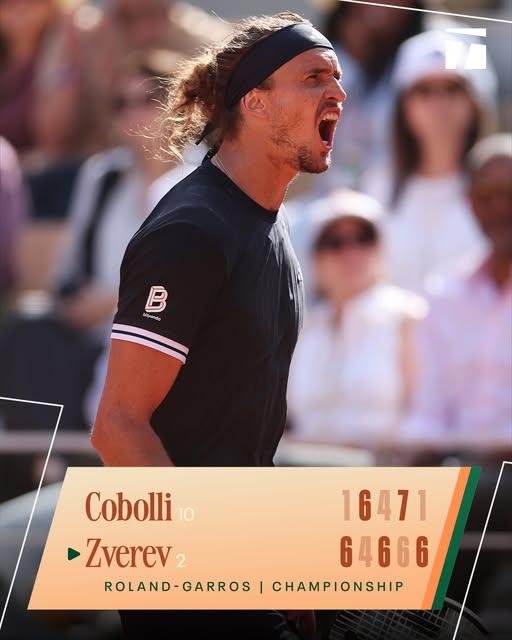
The Day Alexander Zverev Finally Became a Grand Slam Champion
The Paris sky hung heavy over Court Philippe-Chatrier as thousands of fans settled into their seats for what many expected to be a fascinating battle between experience and ambition.
On one side stood Alexander Zverev.
A player who had spent years carrying the burden of expectation.
A former Olympic gold medalist.
A multiple-time ATP Finals champion.
A player who had won nearly everything except the trophy that mattered most.
A Grand Slam title.
Across the net stood Flavio Cobolli.
The fearless Italian whose rapid rise had become one of the stories of the tournament.
Young.
Hungry.
Explosive.
Unafraid.
He had spent two weeks proving he belonged among tennis' elite.
Now he stood one victory away from completing one of the greatest breakthroughs in modern tennis.
Five hours later, only one man would leave Paris immortalized.
The scoreboard would read:
Alexander Zverev def. Flavio Cobolli
6-1, 4-6, 7-6, 4-6, 6-1
The score tells the result. Alexander Zverev has maturity game in intensive 5 set game He has level up his game into highest tennis warrior
But it does not tell the story.
The story was written in pressure points, tactical adjustments, emotional battles, and momentum swings that transformed a tennis match into a psychological war.
And ultimately, it became Sascha's moment.
A Nervous Beginning for the Young Challenger
Championship matches are different.
The atmosphere is different.
The pressure is different.
The heartbeat feels different.
Cobolli entered the final playing the best tennis of his career.
Yet from the opening games, signs of nervous energy appeared.
His footwork looked rushed.
His forehand timing was slightly off.
His serve lacked its usual freedom.
Meanwhile Zverev looked composed.
Relaxed.
Focused.
Determined.
The German immediately established control through heavy baseline depth.
Every rally pushed Cobolli further behind the baseline.
Every exchange forced him into uncomfortable defensive positions.
The result was a dominant opening set.
Zverev claimed it 6-1.
From the coaching box perspective, it appeared the experience gap might prove too large.
But champions are rarely crowned easily.
And challengers rarely surrender quietly.
Cobolli Refuses to Disappear
The second set changed everything.
Instead of retreating into caution, Cobolli became aggressive.
His body language transformed.
His movement improved.
His confidence returned.
Most importantly, he began attacking Zverev's forehand wing with greater consistency.
This adjustment disrupted the German's rhythm.
Rather than allowing Zverev to dictate rallies, Cobolli started creating first-strike opportunities.
Suddenly the momentum shifted.
The crowd sensed it.
The energy inside Philippe-Chatrier changed.
The Italian started playing with freedom.
His forehand exploded through the clay.
His returns landed deeper.
His confidence grew point by point.
When he captured the second set 6-4, the final became a completely different contest.
The Match Turns Into a War
Grand Slam finals often reveal character more than talent.
Both players possessed elite talent.
Now character would decide the outcome.
The third set became the first true battlefield.
Neither player wanted to surrender control.
Games became longer.
Points became heavier.
Pressure intensified.
The rallies increasingly resembled physical combat.
Every exchange demanded endurance.
Every point required concentration.
Every mistake carried consequences.
This was no longer simply a tennis match.
This was survival.
The Third Set Tiebreak That Changed Everything
Looking back, historians may identify the third-set tiebreak as the decisive moment of the championship.
For nearly an hour, neither player could establish separation.
Cobolli repeatedly pressured Zverev.
Zverev repeatedly responded.
The tension inside the stadium became almost unbearable.
Then came the tiebreak.
Championships often hinge on a handful of points.
This tiebreak contained several.
Cobolli created opportunities.
He positioned himself brilliantly during multiple rallies.
He generated attacking chances.
But he could not fully convert.
This is where experience often becomes decisive.
The difference between creating opportunities and finishing opportunities is enormous.
Zverev understood that.
Cobolli learned it the painful way.
Several times the Italian gained control of rallies.
Several times he hesitated at critical moments.
Several times he left openings that an experienced champion could exploit.
Zverev seized the tiebreak.
The scoreboard gave him a two-sets-to-one lead.
But more importantly, momentum had shifted.
The Opportunities Cobolli Will Remember
When young players review painful defeats, they rarely remember the spectacular winners.
They remember the missed chances.
Cobolli will likely replay several moments from this match for years.
Not because he played poorly.
Far from it.
He played extraordinarily well.
The challenge was converting key opportunities when pressure peaked.
There were break points.
Attackable second serves.
Forehand opportunities.
Net approaches.
Several moments where a single point could have changed the trajectory of the championship.
Elite tennis often comes down to execution under maximum stress.
Cobolli created enough opportunities to win.
He simply did not finish enough of them.
The Mental Battle
From an ATP coaching perspective in the United States, the most fascinating element of the match was psychological.
Both men faced different pressures.
For Zverev:
- The pressure of finally winning a Slam
- The pressure of expectation
- The pressure of past disappointments
For Cobolli:
- The pressure of opportunity
- The pressure of becoming a first-time champion
- The pressure of history
These pressures affect decision-making.
They affect footwork.
They affect timing.
They affect shot selection.
As the match deepened, Zverev appeared increasingly comfortable managing those emotions.
Cobolli occasionally looked caught between aggression and caution.
That uncertainty became costly.
The Fourth Set Revival
To his credit, Cobolli refused to quit.
Many young players would have collapsed after losing the third-set tiebreak.
Instead, he responded magnificently.
His resilience became one of the defining stories of the final.
The Italian elevated his intensity.
His forehand became more dangerous.
His movement became more explosive.
His energy infected the crowd.
Once again momentum shifted.
Zverev suddenly found himself under pressure.
Cobolli attacked relentlessly.
He earned the fourth set 6-4.
The championship was heading into a deciding fifth set.
One final battle.
One final opportunity.
One final test.
Momentum Is Tennis' Invisible Force
Momentum cannot be measured on a scoreboard.
Yet it often determines championships.
Heading into the fifth set, many observers felt Cobolli had seized emotional control.
He had won the fourth.
He had energized the crowd.
He looked physically strong.
He appeared fearless.
But momentum is fragile.
One poor game can destroy it.
One missed opportunity can reverse it.
That is exactly what happened.
The Opening Games of the Fifth Set
The first few games of the fifth set proved decisive.
Cobolli generated opportunities.
The openings were there.
The pathways existed.
Yet he failed to capitalize.
This is where championship experience matters most.
Zverev sensed hesitation.
The German understood that survival often creates opportunity.
Rather than forcing the issue, he remained patient.
Disciplined.
Focused.
Waiting.
And eventually the cracks appeared.
Why Cobolli Lost Momentum
Several factors contributed.
Emotional Fatigue
Playing a Grand Slam final requires enormous mental energy.
The emotional investment throughout four intense sets began to accumulate.
Decision-Making Under Pressure
At critical moments, Cobolli occasionally selected lower-percentage options.
Missed Conversion Points
Opportunities created but not finished gradually affected confidence.
Experience Gap
Zverev had lived through major finals before.
Cobolli had not.
This difference became increasingly important as pressure intensified.
Zverev's Championship Adjustment
Great champions adjust.
Elite champions adjust faster than opponents.
During the fifth set, Zverev made a subtle but critical change.
Instead of engaging in extended forehand exchanges, he increased depth through the middle of the court.
This tactic accomplished three goals.
First, it reduced Cobolli's angles.
Second, it increased rally tolerance demands.
Third, it forced the Italian to generate additional pace.
The adjustment was brilliant.
Suddenly Cobolli was working harder for every point.
The rallies became physically exhausting.
The momentum slowly shifted.
Then it accelerated.
The Serve That Delivered History
Throughout his career, Zverev's serve has been one of his greatest weapons.
In the fifth set it became decisive.
When pressure peaked, he trusted his fundamentals.
Big first serves.
Accurate placement.
Smart patterns.
The serve allowed him to escape danger repeatedly.
Champions rely on trusted weapons.
Zverev trusted his serve.
It rewarded him.
Physical Endurance Wins Championships
Five-set matches expose weaknesses.
Physical.
Technical.
Mental.
The final set became a test of endurance.
Who could maintain quality?
Who could sustain concentration?
Who could continue making correct decisions?
Zverev answered those questions emphatically.
His movement remained efficient.
His balance stayed stable.
His shot selection remained disciplined.
Cobolli fought bravely.
But maintaining championship-level execution became increasingly difficult.
The Final Collapse of Momentum
Momentum rarely disappears instantly.
It erodes gradually.
Point by point.
Game by game.
That was the story of the fifth set.
Cobolli's opportunities vanished.
Zverev's confidence surged.
The German sensed history approaching.
Instead of becoming nervous, he became more aggressive.
That is what champions do.
The closer victory gets, the more conviction they play with.
Zverev captured break after break.
The scoreline widened.
The dream grew closer.
The Championship Moment
Then it happened.
One final point.
One final roar.
One final release of emotion.
Alexander Zverev fell into celebration.
Years of pressure disappeared.
Years of questions disappeared.
Years of criticism disappeared.
For the first time in his career, he was a Grand Slam champion.
Not a contender.
Not a favorite.
Not a future champion.
A champion.
What This Victory Means for Zverev
This title changes everything.
The psychological barrier is gone.
The burden is lifted.
The doubts disappear.
Future Grand Slam events will feel different.
The pressure of chasing a first major no longer exists.
The confidence generated by this victory could unlock an entirely new phase of his career.
Many players become even more dangerous after winning their first Slam.
Zverev now enters that category.
Why Cobolli's Future Remains Bright
Defeat hurts.
Especially in a Grand Slam final.
But ATP coaches will look beyond the result.
They will examine the performance.
And the performance revealed enormous promise.
Cobolli demonstrated:
- Elite athleticism
- High-level shot production
- Tactical intelligence
- Physical endurance
- Competitive courage
Most importantly, he proved he belongs on the biggest stage.
He stood toe-to-toe with one of the world's best players for five demanding sets.
That experience is invaluable.
Lessons From the Final
Every major championship teaches lessons.
For Zverev, the lesson was persistence.
Never stop believing.
Never stop improving.
Never stop fighting.
For Cobolli, the lesson was conversion.
At the highest level, opportunities are precious.
Championships are often decided by only a handful of points.
The difference between winning and losing is frequently measured not by talent but by execution during the biggest moments.
USA ATP Expert Assessment
From a professional coaching perspective, this final was ultimately decided by three factors:
1. Experience Under Pressure
Zverev handled critical moments better.
2. Point Conversion
Cobolli created enough opportunities but failed to convert enough of them.
3. Fifth-Set Adjustments
Zverev's tactical changes gradually dismantled Cobolli's momentum.
The Italian played brilliantly.
But championships demand ruthless execution.
Zverev delivered it.
A Champion Is Finally Crowned
When the dust settled on Court Philippe-Chatrier, the story became larger than tennis.
It became a story about perseverance.
A story about resilience.
A story about surviving disappointment and continuing forward.
Alexander Zverev had waited years for this moment.
He endured injuries.
He endured heartbreak.
He endured near misses.
And finally, on the biggest clay court in the world, everything came together.
Cobolli came within touching distance of history.
He fought courageously.
He pushed the match to the limit.
He showed the tennis world that his future is exceptionally bright.
But on this day, the biggest points belonged to Sascha.
The momentum.
The adjustments.
The courage.
The execution.
The championship.
And as the crowd rose to its feet inside Philippe-Chatrier, one truth stood above everything else:
It was Alexander Zverev's moment.
A five-set marathon.
A battle of nerves.
A test of endurance.
And at the end of it all, Alexander Zverev finally lifted the French Open trophy and secured his place among Grand Slam champions.