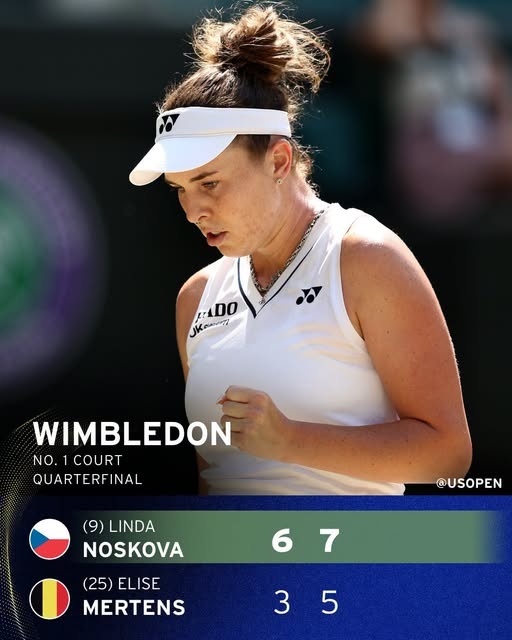
Wimbledon 2026 – Women's Quarterfinal
Final Score: Linda Nosková def. Elise Mertens 6-3, 7-5
Linda Nosková delivered one of the most technically complete performances of her young career, defeating veteran Belgian Elise Mertens in straight sets to secure a place in the Wimbledon semifinals. The scoreboard suggests a comfortable victory, but beneath the numbers was a fascinating tactical battle that highlighted Nosková's rapid evolution into one of the WTA Tour's most dangerous all-court players.
Against one of the tour's most intelligent defenders, Nosková combined explosive power with exceptional decision-making, maintaining physical intensity while making subtle technical adjustments throughout the match. According to many American tennis analysts and coaches, this type of performance reflects the qualities of a future Grand Slam champion—controlled aggression, disciplined shot selection, and the ability to elevate her level during the most important moments.
First Set: Immediate Offensive Intent
From the opening game, Nosková established herself as the aggressor.
Instead of allowing Mertens to dictate with deep, consistent rally balls, the Czech immediately attacked from inside the baseline.
Her early strategy focused on four key objectives:
- Dominate with first-serve percentage
- Attack second serves aggressively
- Take the ball early
- Keep Mertens constantly defending
The first three games demonstrated remarkable confidence. Rather than exchanging long rallies, Nosková shortened points with penetrating forehands and aggressive backhand drives.
This prevented Mertens from establishing the rhythm that has made her one of the most consistent players on tour.
Technical Ball Adjustments Throughout the Match
One of the most impressive aspects of Nosková's performance was her ability to adapt her ball characteristics depending on each situation.
1. Flatter Forehand Penetration
Instead of producing excessive topspin, Nosková consistently flattened her forehand.
On grass courts this adjustment provides several advantages:
- Faster ball speed
- Lower bounce
- Greater penetration through the court
- Less recovery time for opponents
Mertens repeatedly found herself hitting defensive shots above shoulder height despite the naturally low bounce of Wimbledon grass.
2. Earlier Contact Point
American tennis coaches frequently emphasize that elite grass-court players "steal time" from opponents.
Nosková executed this perfectly.
She stepped inside the baseline to strike the ball almost immediately after the bounce.
Benefits included:
- Reduced reaction time for Mertens
- Increased offensive opportunities
- Shorter rallies
- Constant scoreboard pressure
This adjustment became increasingly effective as the match progressed.
3. Backhand Direction Changes
Rather than exchanging predictable crosscourt rallies, Nosková frequently redirected her backhand down the line.
These sudden directional changes:
- Opened large court spaces
- Forced Mertens into awkward recovery positions
- Prevented defensive anticipation
- Created numerous forehand finishing opportunities
4. Variety in Serve Placement
Instead of relying purely on power, Nosková mixed her serve intelligently.
She alternated:
- Wide serves
- Body serves
- Flat serves down the T
- Kick second serves
This variety prevented Mertens from anticipating return patterns.
Game Adjustments That Changed the Match
Elite tennis is rarely won with one strategy.
Nosková made continuous adjustments.
Opening Phase
Her initial objective was clear:
Attack first.
She refused to become involved in defensive exchanges.
Middle of Set One
Once Mertens began extending rallies, Nosková slightly increased her topspin margin over the net.
This reduced unforced errors while maintaining offensive pressure.
Rather than hitting harder, she hit smarter.
Early Second Set
Mertens attempted to slow the tempo.
Nosková responded by approaching the net more frequently after deep approach shots.
These forward movements shortened points and prevented momentum from shifting.
Closing Stages
At 5-5 in the second set, Nosková raised her aggression again.
Instead of playing cautiously, she trusted her biggest weapons.
That confidence produced the decisive break before serving out the match.
Stamina Awareness: The Hidden Advantage
One of the biggest improvements in Nosková's game has been her physical management during long matches.
Efficient Movement
Rather than sprinting unnecessarily, she conserved energy by:
- Reading ball direction early
- Taking efficient recovery steps
- Maintaining balanced footwork
- Recovering immediately after attacking shots
This intelligent movement allowed her to remain explosive throughout both sets.
Controlled Heart Rate During Pressure
American sports performance specialists often note that elite players maintain composure by regulating their emotional intensity between points.
Nosková displayed excellent routines:
- Deep breathing
- Controlled pace between points
- Quick mental resets
- Positive body language
As pressure increased, her shot quality actually improved.
That is a hallmark of elite competitors.
Energy Conservation
Grass rewards efficient tennis.
Nosková wisely avoided unnecessary marathon rallies.
She finished points early whenever possible, preserving valuable energy for critical service games.
Crucial Points That Defined Victory
Winning Second-Serve Returns
Perhaps the biggest difference in the match was Nosková's aggression on second serves.
Instead of simply returning safely, she immediately attacked.
This consistently placed Mertens under pressure.
Break Point Execution
Championship players capitalize on limited opportunities.
Nosková converted break points with fearless first-strike tennis rather than waiting for opponent errors.
Serving Under Pressure
Late in the second set, her first serve became increasingly effective.
She consistently earned free points or weak returns that allowed immediate offensive control.
Court Position
Throughout the match she maintained excellent court positioning.
Playing inside the baseline enabled her to:
- dictate rallies
- shorten points
- redirect pace
- force defensive replies
Mertens was repeatedly pushed several feet behind the baseline.
Expert USA Tennis Analysis
From the perspective of leading U.S. tennis coaches and high-performance analysts, Nosková's victory showcased several traits associated with future Grand Slam champions.
Offensive Court Positioning
Modern tennis rewards players who control space rather than simply react.
Nosková consistently played inside the court, reducing her opponent's decision-making time and forcing errors.
Controlled Aggression
Many young players confuse power with aggression.
Nosková demonstrated the difference.
She attacked only after constructing the point correctly.
Her winners came from intelligent positioning rather than reckless shot selection.
Mental Maturity
Perhaps her greatest improvement has been emotional discipline.
After missing a shot, she immediately reset.
There were no visible signs of frustration.
Every point became independent from the previous one.
This level of mental stability is essential during Grand Slam competition.
Grass-Court Adaptation
American analysts often emphasize three essentials for Wimbledon success:
- Early ball striking
- Aggressive serving
- Forward movement
Nosková excelled in all three categories.
Her willingness to move toward the net after deep approach shots demonstrated growing tactical maturity on grass.
What Makes Linda Nosková Dangerous
At only a young age, Nosková already possesses an impressive blend of modern weapons:
- Powerful first serve
- Flat penetrating groundstrokes
- Exceptional backhand stability
- Improved volley technique
- Excellent movement
- High tennis IQ
- Tactical flexibility
- Calm under pressure
These qualities allow her to adapt against different playing styles rather than relying on one-dimensional power.
Looking Ahead
Reaching the Wimbledon semifinals marks another major milestone in Linda Nosková's development. More importantly, the manner of her victory suggests she is becoming one of the most complete players on the WTA Tour.
If she continues serving with authority, taking the ball early, and managing her stamina with the same discipline shown against Elise Mertens, she will be a formidable opponent for any player remaining in the draw. Her combination of controlled aggression, physical efficiency, and tactical awareness reflects the profile of a player capable of winning major championships in the years ahead.
Final Analysis
Linda Nosková's straight-set victory was built on intelligent adjustments rather than raw power alone. By flattening her groundstrokes, attacking second serves, varying her serve placement, and consistently taking the ball early, she denied Elise Mertens the time needed to construct points. Equally important was her stamina awareness—efficient movement, emotional composure, and energy conservation allowed her to maintain a high level from the opening game to match point.
From a U.S. high-performance tennis perspective, this performance highlighted every characteristic of a rising Grand Slam contender: tactical intelligence, disciplined aggression, physical resilience, and the confidence to execute under pressure. Wimbledon has become another stage where Linda Nosková has proven that she belongs among the elite, and her semifinal appearance may be only the beginning of a remarkable career.