
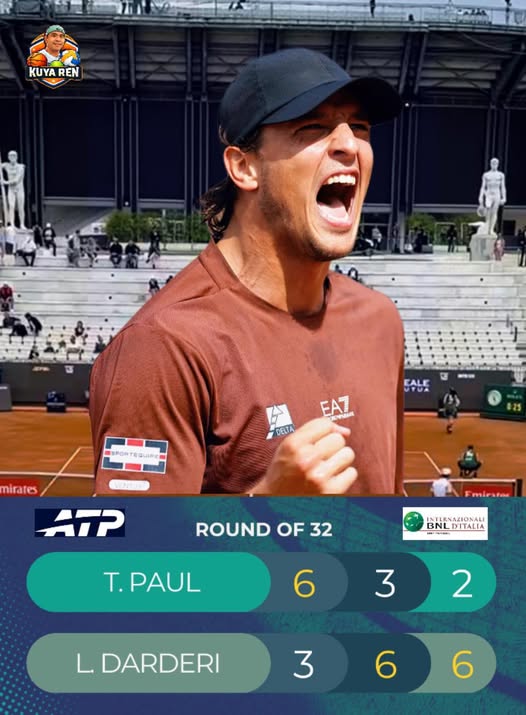
The Italian crowd inside the Foro Italico witnessed one of the most intelligent clay-court turnarounds of the tournament as Luciano Darderi stormed back from a set down to defeat Tommy Paul 3-6, 6-3, 6-2 and advance to the Round of 16 in Rome.
At first glance, the scoreline may look like a simple momentum swing. But underneath the numbers was a masterclass in tactical adaptation, emotional discipline, and clay-court problem-solving. Darderi did not overpower Paul from the beginning. Instead, he slowly read the patterns of the match, adjusted his court positioning, changed the tempo of rallies, and forced the American into uncomfortable situations.
This was not only a physical victory. It was a Tennis IQ victorye.
The match revealed how modern clay-court tennis is no longer only about endurance. It is about recognizing patterns early, understanding opponent tendencies, managing emotional momentum, and making strategic decisions under pressure.
For Darderi, this was one of the most complete wins of his young career.
The Opening Set: Tommy Paul Controlled the Tempo
Tommy Paul started the match exactly the way an experienced top-level player should on clay. He immediately attacked the middle of the court, took the ball early, and prevented Darderi from settling into long heavy-spin exchanges.
Paul’s first-set success came from three important areas:
1. Early Ball Striking
Instead of allowing Darderi time to build points, Paul stepped inside the baseline and redirected pace early. This rushed the Italian and shortened his preparation time on forehands.
On clay, taking time away from an opponent is often more important than hitting outright winners.
Paul understood this perfectly early in the match.
2. Backhand Stability
Paul’s backhand was extremely compact during the opening set. He absorbed Darderi’s heavy topspin and redirected it crosscourt with depth.
That prevented Darderi from controlling rallies with his forehand.
3. Serve Plus One Execution
Paul’s first serve placement was excellent in the first set. Rather than searching for aces, he focused on opening angles and attacking the next shot.
The American repeatedly used wide serves to drag Darderi off the court before finishing with controlled aggression.
The result was a deserved first set victory, 6-3.
At this point, many younger players would panic or overhit. But Darderi remained composed.
That emotional stability became the foundation of the comeback.
Darderi’s First Major Adjustment
The turning point began late in the first set and continued into the second.
Darderi realized he could not win by matching Paul’s flat pace from the baseline. Instead, he needed to transform the geometry of the rallies.
So he made a critical tactical adjustment:
He increased net clearance and added heavier topspinn.
This small technical shift changed everything.
Instead of driving the ball flatter through the court, Darderi began using higher looping forehands to Paul’s backhand side. On clay, those heavy balls jump aggressively after the bounce, especially on slower courts.
Suddenly, Paul’s comfortable strike zone disappeared.
The American started making contact shoulder-high instead of waist-high.
That is where the match changed strategically.
The Importance of Clay-Court Height
One of the biggest differences between elite clay-court specialists and hard-court players is understanding rally height.
Darderi slowly turned the match into a vertical battle rather than a horizontal one.
Instead of only hitting corner to corner, he attacked with trajectory and spin.
This forced Paul to:
- Hit from uncomfortable heights
- Retreat farther behind the baseline
- Generate his own pace repeatedly
- Defend longer rallies
As the rallies extended, Darderi’s confidence grew.
The Italian began controlling not just the pace, but the emotional direction of the match.
Tennis IQ: Reading Tommy Paul’s Movement Patterns
A major reason Darderi won was his ability to recognize movement tendencies.
Paul is extremely athletic, but Darderi noticed several patterns:
- Paul defended better moving laterally than moving backward
- Paul preferred redirecting pace rather than generating heavy topspin
- Paul’s forehand became less dangerous when rushed high above shoulder level
- Paul’s court position drifted deeper during long rallies
Darderi adjusted accordingly.
He stopped forcing low-percentage winners and instead constructed points patiently.
This is elite Tennis IQ:
Understanding not only where your opponent hits the ball, but where they feel uncomfortable moving.
The Forehand Evolution During the Match
Early in the match, Darderi’s forehand was rushed and inconsistent.
But after the tactical changes, it became the dominant shot on court.
Three developments transformed his forehand:
Increased Margin
Darderi stopped aiming close to the lines. Instead, he targeted heavy deep crosscourt patterns.
This reduced unforced errors dramatically.
Better Point Construction
Rather than going for winners immediately, he used the forehand to gradually push Paul wider off the court.
This opened angles later in rallies.
Inside-Out Aggression
Once Paul started defending deeper, Darderi attacked with inside-out forehands into the open court.
These patterns became increasingly difficult for Paul to defend.
By the third set, Darderi was fully dictating baseline exchanges.
Tommy Paul’s Tactical Problems
Paul’s level did not collapse completely. Instead, the match slowly moved away from his preferred style.
That distinction matters.
Darderi forced the change.
Several tactical issues emerged for Paul in the second and third sets.
1. Rally Length Increased
Paul was at his best in shorter aggressive exchanges early.
But once rallies extended beyond six or seven shots, Darderi’s heavier clay-court patterns became more effective.
2. Court Position Drifted Too Deep
Paul gradually retreated farther behind the baseline.
That gave Darderi more time to set up forehands and control spin.
3. Reduced First-Serve Effectiveness
As pressure increased, Paul’s first-serve percentage dropped.
Without easy serve-plus-one opportunities, he had to grind through longer rallies.
That favored Darderi.
4. Forehand Timing Breakdown
The higher-bouncing balls disrupted Paul’s strike timing.
His forehand lost penetration late in the match.
Emotional Momentum Shift
Clay-court matches are often emotional endurance tests.
Darderi handled this part brilliantly.
After winning the second set, the Italian became visibly more energized while Paul appeared frustrated by the changing rally dynamics.
Body language matters enormously in long matches.
Darderi projected belief.
Paul projected uncertainty.
At elite level, opponents notice emotional signals immediately.
The crowd also became a factor.
The Italian fans fed Darderi emotional energy, especially after physically demanding rallies. Every long point victory increased his momentum.
By the start of the third set, the emotional pressure had shifted entirely.
The Third Set: Complete Tactical Control
The final set was Darderi’s best tennis of the match.
Everything clicked:
- Heavy forehands
- Smart point construction
- Patient defense
- Controlled aggression
- Better court positioning
- Improved return depth
Most importantly, Darderi stopped reacting to Paul and started forcing Paul to react to him.
That is the ultimate sign of tactical control.
The Italian repeatedly opened the court with heavy crosscourt forehands before attacking into space.
Paul struggled to recover physically and tactically.
The 6-2 final set reflected complete momentum reversal.
The Hidden Key: Return Positioning
One underrated adjustment from Darderi was his return positioning.
Early in the match, he stood too close to the baseline and rushed his return timing.
Later, he adjusted deeper behind the baseline on first serves.
This gave him:
- More reaction time
- Better balance
- Cleaner contact
- Higher return consistency
Instead of trying to attack every return, he focused on neutralizing.
That tactical patience paid off.
Once rallies began, Darderi trusted his clay-court patterns to win points.
Physical Endurance and Recovery
Clay-court tennis demands elite endurance.
Darderi’s physical conditioning became increasingly important as the match progressed.
Several elements stood out:
Efficient Sliding
Darderi slid into shots naturally and recovered balance quickly.
Lower Energy Waste
Unlike earlier in the match, he stopped overhitting and conserved energy through smarter construction.
Explosive Recovery Steps
Even during long rallies, he recovered position aggressively after wide shots.
By contrast, Paul appeared to lose explosiveness late in the match.
The physical edge became obvious during extended baseline exchanges.
Why This Win Matters for Darderi
This victory was bigger than simply reaching the Round of 16.
It showed that Darderi can:
- Solve problems during matches
- Adapt tactically under pressure
- Beat high-level opponents on major stages
- Manage momentum swings emotionally
- Execute intelligent clay-court tennis
Those are qualities of players who continue rising in the rankings.
Young players often rely only on power or emotion.
Darderi showed maturity beyond his age.
Great Highlights of the Match
Highlight 1: The Momentum-Holding Service Game in the Second Set
One of the biggest moments came midway through the second set when Darderi saved pressure during a difficult service game.
Instead of panicking, he trusted heavy topspin patterns and patient rally tolerance.
Holding serve there prevented Paul from regaining momentum.
Highlight 2: The Extended 20+ Shot Rally
A brutal rally late in the second set energized the crowd and shifted emotional control completely.
Darderi defended brilliantly before turning defense into offense with a deep forehand angle.
That rally symbolized the entire tactical transformation of the match.
Highlight 3: Inside-Out Forehand Winner
One of the cleanest shots of the match came early in the third set when Darderi opened the court with crosscourt spin before finishing with a devastating inside-out forehand.
That point demonstrated his improved confidence and point construction.
Highlight 4: Crowd Energy in Rome
The atmosphere became electric as Italian fans sensed the comeback.
Every long rally amplified the pressure on Paul.
Clay tennis in Italy creates emotional intensity unlike almost anywhere else.
Darderi used that energy intelligently rather than emotionally overplaying.
Highlight 5: Closing the Match With Authority
Many young players become tight when serving for major wins.
Darderi stayed composed.
He continued playing proactive tennis instead of protecting the lead.
That mentality helped him finish strongly.
The Mental Side of the Comeback
Elite tennis is often decided mentally before technically.
Darderi’s mindset throughout the match was impressive.
He Did Not Panic After Losing the First Set
Many players abandon strategy too quickly.
Darderi stayed patient.
He Trusted Long-Term Patterns
Instead of searching for miracle winners, he trusted heavy clay-court pressure.
He Managed Crowd Energy Well
Sometimes home players become too emotional.
Darderi remained focused.
He Played the Score Intelligently
He understood when to attack and when to extend rallies.
This balance reflected advanced Tennis IQ.
Tactical Lessons for Young Tennis Players
This match offers valuable lessons for developing players.
Adaptation Wins Matches
If Plan A fails, intelligent players adjust.
Height and Spin Matter on Clay
You do not always need more power.
Sometimes more spin is the solution.
Emotional Control Creates Opportunities
Calm players recognize tactical openings better.
Patience Is a Weapon
Clay rewards players who build points intelligently.
Tennis IQ Is Trainable
Studying opponent patterns is a skill.
Darderi demonstrated this beautifully.
What This Means Moving Forward
Darderi’s performance sends a message to the rest of the field.
He is not only dangerous physically.
He is learning how to win strategically.
That combination is extremely dangerous on clay.
Players who can:
- Adjust mid-match
- Handle pressure
- Construct points intelligently
- Maintain emotional discipline
often become serious threats during the clay season.
This victory over Tommy Paul may become a defining moment in Darderi’s development.
Final Thoughts
Luciano Darderi’s comeback victory in Rome was a perfect example of modern clay-court intelligence.
After losing the first set, he did not chase reckless winners or emotionally unravel. Instead, he analyzed the match, identified tactical weaknesses, and systematically changed the direction of the battle.
His heavier topspin, deeper rally tolerance, improved return positioning, and emotional composure gradually broke Tommy Paul’s rhythm.
This was not luck.
This was adaptation.
This was Tennis IQ.
The scoreline — 3-6, 6-3, 6-2 — tells only part of the story.
The real story was how Darderi transformed the match point by point, adjustment by adjustment, until he completely controlled the emotional and tactical landscape of the court.
For fans watching in Rome, it was thrilling entertainmentte.
For coaches and players studying the game, it was a lesson in how intelligent clay-court tennis can defeat even the most athletic opponents.
And for Luciano Darderi, it may be remembered as one of the breakthrough performances that proved he belongs on the biggest stages of professional tennis.