
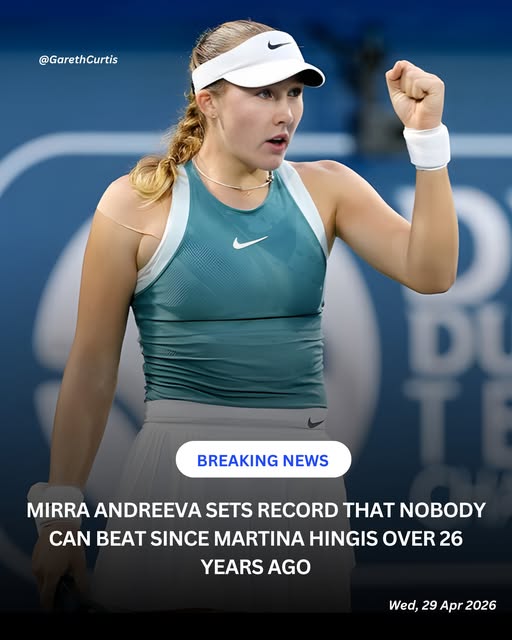
Russian teenager Mirra Andreeva has set a record that nobody can beat since Martina Hingis over 26 years ago. The 17‑year‑old sensation achieved the remarkable feat during her impressive run at the Madrid Open, becoming the youngest player in more than two decades to reach three consecutive quarter‑finals at a single Tier I/WTA‑1000 event – a milestone that had stood untouched since Hingis accomplished it in Miami between 1997 and 1999.
Part One: The Record That Nobody Could Touch for 26 Years
For more than a quarter of a century, the records of Martina Hingis seemed almost mythical. The Swiss prodigy, who turned professional at just 14, had set a benchmark for teenage success that many assumed would never be matched. Between 1997 and 1999, Hingis reached three consecutive quarter‑finals at the Miami Open, a Tier I event that was then one of the most prestigious tournaments on the women’s circuit. In 1997, she went on to claim the title, beating Monica Seles 6‑2, 6‑1 in the final. The following year, she fell to Venus Williams in the semi‑finals, and in 1999 she repeated that stage exit, this time to Serena Williams.
That record of three straight quarter‑final appearances as a teenager stood for 26 years. No player – not Serena Williams, not Maria Sharapova, not Caroline Wozniacki, not Coco Gauff – had managed to match it. Until Mirra Andreeva came along.
Andreeva, who was born in Krasnoyarsk, Siberia, first announced herself on the big stage at the age of 15, when she received a wildcard into the main draw of the Madrid Open and promptly won her first WTA Tour match against Leylah Fernandez. The following year, she reached the quarter‑finals for the first time, defeating Taylor Townsend, Linda Noskova, Marketa Vondrousova and Jasmine Paolini before falling to Aryna Sabalenka. In 2025, she returned to the quarter‑finals once again, this time losing to Coco Gauff. And in 2026, she made it three in a row, beating Panna Udvardy, Dalma Galfi, Anna Bondar and Leylah Fernandez to book her place in the last eight.
According to OptaAce, Andreeva is the youngest player since Martina Hingis to reach three consecutive quarter‑finals at a single Tier I/WTA‑1000 event – a feat that Hingis accomplished in Miami between 1997 and 1999, and which has remained unmatched for over two decades. As one report put it: "Mirra Andreeva has established a record that hasn't been achieved in the last 26 years".
Part Two: More Than One Record – A Blizzard of Milestones
The Madrid Open quickly became a festival of statistical anomalies for Andreeva. No sooner had she matched Hingis’s quarter‑final feat than she began rewriting other chapters of the tennis history books.
First, she became the first teenager to reach three WTA 1000 finals since the current format was introduced in 2009. Having already reached the championship matches in Dubai and Indian Wells in 2025 – both of which she won – she added Madrid to that list, ensuring that no player younger than 20 had ever appeared in three of the top‑tier events before.
Second, she became the youngest player to reach Tier I/WTA 1000 finals on multiple surfaces since Maria Sharapova in 2005. Sharapova achieved the feat aged 17 at the Toray Pan Pacific Open in Tokyo that year, when WTA events were still held on carpet. Andreeva has now reached WTA 1000 finals on hard courts (Dubai, Indian Wells) and on clay (Madrid).
Third, she became the youngest player since Caroline Wozniacki in 2009 to reach the Madrid Open final, cementing her place as the second‑youngest finalist in the tournament’s history.
Fourth, she recorded her 12th clay‑court victory of the season in Madrid – the most by any player on the WTA Tour in 2026. She has now won all but one of her 13 clay‑court matches this season, taking the title in Linz and reaching the semi‑finals in Stuttgart earlier in the spring campaign.
Fifth, she guaranteed that she would climb back to world No. 7 in the PIF WTA Rankings following the tournament, regardless of the result in the final. Moreover, she also became the first player to reach the last eight at Madrid twice before turning 18 since Martina Hingis did it back in 1996 and 1997.
The most remarkable numerical feat? Since the format’s introduction in 1990, only four players have recorded more Tier I/WTA 1000 wins before turning 19 than Andreeva. She reached 44 such wins in Madrid, trailing only Martina Hingis (84), Maria Sharapova (48) and Jennifer Capriati (47). That puts her in company that includes four Hall‑of‑Famers – and she has only just turned 19.
Part Three: Mirra Andreeva vs. Martina Hingis – A Statistical Comparison
With every passing match, the comparisons between Andreeva and Hingis grow louder – and for good reason. The statistical parallels between the two prodigies are striking, yet the differences in their playing styles and career trajectories reveal two distinct eras of women’s tennis.
Career Trajectory: The Age Factor
Hingis burst onto the scene at an even younger age than Andreeva. She turned professional in October 1994, shortly after her 14th birthday, and three months later became the youngest player to win a match at a Grand Slam when she reached the second round of the 1995 Australian Open. Her defining moment came at the 1997 Australian Open, where she became the youngest Grand Slam singles champion in tennis history – male or female – at 16 years and 117 days old.
Andreeva, by contrast, has followed a more measured ascent. She turned professional in 2023 and won her first WTA title at the Iasi Open in 2024 at the age of 17 years and three months – historically impressive, but not quite Hingis’s territory. Where Andreeva truly matches Hingis is in her consistency at the highest level. She became the youngest player to win back‑to‑back WTA 1000 tournaments since Hingis in 1997, taking titles in Dubai and Indian Wells.
Playing Style: Finesse vs. Power
Hingis was the ultimate finesse player – a tactical genius who relied on placement, anticipation and variation rather than raw power. Her backhand was widely considered one of the best in the history of the game, and her ability to dissect opponents’ games was almost chess‑like.
Andreeva, while certainly no brute, possesses more baseline power than Hingis ever did. She has a heavier groundstroke, a more reliable first serve, and the ability to dictate rallies from the back of the court. In Madrid, she landed 77 per cent of her first serves and won 100 per cent of those points in the first set of her semi‑final against Hailey Baptiste – statistics that Hingis, whose serve was often considered her weakest shot, could rarely match.
What they share is exceptional anticipation and court coverage. Both players possess that rare gift of being in the right place at the right time, reading their opponent’s intentions before the ball has left the strings.
Mental Strength: The X‑Factor
Where Andreeva may eventually match – or even surpass – Hingis is in her mental resilience. Hingis was famously volatile, prone to on‑court tantrums and emotional meltdowns that sometimes undermined her prodigious talent. She retired from the sport at just 22, exhausted by the pressure and the physical toll of competing with the power‑hitting generation.
Andreeva has already shown signs of the same emotional volatility. At Indian Wells earlier in 2026, she had an unsportsmanlike outburst after losing to Katerina Siniakova, and in Madrid she had a heated exchange with chair umpire Kader Nouni about an electronic line call during the semi‑final. But what distinguishes her from Hingis is her ability to channel that emotion into performance rather than letting it consume her. After her furious reaction to losing a lead against Anna Bondar, Andreeva reflected that the meltdown actually helped her refocus.
"I was not reacting a lot on the points, or on the games that I was winning," she said after beating Baptiste. "I felt like that was helping me to stay calmer, and also kind of saving energy a little bit".
Achievements at Age 19
At the age of 19, Hingis had already won five Grand Slam singles titles (Australian Open 1997, 1998, 1999; Wimbledon 1997; US Open 1997), had been ranked world No. 1 for 209 weeks, and had won 12 WTA titles including the season‑ending WTA Championships. Andreeva, by contrast, has zero Grand Slam titles, has never been ranked higher than No. 5, and has five WTA titles at the time of writing.
But this is not an apples‑to‑apples comparison. Hingis came of age in an era when the women’s tour was deeper and more competitive at the very top, but also before the physical revolution that saw players like Serena Williams, Maria Sharapova and Lindsay Davenport raise the power bar to unprecedented heights. Andreeva is competing against a generation of players – Sabalenka, Swiatek, Gauff, Rybakina – who hit the ball significantly harder than anyone Hingis faced.
What the comparison reveals is not that Andreeva is "better" or "worse" than Hingis, but that she is pursuing a different kind of greatness. Hingis was a comet – brief, brilliant and unforgettable. Andreeva has the chance to be a sun – burning steadily for much longer.
Part Four: The Madrid Run – Match by Match
Andreeva’s path to the final in Madrid was anything but straightforward. It was a testament to her mental toughness, her tactical adaptability and her ability to win even when she was not playing her best tennis.
Round One: Convincing Start
Andreeva began her campaign with a routine 7‑5, 6‑2 victory over Hungary’s Panna Udvardy. She was not broken once on serve, faced just two break‑point opportunities across the entire match, and converted three of her four break‑point chances. The win marked her eighth clay‑court victory of the season, the most by any player on the WTA Tour at that point, and her 11th career victory at the Madrid Open, tying Roland Garros for the most wins she had recorded at any WTA‑level event.
Round Two: More Hungarian Resistance
In the second round, Andreeva faced another Hungarian, qualifier Dalma Galfi. This time, the scoreline was even more emphatic: 6‑3, 6‑2. Andreeva was already beginning to find her rhythm on the Madrid clay, moving fluently and dictating points with her backhand down the line.
Round Three: The Bondar Marathon
The third round was where the real drama began. Andreeva faced Anna Bondar in a match that lasted three hours and five minutes – an epic that pushed the young Russian to the brink of elimination. After losing the first set in a tiebreak 6‑7(5), Andreeva fought back to take the second set 6‑3. The third set saw her race to a 5‑1 lead, only for Bondar to stage a remarkable comeback, winning five straight games to lead 6‑5. Andreeva saved set points, forced a final‑set tiebreak, and eventually emerged victorious 7‑6(5).
The victory came at a cost. Andreeva shed tears of relief after coming through the match, and the physical toll was evident. But she had found a way to win when she was not at her best – a hallmark of every great champion.
Quarter‑Finals: Stepping Up Against Fernandez
In the quarter‑finals, Andreeva faced a familiar opponent: Canada’s Leylah Fernandez, a former US Open finalist and a player who had beaten her in the past. Andreeva rose to the occasion, winning 7‑6(1), 6‑3 in a performance that combined power, precision and poise. The first‑set tiebreak was a masterclass – Andreeva won it 7‑1, dominating from the baseline and refusing to give Fernandez any rhythm. With that victory, she booked her place in the Madrid semi‑finals for the first time in her career.
Semi‑Finals: Saving Set Points Under Pressure
The semi‑final against Hailey Baptiste was the most dramatic match of Andreeva’s tournament – and perhaps of her career. The American, ranked 30th in the world, had just upset world No. 1 Aryna Sabalenka in the quarter‑finals, saving six match points along the way. She was playing with the confidence of a woman who had nothing to lose.
Andreeva took the first set 6‑4, serving brilliantly throughout. She won 20 of 22 points on her serve across five service games in the opening set, landing 77 per cent of her first serves and winning 100 per cent of those points.
But the second set was a different story. Andreeva broke early to lead 5‑3 and served for the match, only to double‑fault and lose her serve, allowing Baptiste to level at 5‑5. The tiebreak was a nerve‑shredding affair. Baptiste raced to a 4‑0 lead, then to 6‑4, earning two set points. Andreeva saved both – one with a lob that landed just inside the baseline, the other with an ace. At 6‑7, she faced another set point and saved it with a second ace. Finally, at 8‑7, she converted her third match point with a backhand winner down the line.
"Honestly, I feel so much adrenaline inside," Andreeva said after the match. "I'm just so happy that I won and that I was able to save all those set points. The serve helped me a lot. I'm so, so happy – I cannot really find ways to describe what I'm feeling right now".
The victory was her 12th on clay in 2026, the most by any player on the WTA Tour, and it guaranteed her a return to the Top 7 in the world rankings.
Part Five: The Final and Beyond – What Comes Next
On Saturday, Andreeva will face 26th seed Marta Kostyuk of Ukraine in the Madrid Open final – her third WTA 1000 final and her first on clay. Kostyuk advanced to her first WTA 1000 final by beating Austria’s Anastasia Potapova 6‑2, 1‑6, 6‑1 in an error‑strewn semi‑final.
Andreeva trails Kostyuk 1‑0 in their head‑to‑head record, but she has won three of her four WTA‑level meetings against Potapova, whom she would have faced had the other semi‑final gone differently.
Regardless of the outcome, Andreeva has already achieved something extraordinary. She has announced herself as a genuine contender on clay – a surface that historically rewards experience and patience, but which she has mastered with remarkable speed. Her record of 12 clay‑court wins in 2026 leads the entire WTA Tour, and her ability to save set points, come from behind and win ugly matches suggests a maturity that belies her 19 years.
The question now is not whether Andreeva will become a Grand Slam champion – she almost certainly will – but when. With the French Open just weeks away, she will head to Roland Garros as one of the favourites, carrying the weight of history on her young shoulders. The parallels with Hingis may be imperfect, but one thing is certain: Mirra Andreeva has already done what nobody has done in 26 years. And she is only just getting started.
As the tennis world watches, the Russian teenager continues to chase history, matching the Swiss legend one record at a time. Whether she can surpass her remains the most compelling question in women’s tennis today.