
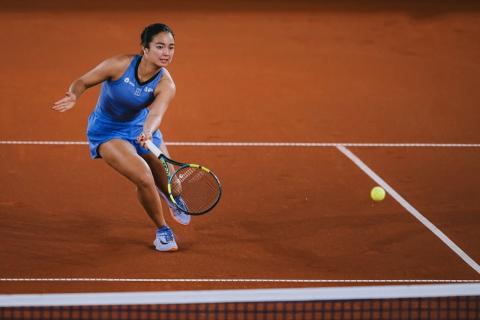
Why Clay Defines True Development
For Alex Eala, clay courts are not just a surface—they are a measuring tool of maturity. Clay removes shortcuts. It exposes decision-making, patience, and tactical discipline. Players who succeed on clay are not simply skilled; they are structured.
Eala’s growth on clay reveals how close she is to transitioning from a promising talent into a complete tour-level competitor.
Core Identity on Clay
Eala’s natural game aligns with many clay-court fundamentals:
- Left-handed spin creates uncomfortable angles
- Heavy topspin pushes opponents back
- Strong rally tolerance and defensive coverage
- Tactical awareness beyond her age
However, alignment is not mastery. The difference lies in how consistently she applies these tools under pressure.
Cross Examination of Game Maturity
1. Point Construction Discipline
Strength:
Eala understands how to build points—she rarely overhits early in rallies.
Limitation:
She sometimes abandons structure when an opportunity appears too early.
Maturity Gap:
Top clay players do not just recognize openings—they validate them before attacking.
Adjustment:
Adopt a “two-confirmation rule”:
- First: create imbalance
- Second: confirm weak reply
- Then: attack
2. Shot Selection Under Pressure
Strength:
Variety—looping forehands, angles, and controlled backhands
Limitation:
Shot tolerance drops in tight scorelines (30–30, break points)
Maturity Gap:
Elite players maintain identity under pressure; developing players change patterns.
Adjustment:
Commit to high-percentage patterns on big points:
- Crosscourt exchanges
- Deep margin shots
- Avoid low-percentage line changes
3. Court Position Awareness
Strength:
Comfortable defending from behind baseline
Limitation:
Delayed transition from defense to offense
Maturity Gap:
Clay-court experts recognize when to step in—not just how
Adjustment:
Introduce “trigger recognition”:
- Short ball inside service line → step in immediately
- Opponent off-balance → take time away
4. Use of Left-Handed Advantage
Strength:
Natural wide serve and crosscourt forehand angles
Limitation:
Underutilization in structured patterns
Maturity Gap:
Top left-handers weaponize patterns, not just shots
Adjustment:
Build repeatable patterns:
- Ad court wide serve → open court → forehand to opposite corner
- Crosscourt forehand → stretch opponent → attack next ball
5. Rally Management
Strength:
Comfortable in long exchanges
Limitation:
Neutral rallies sometimes remain neutral too long
Maturity Gap:
Clay specialists gradually increase pressure within rallies
Adjustment:
Shift from neutral → directional control:
- Add depth before adding speed
- Push opponent back before changing direction
Tactical Framework for Clay Success
Phase 1: Neutralization
- High net clearance
- Heavy topspin
- Deep targets (baseline or deeper)
Objective: Remove opponent’s ability to attack early
Phase 2: Manipulation
- Use angles to open space
- Change height and spin
- Move opponent laterally
Objective: Create imbalance without rushing
Phase 3: Controlled Aggression
- Step inside baseline
- Attack to large targets
- Avoid low-margin winners
Objective: Finish points with structure, not force
Key Adjustments for Immediate Improvement
1. Serve Development on Clay
- Focus on placement, not speed
- Use kick serve to push opponents back
- Prioritize first-ball control
Impact: Prevents immediate pressure after serve
2. Depth Consistency
Depth is more important than pace on clay.
- Aim consistently within 1–2 meters of baseline
- Reduce short balls that allow opponents to step in
3. Transition Game
Eala must improve her ability to recognize:
- When defense becomes offense
- When to step inside baseline
Simple rule:
If the ball lands short, hesitation is the mistake
4. Physical Endurance and Point Tolerance
Clay rewards:
- Patience
- Recovery speed
- Repetition of patterns
Eala already has a strong base here, but must maintain it mentally—not just physically.
Strategic Adoption: The Clay-Court Mindset
To reach higher levels, Eala must adopt a specific philosophy:
1. “Win Slowly, Not Quickly”
Clay is not about hitting through opponents—it is about outlasting and outmaneuvering them.
2. “Build Pressure Before Finishing”
Every winner should feel inevitable, not hopeful.
3. “Discomfort is the Goal”
Instead of hitting winners, create situations where opponents break down.
Comparison to Elite Clay Players
Eala’s pathway resembles early-stage development seen in players who later succeeded on clay:
- Emphasis on spin and angles
- Tactical awareness
- Need for stronger finishing patterns
The gap is not in understanding—it is in execution consistency under pressure.
Future Projection on Clay
If Eala successfully integrates these adjustments:
- She becomes dangerous against flat hitters
- She can extend rallies against power players
- She increases upset potential on slower surfaces
Without these adjustments:
- She remains competitive but struggles to close matches
- She risks being overpowered by aggressive opponents
Final Insight
Clay does not reward talent—it rewards clarity.
For Alex Eala, the next step is not adding new shots, but refining decision-making:
- When to attack
- When to wait
- When to step in
Her ceiling on clay will be defined by how well she turns structure into instinct.
That is the transition from a good player to a winning player.