A Story of a Tight Game Lost in the End
The scoreboard read 6-4, 5-7, 10-12 in the match tiebreak. Two hours and fifteen minutes. Four match points saved. One championship point lost. And the only thing the losing team could feel was the weight of a thousand small mistakes.
They did not lose because their groundstrokes were weak. They did not lose because their serves were slow. They lost because of poor volleys and a lack of focus that bled points at the worst possible moments.
This is a story that happens every weekend on tennis courts around the world. Good teams lose tight matches not because of bad technique, but because of bad timing and bad decisions. Waiting too long. Moving too early. Going without a plan.
Great doubles is about reading, timing, and trust with your partner. Fix these habits, and you will win more without changing your strokes.
The Anatomy of a Collapse: One Point That Sums It All
The final point of the match tiebreak. Their opponents served at 11-10. The return was average, landing near the service line. The net player, let us call him Player A, had a clear volley. High forehand. No pressure from the opposing net player. A simple put‑away.
But Player A waited too long.
He watched the ball bounce twice in his mind. He thought about where to place it. He hesitated. By the time he moved his racket, the ball had dropped below net level. He guided it weakly into the middle of the court. The opposing team punched it back. Player A’s partner, confused by the hesitation, moved too early and left a gap. The next volley sailed past them. Match over.
That one point captured every flaw: hesitation, poor timing, lack of trust, and a volley that died instead of attacking.
Why Poor Volleys Are Rarely About Technique
Most doubles players believe that missing a volley means they need to practice more volleys. That is often wrong. A volley is missed because:
-
You decided too late where to hit it
-
You moved your feet after the opponent hit instead of before
-
You were not balanced because you guessed instead of read
In the story above, Player A had solid volley technique in practice. But under match pressure, his decision timing collapsed. He waited to see where the opponent was moving. That is waiting too long. A volley at net must be hit before the opponent recovers. If you wait, you lose the angle.
Fix: On every volley, decide your target before the ball crosses the net. High percentage: down the middle or at the feet of the opposing net player. Do not watch the ball and decide after contact. Decide first, then execute.
Lack of Focus: The Silent Point Killer
Doubles requires constant attention. Singles players can drift between points. Doubles punishes drifting. In the tight match described, the losing team lost four points in the second set because:
-
One player looked at the scoreboard instead of the server
-
They forgot the return direction they had agreed on
-
After a long rally, both players assumed the other would cover the lob
Each of these errors came from a momentary lapse in focus. Not lack of effort. Lack of discipline.
The rule: In doubles, focus is not a feeling. It is a sequence of actions. Between every point, do the same three things: look at your partner, confirm the formation, take one deep breath. If you skip any step, you are inviting an unfocused error.
The Three Deadly Timing Mistakes
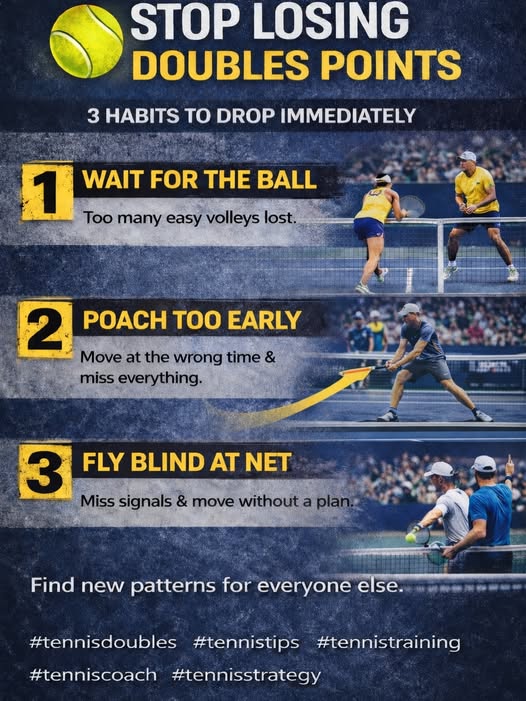
Most doubles points are lost because of timing, not talent. Let us break down the three mistakes from the story.
Mistake 1: Waiting Too Long
The net player who sees a high volley but does not move forward immediately. He waits to see if the opponent will move. He waits to see if the ball bounces. He waits to be sure. By then, the opportunity is gone.
Solution: Attack every ball above net level. Do not wait. Your job at net is to shorten time for the opponent. Every millisecond you hesitate, you give them time to recover.
Mistake 2: Moving Too Early
The partner who anticipates the cross‑court and leaves the line open. In the match tiebreak, Player A’s partner saw the weak volley and guessed that the opponent would hit down the line. He moved before the shot. The opponent saw the movement and went behind him.
Solution: Move after the opponent commits, not before. Read the racket face. In doubles, being a half‑step late is better than being a full step wrong. Trust your reaction.
Mistake 3: Going Without a Plan
The team that steps onto the court hoping to play well. They have no formation strategy. No signal system. No agreement on who takes the middle ball. Every point becomes improvisation. Improvisation breaks under pressure.
Solution: Before every match, agree on three things: your serve formation (standard or I‑formation), your return position (stay back or attack), and who calls the middle ball. Write it down if needed. A bad plan is better than no plan.
Trust: The Missing Ingredient in Tight Losses
In the final set of the story, the losing team stopped trusting each other. After missing three volleys in a row, Player A started covering his partner’s side. His partner did the same. They created a gap down the middle that the opponents exploited for five consecutive points.
Trust in doubles means:
-
You cover your zone, not your partner’s
-
You do not look back after a miss
-
You communicate between points, not during points
The moment you doubt your partner, you move out of position. That gap becomes a target. Trust is not a feeling. It is a decision. Decide to trust before the match begins, and reinforce that decision after every point, win or lose.
From Collapse to Comeback: What the Losing Team Could Have Done
The story had a sad ending, but it did not have to. Here is what they could have changed.
After the first set loss (4-6)
Instead of blaming each other, they could have said: “We are waiting too long on volleys. Let us commit to hitting every volley down the middle for the next three games.” That small adjustment would have built rhythm.
At 5-5 in the second set
Instead of each player focusing on their own errors, they could have taken 30 seconds at the changeover to breathe together. One slow inhale. One slow exhale. Then one word: “trust.” That reset would have lowered heart rates.
At 10-10 in the match tiebreak
Instead of going without a plan, they could have signaled a simple formation: both players back on the first serve, then both rush net after the return. That plan would have removed hesitation.
They did none of these things. And that is why they lost.
The Winning Blueprint: Read, Time, Trust
Great doubles is not complicated. It is three things.
Reading: Watch the opponent’s racket face at contact. That tells you direction before the ball moves. Train yourself to see the angle, not the ball.
Timing: Move after you read, not before. On volleys, decide your target before the ball arrives. On poaches, go only when the returner is committed.
Trust: Cover your zone. Communicate between points. Never look back at a miss. Your partner’s error is your next opportunity to win a point.
These three habits will win you more matches than any technique drill. Why? Because most doubles points are not lost because of bad technique. They are lost because of bad timing and bad decisions.
Final Word
The team in our story walked off the court shaking their heads. They said, “We should have won.” And they were right. They had the strokes. They had the fitness. They lost because they waited too long, moved too early, and went without a plan.
Do not be that team.
Fix your timing. Sharpen your focus. Trust your partner. Great doubles is about reading, timing, and trust. No new strokes required. Just better decisions.
The next time you step onto the court for a tight match, remember: the point is lost before the ball is struck. It is lost in the hesitation, the distraction, the doubt. Remove those, and you will win more without changing a single swing.
Now go play. Read. Time. Trust. Win.