One mission. Defend the crown. For Aryna Sabalenka, the Madrido Open was never going to be a gentle stroll through the Spanish sunshine. Clay is supposed to be the great equalizer, the surface that tames power hitters and rewards patience, touch, and tactical cunning. But someone forgot to tell the Belarusian tiger that. From the moment she stepped onto the Manolo Santana Stadium court for her first match, the path to defending her title unfolded like a war plan—every round a fresh ambush, every opponent a Grand Slam champion, a top seed, or a rising star desperate to make a name. This is the story of how Sabalenka survived a brutal clay battlefield, match by match, game by game, and why her mindset proved more lethal than any forehand.
The Weight of the Crown
Coming into Madrid as the defending champion is a double-edged sword. On one side, you carry the power confidence of having conquered the altitude and the slippery red brick before. On the other, every player in the draw has studied your game, dissected your losses, and circled your name as the ultimate scalp. Sabalenka knew this. After her breakout title in 2023, where she outlasted Iga Swiatek in a three-set final for the ages, the pressure was immense. But pressure, as she has often said, is a privilege. And this year, the draw gods offered no mercy.
The 2024 Madrid Open women’s singles bracket was a gauntlet of heavy hitters, defensive wizards, and hungry youngsters. With Swiatek, Rybakina, Gauff, and a resurgent Caroline Wozniacki all in the mix, every round promised a potential landmine. Sabalenka’s mission: survive and defend. No room for a slow start. No space for mental lapses. Just pure, unrelenting aggression tempered by the kind of tactical discipline that only a two-time Grand Slam champion can summon.
Round 1: The Rust-Buster Against a Qualifier
Every champion dreads the opening round of a title defense. The legs feel heavy, the timing just slightly off, and the opponent—often a qualifier with nothing to lose—plays with reckless freedom. Sabalenka drew Magdalena Frech, a Polish qualifier ranked outside the top 50, but one who had already won two matches just to reach the main draw. On paper, a routine win. On clay, a potential trap.
Frech’s strategy was clear: use slice, change pace movements, and drag Sabalenka into long rallies where impatience could creep in. The first three games were a chess match. Sabalenka double-faulted twice in her opening service game, a ghost of her old yips. But here was the first test of her mindset. Instead of tightening up, she roared. She broke back immediately with a series of inside-out forehands that left Frech scrambling. The key strategic adjustment: Sabalenka stopped trying to paint lines and started aiming for bigger targets with heavy topspin. On clay, the ball bounces higher, and her heavy stroke became a weapon that pushed Frech behind the baseline.
Winning the first set 6-3, Sabalenka then faced a brief rain delay. Upon return, she shifted gears. The second set became a masterclass in controlled aggression. She served 70% first serves, won 85% of those points, and attacked Frech’s second serve with venom. Final score: 6-3, 6-2. The crown still fit. But the real battle was only beginning.
Round 2: A Grand Slam Champion’s Test – Caroline Wozniacki
If the first round was a warm-up, the second was a wake-up call. Caroline Wozniacki, former Australian Open champion and one of the smartest tacticians ever to hold a racket, stood across the net. The Dane had returned from retirement and motherhood with a fire that surprised everyone. On clay, Wozniacki’s defensive skills and court coverage could suffocate any power player.
Sabalenka knew this was a mindset game more than a physical one. Wozniacki would try to extend rallies, hit angles, and force errors. The Belarusian’s strategy: take time away from the Dane by stepping inside the baseline on every short ball. No hesitation. In the first set, Sabalenka committed to the net more than in any previous clay match—eight approaches in the first five games alone. Why? Because Wozniacki’s passing shots, while accurate, lacked the pace to trouble a confident volleyer. Sabalenka had been drilling her net game with coach Anton Dubrov, and it paid off.
The turning point came at 4-4 in the first set. A 24-shot rally—Wozniacki’s dream scenario. But instead of trying to out-rally her, Sabalenka injected a drop shot off a deep backhand, then followed it with a lob that landed on the baseline. Wozniacki, caught in no-man’s land, framed her reply. Break point. On the next point, Sabalenka served and volleyed for the first time in the match, a bold declaration of intent. She took the set 6-4.
The second set was a masterclass in mental resilience. Wozniacki broke early and led 3-1. Sabalenka could have panicked. Instead, she slowed down her breathing between points, a technique she adopted after working with a sports psychologist. She visualized each serve placement. She stopped looking at her box after errors. And she started targeting Wozniacki’s forehand—the weaker wing—with high-kicking serves. The comeback was clinical: five straight games, ending with a backhand down the line winner that left Wozniacki applauding as she walked to the net. Final score: 6-4, 6-3.
Round 3: The Rising Star – Mirra Andreeva
By the third round, the body starts to feel the grind of clay. The slides, the lunges, the extra steps—it all adds up. But Sabalenka’s next opponent, 17-year-old Mirra Andreeva, had no such fatigue. The Russian prodigy had already taken out two seeds and was playing with the reckless joy of youth. Her game? A hybrid of precision and power, with a backhand that reminded many of a young Novak Djokovic.
The key to this match, for Sabalenka, was not to overpower Andreeva—because the teenager could counter-punch with ease—but to disrupt her rhythm. Andreeva thrives on predictable pace. So Sabalenka varied everything: slice backhands, moonballs, sudden drops, and then thunderous flat drives. She also employed a tactical tactic she calls “the clay shuffle”—exaggerated sideways movement before the opponent’s contact point to obscure her intended direction.
The first set was tight, with both players trading breaks. At 5-5, Sabalenka faced three break points. This was the defining moment of the match. She dug deep into her mindset toolkit: she remembered her 2023 Australian Open final collapse and recovery, remembered that she is not the same player who once let frustration boil over. She served three consecutive aces out wide to the deuce court, then finished the game with a drop-volley that Andreeva couldn’t reach. The roar that followed was primal. She broke in the next game and took the set 7-5.
The second set was a clinic in experience. Andreeva’s level dipped momentarily—a common trait in young players—and Sabalenka pounced. She won 12 of the first 14 points, racing to a 4-0 lead. The match ended 7-5, 6-2. Afterward, Sabalenka praised her young opponent but noted, “On clay, you have to earn every point. I earned them by staying patient with my aggression.”
Quarterfinal: The Rematch with Elena Rybakina
If there is one player on tour who can match Sabalenka’s power, it is Elena Rybakina. The 2022 Wimbledon champion has a serve that can touch 190 km/h and a flat groundstroke game that skids through clay like a grass-court missile. Their head-to-head was almost dead even, and every meeting felt like a heavyweight title fight.
The Madrid quarterfinal was scheduled for the night session, under lights where the ball travels even faster through the thin air. Sabalenka’s strategy was clear: she could not allow Rybakina to dictate with her serve. That meant attacking the return aggressively, standing close to the baseline, and chipping back deep slices to neutralize Rybakina’s first strike.
The first set was a tiebreak for the ages. Neither player lost serve. Sabalenka saved two set points with fearless second-serve bombs. In the tiebreak, she noticed a pattern: Rybakina was sliding wide on her backhand side, leaving the down-the-line forehand open. Sabalenka targeted that space three times in a row, winning the breaker 7-5.
The second set saw a brief dip. Sabalenka’s intensity wavered after a disputed line call, and she dropped serve twice, losing the set 3-6. But here was the ultimate mindset test: a deciding set on clay against a player who had beaten her in three previous third sets. Sabalenka walked to her chair, took a long drink, and closed her eyes. She later revealed she repeated a single phrase: “One point at a time. The past is gone.”
The third set became a lesson in risk management. Instead of going for winners from anywhere, Sabalenka constructed points. She used her forehand to push Rybakina behind the baseline, then stepped in to hit angles. She served with 68% first serves, a remarkable number for a third set. The decisive break came at 3-3, when Sabalenka chased down a drop shot, flicked a passing shot cross-court, and watched Rybakina’s lunging volley sail long. From there, she rode the momentum to a 6-3 final set. Final score: 7-6(5), 3-6, 6-3.
Semifinal: The Clay Specialist – Ons Jabeur
By the semifinals, Sabalenka’s body was screaming. Clay court matches average 20% more rallies than hard courts, and she had already spent over seven hours on court. But her next opponent, Ons Jabeur, was fresh off a straight-sets win and possessed the most varied game on tour: drop shots, lobs, slices, and an uncanny ability to wrong-foot opponents.
To beat Jabeur on clay, you cannot just hit hard. You have to anticipate. Sabalenka’s strategy was built around one tactical adjustment: she stood two meters behind the baseline to receive serve, giving herself time to read Jabeur’s trademark drop shots. Then she sprinted forward. It sounds simple, but executing it against a magician like Jabeur requires extraordinary footwork and discipline.
The first set was a chess match. Jabeur tried everything: high balls to Sabalenka’s backhand, low slices, serve-and-volley. But Sabalenka refused to be drawn into the Tunisian’s rhythm. She hit 70% of her groundstrokes cross-court, neutralizing Jabeur’s angles. And when a short ball came, she didn’t just hit a winner—she hit a winner with heavy topspin that kicked up to Jabeur’s shoulder, making the drop shot reply almost impossible. Sabalenka took the first set 6-4.
In the second set, Jabeur raised her level, breaking serve twice to lead 4-1. This was the danger zone. On clay, against a player like Jabeur, a two-break lead can feel insurmountable. But Sabalenka’s mindset shifted to “survival mode.” She stopped thinking about the score and focused entirely on each point’s pattern. She started serving more body serves to jam Jabeur’s swing. She used her kick serve to drag Jabeur off the court. Slowly, inexorably, she clawed back. The comeback was complete at 5-5, when Sabalenka hit a backhand return winner off a 170 km/h first serve. She held her nerve in the tiebreak, winning 7-3. Final score: 6-4, 7-6(3).
Final: Defending Against Iga Swiatek – The Ultimate Clay Test
And then there was one. Iga Swiatek, the queen of clay, the two-time Roland Garros champion, the woman who had not lost on red dirt in over a year. If Sabalenka wanted to defend her crown, she had to go through the very player she had beaten in the 2023 final. But this Swiatek was different: more powerful, more confident, and absolutely ruthless in Madrid all week, having dropped only 15 games en route to the final.
The final was a three-act drama. Act one: Sabalenka came out firing, breaking Swiatek’s serve in the opening game with a series of inside-in forehands. She played with a freedom that surprised even her coach. The strategy: attack Swiatek’s forehand (which, while excellent, is less reliable than her backhand) and use the serve as a weapon on the clay, which Swiatek usually neutralizes. Sabalenka took the first set 6-3.
Act two: Swiatek adjusted. She started looping her returns higher, forcing Sabalenka to hit up rather than through. The altitude of Madrid (over 600 meters) normally helps power hitters, but Swiatek used it to add even more spin, making the ball bounce above Sabalenka’s shoulder. The Belarusian’s errors multiplied. Swiatek won the second set 6-2, and the momentum had completely shifted.
Act three: The mindset championship. With the crowd roaring, Sabalenka walked to the baseline for the deciding set. She knew she could not out-rally Swiatek from the baseline. So she reverted to a high-risk, high-reward strategy: she would go for winners off any short ball, even if it meant 20 unforced errors. And she would serve-and-volley at least once per service game to keep Swiatek guessing.
The third set was a masterpiece of controlled chaos. Sabalenka broke serve immediately with a backhand return that kissed the line. She held serve with an ace, a volley, and two crushing forehands. Swiatek broke back, but Sabalenka broke again. At 4-3, serving for a 5-3 lead, Sabalenka faced three break points. This was the moment. She later said, “I told myself: you have nothing to lose. You already won here last year. Just swing.”
She swung. Ace. Forehand winner. Unreturnable serve. And then, on the third break point, a 22-shot rally that ended when Swiatek’s forehand found the net. Sabalenka roared, held serve, and broke Swiatek again to win the match 6-3, 2-6, 6-4.
The Crown Stays
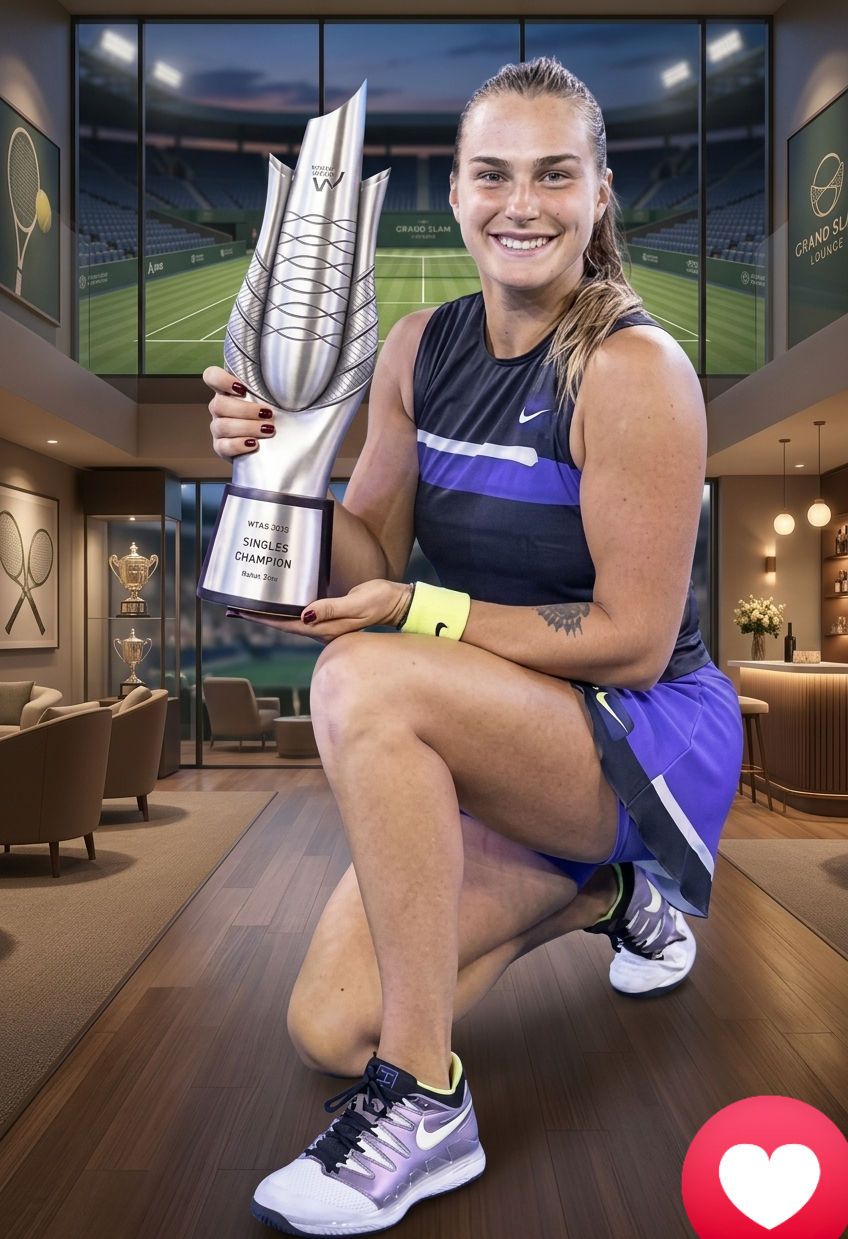
As she dropped to her knees on the clay, tears mixing with the red dust, Aryna Sabalenka had done it. She had defended her Madrid Open title through a draw that included a Grand Slam champion (Wozniacki), a rising star (Andreeva), a fellow power hitter (Rybakina), a magician (Jabeur), and the queen of clay herself (Swiatek). Every round was a brutal battlefield. Every match demanded a different strategy. But through it all, her mindset remained unbreakable.
What can we learn from Sabalenka’s path? That on surface clay, power alone is not enough. Mental power and imagination. You need patience, tactical flexibility, and the mental strength to forget the last point—whether a winner or an error. She served smarter, varied her patterns, and trusted her net game. She embraced the grind rather than fighting it. And when the pressure was highest, she did not shrink. She roared.
One mission. Defend the crown. Completed.
MadridOpen Sabalenka WTA Tennis