
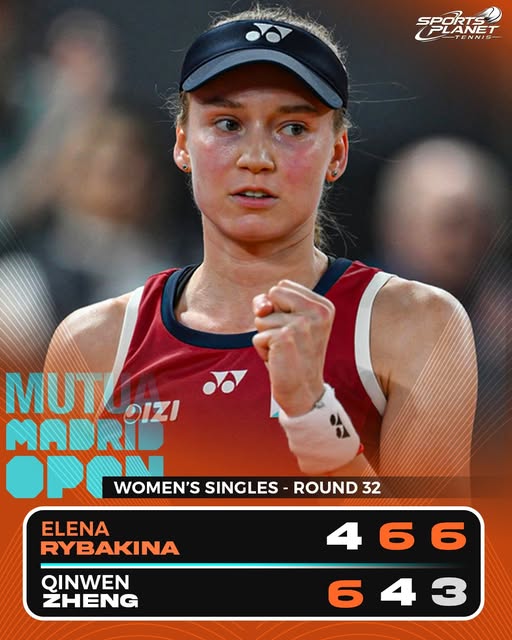
MANILA / MADRID — There is a cold, quiet kind of pressure that arrives when you are a set and a break down. The crowd starts shifting in their seats. The opponent smells blood. Your own strokes begin to feel like borrowed goods. For most players, that moment triggers a slow spiral. For Elena Rybakina, it triggers a recalibration.
The Kazakh star, former Wimbledon champion and current leader in 2026 wins, found herself in exactly that cauldron against Zheng Qinwen at the Madrid Open. Down 4-6 and an early break in the second set, Rybakina looked anything but the tour’s winningest player. Her serve was misfiring. Her forehand was landing short. Zheng, the young Chinese powerhouse, was painting lines and dictating with venom.
But the final scoreline read 4-6, 6-4, 6-3. Another comeback. Another lesson. Another testament to the most underrated skill in tennis: the ability to adjust in real time and listen to the feedback the game gives you.
The First Set: When the Game Sends a Warning
To appreciate the comeback, we have to respect what went wrong first. Zheng Qinwen played a brilliant opening set. She read Rybakina’s serve better than anyone has in weeks, stepping into the second delivery and firing returns down the line. Rybakina, by her own admission later, was “a step slow.”
But champions don’t panic. They collect data.
Every missed shot is feedback. Every pattern that Zheng successfully executed was a signal. The first set was not a disaster—it was information. Rybakina walked to her chair at 4-6 not with frustration, but with a mental checklist. Where was Zheng hurting her? Deuce-court wide serves followed by inside-out forehands. Where was Rybakina losing points? Short balls sitting up on her backhand side, allowing Zheng to run around and unleash her own heavy forehand.
That is the first rule of adjustments: you cannot fix what you do not measure. Rybakina measured.
The Turning Point: Making Micro-Adjustments That Matter
Down a break at 1-2 in the second set, Rybakina made three subtle changes that turned the match.
First adjustment: Serve location. She had been splitting her serves wide and down the T fairly evenly. Zheng was anticipating well. Rybakina started going body serve—jamming Zheng’s hips, taking away the swing path. Suddenly, Zheng’s returns became shorter and more defensive. Feedback received: the body serve works. She stayed with it.
Second adjustment: Depth on the backhand slice. Rybakina is not known as a slice artist, but she began floating deep, heavy slice cross-court to Zheng’s forehand. It didn’t look spectacular, but it forced Zheng to bend her knees and generate her own pace. The Chinese star’s error count began climbing. Another piece of feedback: Zheng struggles with low, skidding balls when she’s rushed.
Third adjustment: Return position on second serves. This was the masterstroke. Rybakina crept two feet inside the baseline on Zheng’s second deliveries. She had been standing deep, allowing Zheng time. The new position forced Zheng to look at a closer, more aggressive returner. Double faults appeared. Confidence wobbled.
These are not massive overhauls. They are surgical tweaks. And they are impossible without a mindset that treats each point as a live experiment.
The Deciding Set: When Feedback Becomes Fluency
By the third set, the match had completely inverted. Rybakina was the one dictating. Zheng, who had been so composed, was suddenly over-hitting, afraid of the body serve, and rushing her footwork. The final set score of 6-3 flattered Zheng more than Rybakina; the Kazakh could have closed it out even earlier.
What makes Rybakina’s approach special is her emotional neutrality. She does not scream or glare. She takes feedback the way a pilot reads instruments—without drama, with immediate correction. After losing her serve early in the second set, she broke back immediately, then held, then broke again. The momentum swing was not loud. It was surgical.
This is where Philippine players and coaches can learne. Too often, we see talentede juniors or club players lose matches not because they lack shots, but because they stick to a losing game plan for too long. They become stubborn instead of curious. Rybakina is ruthlessly curious. Every error is a question: “What did the ball tell me? Where should I go next?”
The Numbers That Prove the Mindset
Let us look at the cold statistics that back up this champion mentality. Rybakina’s 27th victory of 2026 leads the entire WTA tour. She has won 38 of her last 43 matches. Back-to-back comeback wins in Madrid alone. Three consecutive Round of 16 appearances at this tournament.
Those numbers are not accidents. They are the product of a player who treats every match as a seven-round boxing fight, adjusting between rounds based on feedback. Down a set? She has been there before. Down a break? She knows how to find a solution.
Zheng Qinwen is no easy out. She is a future Grand Slam contender in her own right. But on this night in Madrid, she was beaten not by a better version of Rybakina’s A-game, but by a champion who was willing to play B-plus tennis while constantly asking: “What is working right now? What isn’t? Change it.”
What Filipino Tennis Players Can Take Away
From my perspective as a tennis expert based in the Philippines, where many of our players compete on hot, slow hard courts and clay with limited coaching resources, the Rybakina model is pure gold. Adjustments do not require a coach in your ear every point. They require a mental habit: after every game, ask two questions.
First, what is my opponent doing that hurts me? Second, what is one thing I can change to make them uncomfortable?
Rybakina does this seamlessly. Against Zheng, she changed her return position, serve location, and slice depth. Three small shifts. One massive result.
We also preach the “feedback loop” in Philippine tennis clinics: hit a shot, watch the opponent’s response, learn, adjust. Too many players hit and hope. Champions hit and read. Rybakina reads the ball, the opponent’s body language, the error patterns, and she responds instantly.
The Champion Energy
Elena Rybakina is not the flashiest player on tour. She does not have Coco Gauff’s explosive athleticism or Iga Swiatek’s clay-court spin rates. What she has is a quiet, relentless commitment to problem-solving. She fights not with rage but with intelligence. She refuses to go down not because of ego but because she knows there is always another solution waiting to be triede.
As she secured her third Madrid Round of 16 with a final forehand winner, she walked to the net with the same calm expression she had at 4-6, 1-2. That composure is the ultimate competitive advantage.
The next time you find yourself down a set, remember Rybakina’s blueprint. Don’t panic. Collect feedback. Make one small adjustment. Then another. Before you know it, the match flips. And you become the player who refuses to lose.
Fighter. Warrior. Champion energy. That is Elena Rybakina. That is what adjustments and feedback look like at the highest level.
— A Philippine Tennis Expert’s View