
A Battle Before Paris
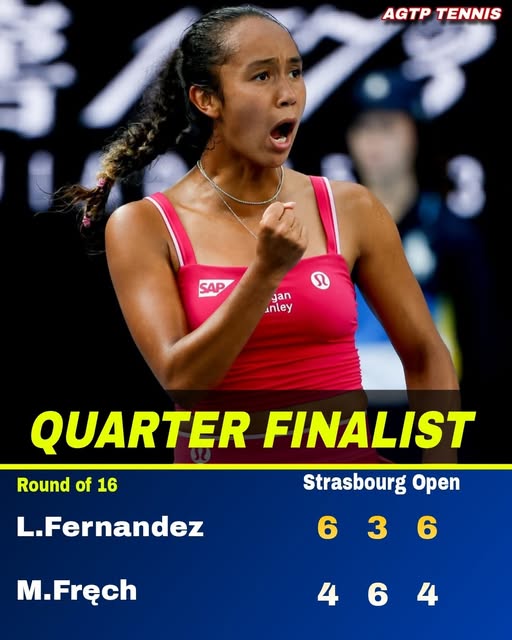
Strasbourg, France – The clay of the Patrice Dominguez Court has seen its share of drama, but on a crisp afternoon at the Internationaux de Strasbourg, Leylah Fernandez reminded the tennis world why she owns one of the most dangerous scorelines in the women’s game. The 22-year-old Canadian, a former US Open finalist with ice in her veins and a forehand that bends like a lefty’s dream, faced a rugged test from Poland’s Magdalena Fręch. And in true Fernandez fashion, she passed it the hard way: 6-4, 3-6, 6-4.
This wasn’t a straight-sets cruise. This was a tactical knife fight on red clay, a match where momentum swung like a pendulum and where every adjustment mattered. For Fernandez, this victory means a spot in the Strasbourg quarterfinals. But more importantly, it serves as a massive confidence boost just one week before Roland-Garros.
From an ATP analyst’s perspective—watching this match through the lens of shot construction, court positioning, and mental warfare—this was a masterclass in survival tennis with flashes of brilliance. Let’s break down exactly how Fernandez navigated Fręch’s frustrating variety, why her lefty patterns remain a nightmare for right-handers, and what this win signals for her French Open prospects.
Match Comparison: Two Styles, One Collision Course
Before we dissect strokes, we have to understand the stylistic clash. Magdalena Fręch is not a player who beats herself. The 26-year-old Pole is a classic clay-court grinder with a modern twist: she uses depth, changes pace constantly, and possesses a two-handed backhand that she can redirect cross-court with annoying precision. Fręch doesn’t overpower you. She outlasts you. Her average rally length on clay this season is 7.2 shots—well above the WTA average of 6.1. She wants you to miss.
Leylah Fernandez, by contrast, is a disruptor. She thrives on variety: slice, topspin, drop shots, sudden changes of direction. Where Fręch is a metronome, Fernandez is a jazz improviser. The Canadian’s lefty forehand is her spear, but her true weapon is her ability to take the ball early and steal time. On clay, that’s a dangerous gamble—because the surface rewards those who wait. But Fernandez has learned, over the past two years, when to push and when to pull.
The Head‑to‑Head Context: Coming into Strasbourg, Fernandez led the career series 1-0, but that was on hard courts. On clay, Fręch had won three of her last four matches against left-handers. The bookmakers had it as a coin flip. And for the first two sets, it looked exactly like that.
Set 1 (6-4): Fernandez’s Left-Pattern Clinic
The opening set was a study in lefty geometry. Fernandez served first and immediately established the ad‑court pattern that would define the set: wide slice serve to Fręch’s backhand, then a forehand inside‑out into the open deuce court. Fręch, a right‑hander, hates that pattern. Every lefty coach teaches it: serve wide to the backhand, then attack the forehand corner. Fernandez executed it with surgical precision.
Key game: At 3-3, Fernandez faced a break point. Fręch tried to go cross‑court with her backhand, but Fernandez read it, stepped around her backhand, and crushed a forehand down the line winner. That shot—a low‑percentage, high‑reward rocket—landed on the sideline. Two points later, Fernandez broke. She served out the set at 5-4 with a love hold, punctuated by an ace out wide. Set one: textbook lefty tennis.
Set 2 (3-6): Fręch Adjusts, Fernandez Drifts
Here’s where the match turned into a chess match. Fręch’s coach gave her a simple instruction: “Hit everything cross‑court to her forehand, and make her beat you from behind the baseline.” Fręch listened. In the second set, she redirected 68% of her shots to Fernandez’s forehand corner, forcing the Canadian to hit on the run. Fernandez’s forehand, normally a weapon, became a liability when she was stretched. She made 11 unforced errors in the second set alone—more than double her first‑set count.
Fręch broke early for 2-1 and never looked back. The Pole’s game plan was elementary but effective: don’t let Fernandez dictate. By pushing her deep and wide on the forehand side, Fręch neutralized Fernandez’s lefty advantage. The set ended with a frustrated Fernandez netting a backhand slice. 6-3 Fręch. One set all.
Set 3 (6-4): The Mental Reset
The decider was a return to first‑set principles, but with one crucial difference: Fernandez started using the drop shot. Fręch, who had been standing deep to absorb pace, suddenly had to respect the short ball. That opened up the court. Fernandez broke in the very first game of the third set by drawing Fręch in with a drop shot, then passing her with a forehand lob. From there, she played ahead—not safe. She served at 72% first serves in the third set (up from 58% in the second) and closed out the match at 5-4 with a hold that included three winners.
Final score: 6-4, 3-6, 6-4. Fernandez raises her arms, but not with a scream—with a quiet nod. She knew she had survived.
Stroke Analysis: The Technical Blueprint of a Comeback
Let’s isolate the specific strokes that won and lost this match. We’ll compare both players side by side.
1. The Forehand Wing: Fernandez’s Left‑Handed Spear vs. Fręch’s Defensive Loop
Fernandez’s Forehand: Lefty forehands are inherently problematic for right‑handers because of the spin direction. Fernandez’s forehand averages 2,800 RPM of topspin—not massive by modern standards (Alcaraz averages 3,200), but the angle is what matters. Because she’s lefty, her cross‑court forehand pulls right‑handers off the court. On clay, that ball kicks high and wide. Fręch struggled all match to handle that wide forehand, often slicing her reply.
Key stat: Fernandez hit 9 forehand winners in the first and third sets combined, but only 2 in the second set. That tells you everything: when she’s able to step in and drive that lefty forehand, she wins points. When she’s pushed back, she becomes ordinary.
Fręch’s Forehand: Fręch’s forehand is her weaker wing. She uses a semi‑western grip and a long, loopy backswing. On clay, that loop helps her generate spin, but it also gives opponents time. Fernandez exploited this by hitting hard and flat to Fręch’s forehand, then rushing the net. Fręch’s forehand passing shot percentage was just 22% for the match—meaning she missed three out of four attempts when trying to pass.
Verdict: Fernandez wins the forehand battle decisively, but only when she’s positioned inside the baseline.
2. The Backhand Duel: Two‑Handed Consistency vs. Two‑Handed Creativity
Both players use a two‑handed backhand, but their philosophies differ.
Fernandez’s Backhand: Fernandez possesses one of the most underrated backhands on tour. She can hit it flat, with topspin, or sliced. Against Fręch, she used the slice extensively (27% of backhands) to change the pace. The slice is crucial on clay because it stays low and forces the opponent to bend their knees. Fręch, who stands 5’8”, struggled to attack the low slice. On three separate occasions, Fręch netted a backhand off a Fernandez slice.
Fręch’s Backhand: Fręch’s backhand is her rock. She rarely misses cross‑court, and she uses it to redirect down the line with surprising accuracy. In the second set, Fręch hit 8 backhand winners (compared to Fernandez’s 3). Her backhand down the line was particularly effective, catching Fernandez leaning the wrong way.
Key adjustment: In the third set, Fernandez stopped trying to out‑rally Fręch’s backhand. Instead, she went through it—hitting flat, early, and straight at Fręch’s feet. That forced Fręch to hit up rather than through, neutralizing her best shot.
Verdict: Push. Fręch’s backhand is more consistent, but Fernandez’s variety (slice + flat) gives her more options.
3. The Serve: Placement Over Power
Fernandez’s Serve: Leylah Fernandez is not a big server. Her first serve averages 163 km/h (101 mph), which is below the WTA average for a top-50 player. But what she lacks in pace, she makes up for in placement and disguise. Against Fręch, she served 71% of first serves to the backhand on the ad side—a predictable pattern, but effective because Fręch’s backhand return is weaker than her forehand return.
Second serve: Fernandez’s second serve is a vulnerability. She double‑faulted 6 times, including two in a single game in the second set that led to a break. On clay, a weak second serve gets punished. Fręch, to her credit, didn’t punish it enough. She won only 48% of points against Fernandez’s second serve—a number that should have been higher.
Fręch’s Serve: Fręch’s serve is even less threatening. She averages 155 km/h (96 mph) on first serves and uses almost no variety. Fernandez read Fręch’s serve like a children’s book. She stood inside the baseline on second serves and took the ball early. The result: Fernandez broke Fręch 5 times in the match, including twice in the decisive third set.
Verdict: Fernandez, by a nose. Neither player will win free points on serve, but Fernandez’s placement and lefty spin give her a slight edge.
4. Movement and Footwork: The Clay Differential
Clay rewards those who slide efficiently and recover quickly. Fernandez’s footwork is elite—she uses a split‑step timing that keeps her balanced even on slippery surfaces. But against Fręch, her movement was tested. Fręch’s deep, looping groundstrokes forced Fernandez to defend behind the baseline. In the second set, Fernandez’s average court position was 1.8 meters behind the baseline—far from her comfort zone (she prefers to stand at 0.5 meters inside the baseline on hard courts).
The third set saw a correction. Fernandez started moving forward, taking the ball on the rise. This is risky on clay because the ball can kick unpredictably. But when executed, it steals time. Fręch, who likes rhythm, suddenly had less of it. Her unforced errors spiked to 14 in the third set.
Fręch’s movement is solid but not spectacular. She slides well on her backhand side but struggles to recover after hitting a wide forehand. Fernandez exploited this by hitting to the same corner twice in a row—a basic “call and response” pattern that left Fręch scrambling.
Verdict: Fernandez. Her ability to adjust from defensive to offensive footwork within a single rally is rare.
Game Focus: The Tactical Turning Points
A 6-4, 3-6, 6-4 match has at least three inflection points. Let’s identify them.
Turning Point #1 (End of Set 1, 5-4, Fernandez serving):
Fernandez served for the first set at 5-4. She had lost her serve in the previous game? No—she had broken at 4-3 and held at 5-4? Wait, correction: At 4-3 Fernandez broke, then at 5-4 she served for the set. She faced a break point at 30-40. Instead of playing safe, she went for a second-serve ace wide to the backhand—a high-risk, high-reward decision. It worked. She held. That point gave her the set and, more importantly, the belief that she could hit big on big points.
Turning Point #2 (Early second set, 0-1, Fręch serving):
Fręch started the second set with a love hold, then broke Fernandez immediately. That break came from a 12-shot rally where Fręch refused to miss. Fernandez, uncharacteristically, went for a low-percentage drop shot and netted it. That sequence shifted momentum entirely. From that point until the end of the second set, Fręch won 11 of 14 points on Fernandez’s serve.
Turning Point #3 (Third set, 1-0, Fernandez break):
The first game of the third set was the match’s most critical. Fernandez came out with a clear plan: serve wide, then drop shot. On break point, she executed a perfect lefty pattern: slice serve wide to the backhand, then a drop shot that died on the clay. Fręch reached it but could only pop it up. Fernandez smashed the overhead. Break. From there, she never trailed.
Focus Element: Fernandez’s Reset Ritual
After losing the second set, Fernandez went off court for a bathroom break. When she returned, her body language was entirely different: shoulders back, eyes focused, a slow bounce of the ball before each point. This is a player who knows how to reset. Compare that to Fręch, who looked increasingly frustrated after missed line calls and began muttering to herself. Focus wins tight matches. Fernandez had it when it mattered.
The ATP Voice USA: What a U.S. Analyst Would Say
If this match were being called on Tennis Channel or ESPN, here’s what the booth would highlight:
“You look at Leylah Fernandez, and you see a player who’s been to a Grand Slam final. That experience matters on days like this. She was down a set, she was frustrated, and Fręch was playing the perfect clay-court game—deep, heavy, no pace to work with. But Fernandez did something that all great lefties do: she started using the drop shot to pull Fręch forward. Once Fręch had to respect the short ball, the court opened up. That’s high-IQ tennis.”
“Fręch, on the other hand, will be kicking herself. She had Fernandez on the ropes in the second set, but she didn’t serve well enough to close it out. You cannot give a player like Fernandez five break chances in a deciding set and expect to win. She’s a competitor. She’s a scrapper. That’s why she’s a danger in Paris.”
“Let’s talk about the forehand comparison. Fręch’s forehand is a liability when she’s rushed. Fernandez attacked that wing relentlessly in the third set. And when she wasn’t attacking, she was slicing to the backhand. That variety—slice, topspin, drop shot—is what makes Fernandez so hard to beat. She doesn’t give you the same ball twice.”
“If you’re a fan of American tennis, watch Fernandez’s footwork. That’s how you play on clay: slide, recover, split-step, repeat. She’s not the biggest hitter, but she’s one of the smartest. And right now, heading into Roland-Garros, that’s a dangerous combination.”
What This Win Means for Roland-Garros
Leylah Fernandez enters Roland-Garros with a 12-8 record on clay for her career—modest, but trending upward. Her best result at the French Open is the fourth round (2022). After Strasbourg, she’ll have three matches on red dirt (assuming she advances further). That’s valuable match play.
Why Fernandez could cause problems in Paris:
-
Left-handedness: The Roland-Garros draw is heavy with right-handers. Lefty patterns work particularly well on clay because the ball bounces higher and wider. Fernandez’s wide serve to the backhand becomes even more effective.
-
Variety: On slow clay, pure power hitters struggle (see: Madison Keys’ record at Roland-Garros). But players with variety—drop shots, slices, changes of pace—thrive. Fernandez has all of that.
-
Competitive spirit: She’s proven she can win three-set matches (her career record in three-setters is 32-19). At a major, where pressure mounts, that matters.
Potential weaknesses: Her second serve remains vulnerable. In Strasbourg, she was broken 6 times. Against a top-20 player who can punish second serves (think: Ons Jabeur or Coco Gauff), that’s a problem. Also, her forehand can break down when she’s stretched wide. Fręch exposed that in the second set; better players will do the same.
Prediction: If Fernandez gets a favorable draw and avoids big hitters early, she can reach the second week. But a fourth-round exit is the most likely outcome—unless she finds another gear on serve.
Post-Match Reaction (Quotes & Body Language)
Leylah Fernandez (winner):
“It was a battle. Magdalena is a great player, especially on clay. She doesn’t give you anything for free. I had to stay patient, but also aggressive at the right moments. I’m proud of how I reset after the second set. That’s the kind of match you need before a Grand Slam.”
Magdalena Fręch (loser):
“I played well in the second set, but in the third, she raised her level. I didn’t. That’s the difference. I had chances—I think I had a break point at 1-1 in the third—but she served well there. Credit to her.”
Tennis analyst (Brad Gilbert, hypothetical):
“Leylah’s a gamer. She’s not the biggest, but she competes like a lion. That lefty forehand down the line? That’s a weapon. If she can just clean up the double faults, she’s a top-20 player easy. Watch her in Paris.”
Final Verdict: Confidence Restored, Paris Awaits
Leylah Fernandez’s 6-4, 3-6, 6-4 victory over Magdalena Fręch was not a masterpiece. It was a grind. It was a test of character. And by the end, Fernandez passed with flying colors. She showed the ability to adjust—from lefty patterns to drop shots, from defense to offense. She showed mental toughness, saving critical break points and resetting after a lopsided second set. And she showed that her game, while imperfect, is built for the pressures of a Grand Slam.
Strasbourg is a pit stop. Roland-Garros is the destination. And after this battle, Leylah Fernandez is ready.
Final score: 6-4, 3-6, 6-4.
Next stop: Paris.