
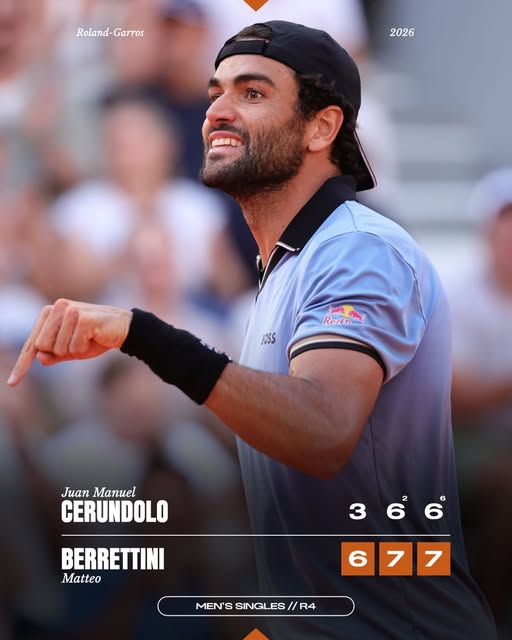
Roland Garros 2026: The Return of a Proven Champion
For the first time since the 2022 US Open, Matteo Berrettini has reached a Grand Slam quarterfinal. The achievement represents far more than another result on a tournament sheet. It is the culmination of years of perseverance through injuries, rehabilitation, ranking fluctuations, and doubts from outside observers.
Against Juan Manuel Cerúndolo at Roland Garros 2026, Berrettini displayed the complete package that once made him one of the most feared players in men's tennis. His powerful serve remained a major weapon, but what stood out most was his maturity, tactical discipline, emotional control, and ability to execute under pressure.
The 6-3, 7-6, 7-6 victory reflected a player rediscovering his highest level. More importantly, it demonstrated that Berrettini's game has evolved. He is no longer relying purely on power. He is winning with intelligence, patience, and strategic adaptation.
The Italian star is back where many believed he belonged all along: competing deep into Grand Slam tournaments.
The Foundation of Berrettini's Game Plan
Every elite player enters a match with a strategic blueprint.
Against Cerúndolo, Berrettini's game plan was built around five major objectives:
- Protect serve at all costs.
- Attack second serves.
- Shorten rallies when opportunities appeared.
- Use forehand dominance to control court positioning.
- Stay emotionally stable during tight moments.
The strategy sounds simple.
Executing it over three sets on a Grand Slam stage is much more difficult.
Berrettini understood that Cerúndolo thrives when points become physical and extended. The Argentine is comfortable constructing rallies and forcing opponents into uncomfortable movement patterns.
Rather than playing directly into those strengths, Berrettini imposed his own identity.
He consistently looked for forehand opportunities and refused to allow Cerúndolo to dictate the tempo.
This is high-level tactical tennis:
Not merely hitting harder, but deciding which patterns should dominate the match.
First Set Analysis: Immediate Authority
The opening set often determines emotional momentum.
Berrettini came out with aggressive intent.
His serving numbers immediately put pressure on Cerúndolo.
The Italian accomplished three important objectives:
Fast First-Serve Percentage
Landing first serves early allowed him to avoid long baseline exchanges.
Every free point reduced physical expenditure.
Forehand Control
Whenever Cerúndolo left the ball short, Berrettini stepped inside the baseline and unleashed his forehand.
The shot remains one of the biggest weapons in professional tennis.
Court Positioning
Berrettini refused to retreat excessively.
By maintaining offensive court positioning, he prevented Cerúndolo from finding comfortable angles.
The result was a commanding first set.
More importantly, Cerúndolo was forced to spend additional physical and mental energy searching for solutions.
Understanding Berrettini's Forehand
When discussing Berrettini's success, everything begins with his forehand.
The shot generates:
- Massive topspin
- Heavy pace
- Deep penetration
- Sharp angles
What separates his forehand from many power hitters is its versatility.
He can:
- Finish points crosscourt
- Change direction down the line
- Create short angles
- Use height and spin for safety
Against Cerúndolo, the forehand served as both offense and defense.
Even neutral balls suddenly became attacking opportunities.
Elite tennis often revolves around creating one favorable forehand.
Berrettini repeatedly achieved exactly that.
Cerúndolo's Strengths
To appreciate Berrettini's victory, one must understand the qualities of his opponent.
Juan Manuel Cerúndolo possesses several dangerous weapons:
Clay-Court Comfort
Growing up on clay has given him natural movement and point construction skills.
Consistency
He rarely gives away free points.
Defensive Ability
Cerúndolo can extend rallies and frustrate aggressive players.
Tactical Patience
He is comfortable waiting for mistakes.
Competitive Mindset
The Argentine competes hard on every point.
These strengths make him particularly dangerous on slower surfaces.
Many power players become impatient against opponents like Cerúndolo.
Berrettini did not.
Cerúndolo's Weaknesses Exploited
Every player has vulnerabilities.
Berrettini's team clearly identified key areas to target.
Serve Pressure
Cerúndolo's serve lacks the overwhelming power possessed by elite servers.
This creates opportunities on return games.
Defensive Court Position
When pushed deep behind the baseline, Cerúndolo sometimes struggles to transition back into offensive positions.
Forehand Exposure
Under heavy pace, his forehand can become less effective.
Tiebreak Pressure
Against elite power players, small mistakes in tiebreak situations become magnified.
Berrettini capitalized repeatedly.
This is where tactical intelligence becomes visible.
Winning isn't merely about playing well.
It is about forcing opponents into situations where their weaknesses become more exposed.
The Importance of the Serve
Berrettini's serve remains among the best in professional tennis.
Throughout the match, it accomplished several goals:
Free Points
Aces and unreturned serves reduce workload.
Scoreboard Pressure
Holding quickly places pressure on opponents to match.
Energy Conservation
Short service games preserve stamina.
Momentum Control
A big serve can stop an opponent's surge.
The serve acted as Berrettini's insurance policy.
Whenever Cerúndolo threatened momentum, the Italian often responded with a dominant service game.
Championship players frequently possess one shot that stabilizes pressure situations.
For Berrettini, that shot remains the serve.
Pressure Point Management
Grand Slam matches are often decided by a handful of critical moments.
Pressure points include:
- Break points
- Deuce games
- Set points
- Tiebreaks
Berrettini excelled because he simplified his decision-making process.
Rule 1: Trust the Serve
Under pressure he relied on his biggest weapon.
No hesitation.
No experimentation.
Rule 2: Attack with Conviction
Passive tennis rarely succeeds in pressure moments.
Berrettini committed fully to aggressive patterns.
Rule 3: Avoid Emotional Swings
Winning players understand that frustration helps opponents.
His body language remained composed.
Rule 4: Focus on Process
Elite competitors think:
"Execute the pattern."
Not:
"Don't miss."
This subtle difference separates champions from contenders.
Why the Tiebreaks Were So Important
The second and third sets both reached tiebreaks.
These moments revealed Berrettini's growth as a competitor.
Many players become tentative.
Berrettini became more decisive.
The Italian demonstrated:
- Better shot selection
- Clear aggression
- Emotional control
- Tactical commitment
He trusted his preparation.
He trusted his game.
And he trusted his ability to execute.
Those qualities often determine Grand Slam success.
Mental Toughness: The Hidden Weapon
Fans often focus on serves and forehands.
Yet mental toughness may have been Berrettini's greatest weapon.
After years of injury setbacks, many athletes struggle to regain confidence.
Berrettini's journey required:
- Patience
- Resilience
- Self-belief
- Daily discipline
The physical recovery is difficult.
The psychological recovery is often harder.
Every injury raises questions:
Can I still compete?
Can I trust my body?
Can I reach my previous level?
Against Cerúndolo, Berrettini answered those questions emphatically.
Stamina Adjustments Throughout the Match
Roland Garros is a test of endurance.
Even straight-set victories demand intelligent energy management.
Berrettini made several key stamina adjustments.
Efficient Service Games
Quick holds conserved energy.
Selective Aggression
He attacked the right balls rather than every ball.
Rally Management
He varied pace and trajectory to avoid unnecessary physical battles.
Recovery Between Points
His breathing and movement routines remained consistent.
These small details accumulate over a three-hour match.
Champions understand that energy is a resource.
The best players spend it wisely.
Tactical Intelligence During Long Rallies
One misconception about Berrettini is that he only wins through power.
The match demonstrated otherwise.
During extended exchanges he frequently:
- Changed height
- Altered pace
- Mixed spin levels
- Opened angles patiently
This prevented Cerúndolo from settling into rhythm.
Tactical variety is essential on clay.
Pure power rarely survives alone.
Berrettini combined aggression with intelligence.
That combination makes him dangerous.
The Evolution of Matteo Berrettini
The version of Berrettini seen in 2026 appears more complete than previous versions.
Earlier in his career he relied heavily on:
- Serve
- Forehand
- Athleticism
Now he adds:
- Tactical flexibility
- Emotional maturity
- Better point construction
- Improved patience
Experience has become a competitive advantage.
Every setback taught lessons.
Every injury forced adaptation.
Every comeback strengthened resilience.
The result is a more sophisticated player.
Why Grand Slam Experience Matters
Young players often struggle in second-week Slam matches.
Berrettini possesses invaluable experience.
He has:
- Played Slam semifinals
- Played a Wimbledon final
- Defeated elite opponents
- Experienced major pressure moments
These experiences create confidence.
When matches become tense, experience becomes a weapon.
Pressure is familiar territory.
Berrettini understands how to navigate it.
Keys to Future Success
As the tournament progresses, several factors will determine how far he can go.
First-Serve Percentage
The serve remains foundational.
Forehand Efficiency
His biggest offensive weapon must continue producing.
Physical Recovery
Recovery between matches becomes increasingly important.
Emotional Stability
Maintaining composure against elite opposition is essential.
Tactical Adaptation
Each opponent requires different solutions.
The deeper a player advances, the more complex the challenges become.
Lessons for Amateur Tennis Players
Berrettini's performance offers valuable lessons for players at every level.
Play to Your Strengths
Do not abandon your best weapon.
Have a Clear Plan
Random tennis rarely wins important matches.
Manage Energy
Smart players conserve stamina.
Stay Composed
Body language matters.
Trust Preparation
Confidence comes from preparation, not hope.
These principles apply whether competing in a Grand Slam or a local club tournament.
The Quarterfinal Mindset
Reaching a quarterfinal is an achievement.
Winning one requires another level.
Berrettini must now maintain the mentality that carried him here.
The danger after a major breakthrough is emotional relaxation.
Elite athletes avoid this trap.
The next challenge becomes the only focus.
No celebration lasts long.
No success guarantees future victories.
Champions reset quickly.
Why Tennis Fans Are Excited Again
Tennis is better when Matteo Berrettini is healthy.
His style combines:
- Explosive serving
- Huge forehands
- Charisma
- Fighting spirit
- Emotional authenticity
Fans connect with players who overcome adversity.
Berrettini's comeback story resonates because it reflects perseverance.
Many doubted whether he would return to the latter stages of Grand Slams.
Now he stands among the final contenders once again.
Conclusion: Back Where He Belongs
Matteo Berrettini's victory over Juan Manuel Cerúndolo was not merely a fourth-round win at Roland Garros 2026.
It was confirmation that one of tennis's most dangerous competitors has returned to the sport's biggest stage.
Through intelligent game planning, elite serving, disciplined forehand aggression, exceptional pressure management, and smart stamina conservation, Berrettini earned his place in the quarterfinals.
The match highlighted everything that has made him successful throughout his career:
- Power
- Tactical intelligence
- Mental resilience
- Competitive courage
Most importantly, it demonstrated that experience and adversity can create a stronger player.
After years of challenges, injuries, and uncertainty, Matteo Berrettini is once again competing in the second week of a Grand Slam.
For tennis fans around the world, the message is clear:
Matteo Berrettini is back where he belongs—and he may not be finished yet.