
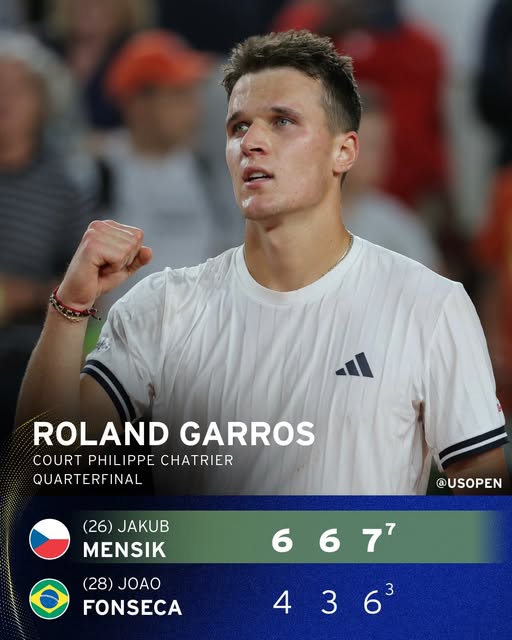
The 2026 Roland Garros quarterfinal between Jakub Mensik and Joao Fonseca showcased the future of men's tennis. Two of the sport's brightest young stars battled on Court Philippe-Chatrier, with Mensik emerging victorious 6-4, 6-3, 7-6(3). The victory propelled the Czech star into his first Grand Slam semifinal and established him as one of the most dangerous young players on the ATP Tour.
While the scoreline suggests a comfortable win, the match was far more complex. Every set featured tactical adjustments, physical battles, emotional momentum swings, and elite-level shot-making.
This analysis explores:
- Tactical game plans
- Match adjustments
- Stamina management
- Breathing techniques
- Footwork patterns
- Mental strength
- Key turning points
- Lessons for aspiring players
Match Overview
Final Score
Jakub Mensik def. Joao Fonseca
6-4, 6-3, 7-6(3)
Match Duration:
Approximately 2 hours and 44 minutes.
Jakub Mensik's Winning Formula
Mensik won because he excelled in five critical areas:
- Serve efficiency
- Neutral-ball patience
- Defensive movement
- Mental composure
- Energy conservation
Throughout the match, Mensik consistently forced Fonseca to play one extra ball.
That single extra shot often became the difference.
First Set Analysis (6-4 Mensik)
Mensik's Strategy
From the opening game, Mensik targeted three areas:
1. Deep Backhand Crosscourt
He repeatedly pinned Fonseca behind the baseline.
This prevented Fonseca from stepping inside the court and attacking.
2. High First-Serve Percentage
Mensik avoided unnecessary risks.
Rather than chasing aces, he focused on:
- Placement
- Height over the net
- Variety
3. Extended Rallies
Fonseca prefers aggressive first-strike tennis.
Mensik intentionally lengthened points.
The strategy paid off.
Fonseca's Problems
Fonseca entered the match full of confidence after defeating elite opponents during his Roland Garros run.
However, he encountered several issues:
Rushed Forehands
At times he tried to finish points too quickly.
Court Position
He stood slightly too far behind the baseline.
Timing
Mensik's heavy depth disrupted his strike zone.
The result:
Unforced errors at key moments.
Second Set Analysis (6-3 Mensik)
The second set demonstrated why Mensik is considered one of the smartest young players on tour.
Tactical Adjustment #1
Serving Wide More Frequently
Mensik noticed:
Fonseca was anticipating body serves.
The Czech player adjusted by:
- Hitting wider serves
- Opening the court
- Attacking the next ball
This created easy forehand opportunities.
Tactical Adjustment #2
Backhand Direction Changes
Instead of repeating crosscourt patterns, Mensik suddenly redirected shots down the line.
This forced Fonseca to:
- Sprint farther
- Change direction
- Defend while moving
These directional changes increased physical fatigue.
Why Fonseca Struggled
The Brazilian's explosive style became a disadvantage.
When aggressive players face opponents who absorb pace effectively:
- Shot tolerance becomes critical.
- Patience becomes critical.
- Discipline becomes critical.
Mensik possessed all three.
Third Set Analysis
The Highest Level of the Match
The final set featured elite tennis from both players.
Fonseca finally began:
- Returning deeper
- Taking balls earlier
- Attacking second serves
The pressure increased dramatically.
Several games featured spectacular rallies.
The crowd sensed a potential comeback.
Mensik's Mental Strength
Many young players panic when match points disappear.
Mensik did not.
He remained calm after failing to close earlier opportunities and elevated his level during the tiebreak.
That emotional stability ultimately won him the match.
Tiebreak Breakdown
What Mensik Did Better
First Serve
He landed crucial first serves.
Court Position
He moved forward.
Shot Selection
He avoided low-percentage winners.
Breathing Control
His breathing rhythm remained stable.
The result:
A dominant tiebreak performance.
Footwork Analysis
Footwork often determines who wins at the highest level.
Mensik's movement was exceptional.
Split Step Timing
Every elite player performs a split step.
Mensik's timing was nearly perfect.
Benefits:
- Faster reaction
- Better balance
- More explosive first step
Recovery Steps
After every shot:
- Hit
- Recover
- Reset
Mensik repeated this pattern relentlessly.
Many players recover late.
Mensik recovered immediately.
Diagonal Movement
Clay court movement differs from hard courts.
Mensik frequently moved diagonally rather than directly sideways.
Advantages:
- Less energy expenditure
- Better court coverage
- Improved balance
Fonseca's Footwork Lessons
Fonseca possesses elite athleticism.
However, several patterns hurt him.
Overcommitting Forward
He occasionally attacked before fully recovering.
Extra Steps
Some rallies required unnecessary movement.
Sliding Efficiency
Mensik slid more efficiently during defensive exchanges.
These small details accumulate over three sets.
Stamina Analysis
Physical conditioning became a major factor.
Mensik's Energy Management
Earlier in the tournament, Mensik battled physical challenges, including a collapse during extreme heat conditions before recovering strongly.
Against Fonseca, he managed energy brilliantly.
Between Points
He slowed his pace.
During Changeovers
He controlled heart rate.
During Rallies
He chose efficient movement patterns.
This preserved energy late in the match.
Breathing Patterns Used by Elite Players
One overlooked aspect of professional tennis is breathing control.
Mensik's Pattern
Before Serve
Deep inhale.
Toss Phase
Controlled breath hold.
Contact
Powerful exhale.
Benefits:
- Stability
- Relaxation
- Power generation
During Long Rallies
Mensik frequently exhaled during contact.
This helps:
- Reduce tension
- Improve timing
- Delay fatigue
Elite players train this extensively.
Why Breathing Matters
Poor breathing creates:
- Tight shoulders
- Slower feet
- Reduced focus
Good breathing creates:
- Better movement
- Better recovery
- Better decision-making
Mensik demonstrated elite breathing discipline throughout the match.
Serve Analysis
Mensik
Strengths
- High contact point
- Excellent disguise
- Wide placement
- Body serve variation
His serve frequently produced short balls.
Fonseca
Strengths
- Explosive acceleration
- Aggressive second serve
- Flat trajectory
Weaknesses
Occasionally rushed under pressure.
Mensik capitalized.
Return of Serve Analysis
Mensik's returning was underrated.
Instead of aiming for winners:
- Deep returns
- Central targets
- High margin
This forced Fonseca into longer rallies.
Mental Toughness Comparison
Mensik
Displayed:
- Emotional control
- Tactical discipline
- Confidence under pressure
These qualities often separate champions from contenders.
Fonseca
Displayed:
- Fearlessness
- Competitive fire
- Aggressive mentality
The future remains extremely bright.
His quarterfinal run included major victories and confirmed his status as one of the game's most exciting young stars.
What Fonseca Must Improve
1. Shot Tolerance
Accept longer rallies.
2. Patience
Not every ball requires attack.
3. Defensive Transitions
Recover faster after offense.
4. Energy Distribution
Avoid spending maximum energy early.
These improvements could transform him into a future Grand Slam champion.
What Makes Mensik Dangerous
Mensik combines:
- Power
- Intelligence
- Athleticism
- Composure
Many young players possess power.
Few possess patience.
Mensik possesses both.
That combination is rare.
Coaching Lessons from This Match
Club players can learn several valuable lessons.
Lesson 1
Depth beats power.
Lesson 2
Patience wins long matches.
Lesson 3
Breathing affects performance.
Lesson 4
Footwork creates opportunities.
Lesson 5
Recovery steps matter.
Training Drills Inspired by Mensik
Drill 1
Crosscourt consistency
Goal:
50 balls without error.
Drill 2
Serve + Forehand Pattern
Serve wide.
Attack next ball.
Repeat.
Drill 3
Movement Recovery Drill
Hit.
Recover.
Split step.
Repeat.
Drill 4
Breathing Rhythm Practice
Exhale at contact.
Train relaxation under pressure.
Future Outlook
Jakub Mensik
Following this breakthrough victory, Mensik established himself among the leading young players in men's tennis and earned a Grand Slam semifinal appearance.
His ceiling is extraordinarily high.
Potential future strengths:
- Top-10 ranking
- Masters titles
- Grand Slam contention
Joao Fonseca
Despite defeat, Fonseca left Paris stronger.
His wins over elite competition and quarterfinal run demonstrated world-class potential. He stated afterward that the tournament increased his belief and understanding of what is required physically and mentally at the highest level.
Future strengths:
- Explosive offense
- Elite shot-making
- Big-match mentality
Final Verdict
Jakub Mensik defeated Joao Fonseca not because he hit harder, but because he managed the match better.
His superior:
- Footwork
- Recovery patterns
- Breathing discipline
- Tactical adjustments
- Mental composure
allowed him to control the biggest moments.
Fonseca showed why he is one of the brightest young stars in tennis, but Mensik demonstrated the complete package required to win Grand Slam quarterfinals.
The future of men's tennis is in excellent hands, and this Roland Garros battle may be remembered as the first chapter of a rivalry that could define the ATP Tour for the next decade.