
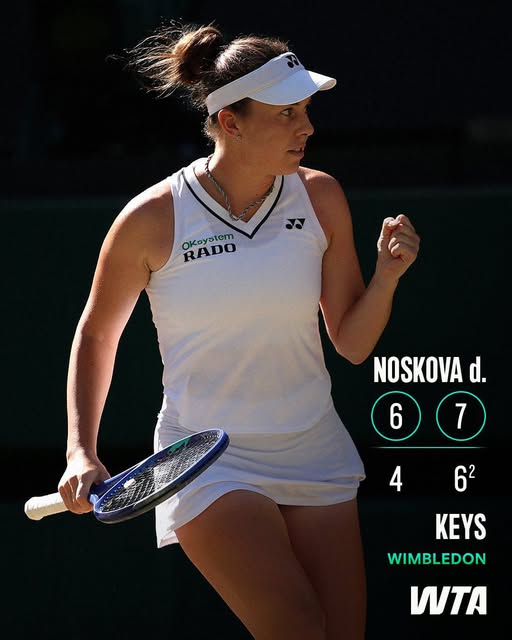
The grass courts of Wimbledon have always rewarded players who combine explosive power with intelligent shot selection. Every season introduces new stars capable of challenging the established order, but few young players have shown year-over-year development as consistently as Linda Nosková.
Her latest Wimbledon victory over Madison Keys demonstrated more than just another impressive win. It revealed a player who is learning how to control matches, solve tactical problems under pressure, and compete with the confidence expected of future Grand Slam champions.
At only a young age, Nosková already possesses many of the characteristics shared by Wimbledon champions: a powerful first serve, aggressive groundstrokes, excellent timing, improved movement, and the mental maturity to remain composed during the biggest moments.
While winning Wimbledon remains an enormous challenge requiring consistent excellence over seven matches, Nosková has developed into one of the most dangerous players in women's tennis.
From an ATP coaching perspective, her progress isn't accidental—it is the result of continuous technical refinement, tactical evolution, physical development, and increasing confidence against elite competition.
Every Season Shows Significant Improvement
One of the biggest indicators of future Grand Slam champions is steady yearly improvement rather than brief flashes of brilliance.
Nosková's game has matured in nearly every department.
Several years ago she relied heavily on raw power.
Today she combines that power with tactical intelligence.
Her evolution can be seen through several important areas.
Better Shot Selection
Earlier in her career, Nosková often attempted difficult winners from defensive positions.
Now she waits for the correct opportunity.
She builds points.
She creates angles.
She moves opponents before delivering the finishing shot.
That patience dramatically increases her consistency.
Improved Court Positioning
Today's Nosková plays much smarter.
Instead of standing several feet behind the baseline, she frequently steps forward to take the ball early.
This shortens her opponent's reaction time.
It also allows her to dictate rallies from the very first aggressive strike.
Grass rewards this style perfectly.
Better Defensive Skills
One of the biggest improvements has been her defense.
Although known as an aggressive player, Nosková now extends rallies when necessary instead of forcing low-percentage shots.
Championship players know when to attack.
They also know when to defend.
Nosková continues developing this balance.
The Mental Side Has Reached Another Level
Physical ability wins points.
Mental strength wins championships.
Nosková's composure has improved dramatically.
She rarely allows one lost point to affect the next.
Her body language remains positive.
She competes with confidence.
She embraces pressure instead of fearing it.
These qualities become increasingly important during Grand Slam tournaments where every match becomes mentally exhausting.
Calm During Pressure Moments
Elite players separate themselves by how they respond under pressure.
Championship points.
Break points.
Tie-breaks.
Momentum swings.
Nosková increasingly trusts her biggest weapons during these moments rather than becoming tentative.
That confidence reflects experience.
Emotional Control
Grass court tennis moves quickly.
Momentum can change in just two games.
Nosková demonstrates improved emotional discipline.
She avoids unnecessary frustration.
She resets quickly after mistakes.
She stays focused on the next point.
These are habits seen in Grand Slam winners.
Experience Is Becoming One of Her Greatest Assets
Experience cannot be taught overnight.
Every major tournament contributes valuable lessons.
Each match against Top 10 opponents teaches different tactical adjustments.
Nosková has accumulated increasingly valuable experience competing against elite players.
She understands different playing styles.
She recognizes patterns earlier.
She adjusts more quickly than she did only two seasons ago.
That maturity significantly raises her ceiling.
Exceptional Ability to Identify Opponents' Weaknesses
One of Nosková's most underrated strengths is her growing tactical awareness.
She processes information during matches exceptionally well.
Rather than repeating the same patterns, she constantly evaluates:
- Which return position creates more opportunities.
- Which side breaks down first.
- Which rally pattern produces short balls.
- Which serve placement earns weaker returns.
- Which defensive movement exposes open court.
This is high-level tennis intelligence.
Great players identify weaknesses.
Champions repeatedly exploit them.
Leveraging Court Position to Maximize Power
Power alone doesn't win Wimbledon.
Positioning determines whether that power becomes effective.
Nosková consistently positions herself inside the baseline whenever possible.
Doing so allows her to:
- Strike earlier.
- Reduce opponent reaction time.
- Control rally direction.
- Finish points more efficiently.
- Apply relentless pressure.
Her powerful forehand becomes significantly more dangerous because of this aggressive positioning.
The Forehand Is Becoming a Match-Winning Weapon
Nosková's forehand has evolved into one of her primary offensive weapons.
It combines:
- Heavy pace.
- Flat penetration.
- Excellent depth.
- Consistent timing.
- Directional versatility.
She comfortably attacks crosscourt before suddenly changing direction down the line.
This prevents opponents from anticipating her next shot.
Grass rewards these quick directional changes.
Backhand Stability Creates Balance
Many power players rely almost exclusively on one wing.
Nosková does not.
Her two-handed backhand has become increasingly reliable.
It withstands pressure.
It redirects pace.
It creates angles.
It absorbs power against hard hitters.
This balance prevents opponents from targeting a single weakness.
Serve Continues to Improve
Every Wimbledon champion serves effectively.
Nosková continues refining both placement and variation.
Her first serve regularly produces:
- Free points.
- Short returns.
- Offensive first-ball opportunities.
Equally important, her second serve has become more dependable, allowing her to stay aggressive without taking unnecessary risks.
Return of Serve Becoming More Aggressive
Modern champions attack second serves.
Nosková increasingly steps forward to pressure opponents immediately.
Instead of beginning rallies defensively, she often starts on offense.
That aggressive mentality shortens points while placing constant psychological pressure on opponents.
Grass Court Tennis Fits Her Natural Style
Several characteristics naturally suit grass:
- Flat groundstrokes.
- Powerful serve.
- Early ball striking.
- Aggressive court positioning.
- Quick point construction.
Nosková possesses each of these qualities.
As her movement continues improving, her effectiveness on grass should continue increasing.
Physical Development Supports Her Aggressive Style
Elite tennis demands extraordinary conditioning.
Nosková appears physically stronger each season.
She maintains stroke quality deep into long matches.
She recovers efficiently between explosive movements.
She continues producing pace late in deciding sets.
This improved endurance allows her aggressive style to remain effective throughout tournaments.
Tactical Flexibility Is Increasing
Championship players rarely rely on one strategy.
Nosková increasingly adapts depending on the opponent.
Against defensive players she increases pace.
Against aggressive hitters she redirects power.
Against big servers she improves return positioning.
Against counterpunchers she finishes points at the net.
This flexibility makes her increasingly difficult to prepare for.
Areas That Can Still Improve
Like every rising contender, Nosková still has room for growth:
- Greater consistency over seven consecutive Grand Slam matches.
- Continued improvement in transition play.
- Sharper net finishing.
- More variety with slice and drop shots.
- Even stronger second-serve reliability under pressure.
These refinements could elevate her from contender to champion.
Can Linda Nosková Win Wimbledon?
She certainly possesses many of the tools required to compete for the title:
- Elite power.
- Improved movement.
- Strong mentality.
- Tactical intelligence.
- Growing experience.
- Grass-court-compatible game.
- Ability to exploit opponents' weaknesses.
- Confidence against top-ranked players.
Winning Wimbledon also requires favorable draws, sustained health, and consistently high-level performances over two weeks. While no outcome is guaranteed, Nosková has established herself as one of the emerging players capable of making a deep run and challenging for the championship.
Final Analysis (ATP USA Voice)
Watching Linda Nosková today compared with just a few seasons ago reveals a player who has evolved well beyond raw talent. She now combines explosive shot-making with tactical maturity, emotional resilience, and a growing ability to read opponents during matches. Those qualities are the foundation of sustained success at the Grand Slam level.
What stands out most is her willingness to take the initiative. She looks to dictate rallies with early ball striking, uses intelligent court positioning to maximize her power, and has become increasingly adept at exposing an opponent's weaker wing. Rather than relying solely on pace, she is learning when to construct points patiently and when to accelerate decisively.
If she continues improving her consistency, transition game, and decision-making under the highest pressure, there is every reason to believe she can become one of the leading contenders at Wimbledon in the coming years. The tools are in place; the next step is converting that potential into a championship run on tennis's most prestigious stage.