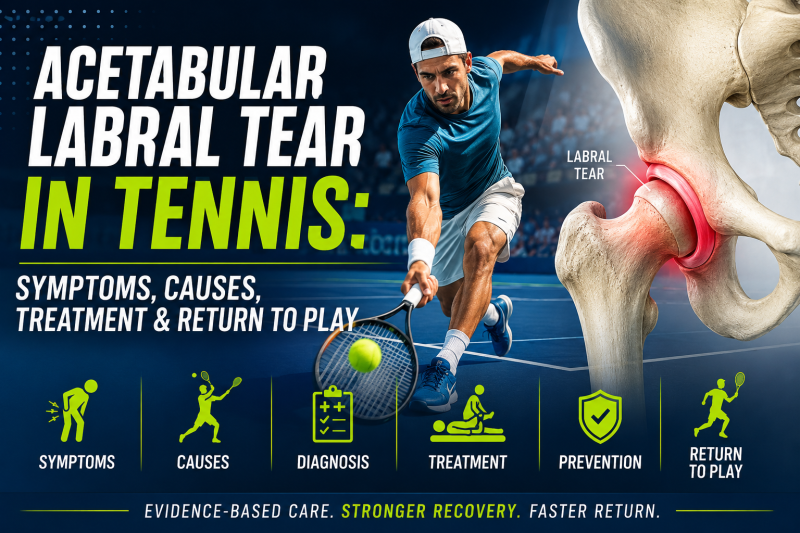
An acetabular labral tear is an injury to the ring of cartilage surrounding the hip socket (acetabulum). The labrum helps stabilize the hip joint and contributes to the joint's fluid seal.
In tennis players, repetitive pivoting, rotation, lunging, sudden changes of direction, and deep hip flexion can place substantial stress on the hip. Labral tears may occur gradually from repetitive loading or after an acute twisting movement.
A labral tear can also occur together with femoroacetabular impingement (FAI), where abnormal contact between the femur and acetabulum damages the labrum and cartilage.
Symptoms
Common symptoms include:
- Deep pain in the groin or front/side of the hip
- Sharp pain during pivoting or rotation
- Clicking, catching, or a locking sensation
- Pain when sitting for long periods
- Pain when getting up from a chair
- Discomfort during squatting or deep hip flexion
- Reduced hip range of motion
- Hip weakness or a feeling of instability
- Pain during running, lunging, or changing direction
For a tennis player, symptoms may become particularly noticeable during wide defensive lunges, open-stance shots, recovery steps, and rapid changes of direction.
Causes
Acetabular labral tears can result from several factors:
Repetitive Tennis Movements
Repeated hip rotation and loading can gradually stress the labrum.
Sudden Twisting
A forceful pivot, awkward landing, or rapid change of direction may produce an acute tear.
Femoroacetabular Impingement
Cam or pincer-type hip morphology can create abnormal contact inside the joint and contribute to labral damage.
Hip Structure
Some athletes naturally have hip anatomy that increases stress on the labrum.
Previous Hip Injury
Previous trauma or joint problems may increase the risk of developing labral pathology.
Diagnosis
A sports-medicine or orthopedic clinician will usually begin with a detailed history and physical examination.
Physical Examination
The clinician may assess:
- Hip range of motion
- Hip and core strength
- Walking and movement mechanics
- Pain with rotation and flexion
- Functional movements such as squatting and lunging
The FADIR test—flexion, adduction and internal rotation—may reproduce familiar groin pain in patients with intra-articular hip pathology. The FABER test may also be used as part of the examination.
A positive test does not by itself prove that a labral tear is present. The findings must be interpreted together with the patient's history and imaging.
Imaging
X-rays may be used to evaluate the bones and look for conditions such as femoroacetabular impingement or arthritis.
MRI or MR arthrography can provide detailed information about the labrum and surrounding cartilage. The choice between standard MRI and MR arthrography depends on the clinical situation and local specialist practice.
Treatment
Treatment depends on the severity of the tear, symptoms, hip anatomy, athletic demands, and whether other problems such as FAI or cartilage damage are present.
1. Non-Surgical Treatment
Many patients initially undergo conservative treatment.
This may include:
- Temporary reduction of painful tennis activities
- Physical therapy
- Core and lumbopelvic stabilization
- Gluteal and hip strengthening
- Improving hip mobility where appropriate
- Correcting movement and muscular imbalances
- Gradual return to tennis
- Pain-relieving medication when medically appropriate
A clinician may sometimes use an image-guided hip injection for diagnostic or therapeutic purposes.
2. Hip Arthroscopy
If significant symptoms persist despite appropriate rehabilitation, an orthopedic hip specialist may consider hip arthroscopy.
Depending on the findings, surgery may involve:
- Labral repair using suture anchors
- Selective labral debridement when tissue cannot be effectively repaired
- Treatment of associated cartilage damage
- Correction of cam or pincer morphology when femoroacetabular impingement is contributing to the problem
The goal is not simply to remove the torn tissue, but to address the underlying mechanical problem while preserving as much healthy hip tissue as possible.
Prevention
Not every acetabular labral tear can be prevented because hip anatomy can play an important role.
Tennis players can nevertheless reduce excessive hip stress by:
- Maintaining strong gluteal and core muscles
- Developing good single-leg stability
- Warming up before playing
- Progressing training volume gradually
- Avoiding sudden increases in court time
- Working on efficient lunging and recovery mechanics
- Addressing persistent hip or groin pain early
- Allowing adequate recovery between high-intensity sessions
Pain that repeatedly returns during rotation, lunging, or changes of direction should not simply be ignored.
Return to Tennis
Return to tennis should be criteria-based rather than based only on a specific number of weeks.
After non-surgical treatment, an athlete may gradually progress through:
Pain control → normal hip mobility → strength → single-leg control → running → change of direction → tennis-specific drills → practice → competitive play
After hip arthroscopy, rehabilitation commonly progresses through several stages. Early rehabilitation emphasizes protection and controlled mobility, followed by progressive strengthening and neuromuscular training. Later stages introduce running, agility, multidirectional movements, and tennis-specific drills.
Before returning to competitive tennis, the athlete should generally demonstrate:
- Minimal or no hip/groin pain
- Functional hip range of motion
- Good strength compared with the opposite side
- Good single-leg balance and control
- Ability to run and change direction without symptoms
- Ability to perform tennis-specific movements at high intensity
- Clearance from the treating medical team when surgery has been performed
Important: Recovery timelines vary considerably. A labral tear associated with FAI, cartilage injury, or surgery may require substantially longer rehabilitation than a mild symptomatic tear managed non-operatively. Return-to-play decisions should therefore be individualized by an orthopedic or sports-medicine professional.