Alexandra Eala Turns Revenge Into a Statement: Filipina Star Storms Past Oliynykova at the 2026 US Open
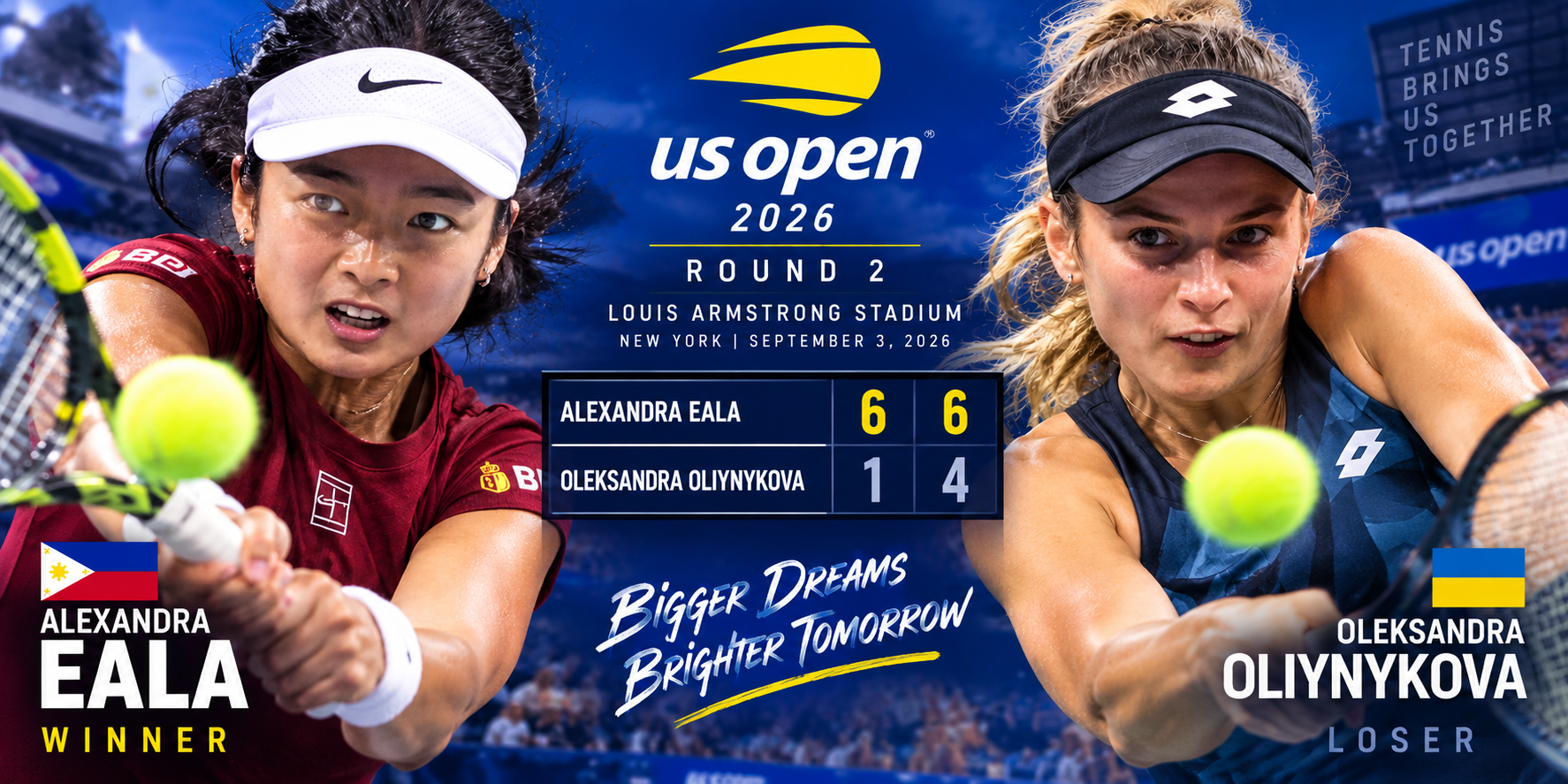
2026 US Open – Round 2 | September 3, 2026
Louis Armstrong Stadium, New York
Alexandra Eala def. Oleksandra Oliynykova, 6–1, 6–4
Match time: 1 hour, 4 minutes
There was history behind this match. There was electricity in the stands. And there was unfinished business between two players who had already gone three sets earlier this season.
But inside a roaring Louis Armstrong Stadium, Alexandra Eala didn't simply settle the score.
She flipped the script.
The No. 17 seed from the Philippines delivered one of her most convincing Grand Slam performances of the season, dismantling Ukraine's Oleksandra Oliynykova 6–1, 6–4 to reach the third round of the US Open for the first time.
And from a tennis perspective, the most impressive part wasn't just the score.
It was how Eala controlled the match.
From Strasbourg heartbreak to New York domination
Back on May 18 at the Strasbourg Open, Oliynykova had already shown Eala exactly how dangerous this matchup could be.
The Ukrainian won that Round of 32 battle 3–6, 7–5, 6–3, turning a match Eala had started strongly into a three-set comeback victory.
Four months later, the rematch had a completely different feel.
Eala came into Louis Armstrong Stadium with more experience, more confidence and a much bigger stage beneath her feet.
This time, she wasn't interested in letting the match become a long tactical chess game.
She wanted control immediately.
And she got it.
According to the official US Open report, Eala won the opening points at a furious pace and raced through the early stages of the match. She opened with a commanding lead, while Oliynykova struggled to find the timing and rhythm that had helped her win in Strasbourg.
The first set lasted only 23 minutes.
Eala took it 6–1.
Eleven winners.
Just 10 points won by Oliynykova.
That wasn't a tennis set.
That was a warning.
Eala's biggest weapon: pressure without panic
From an American tennis analyst's perspective, this was the fascinating part of Eala's performance.
She didn't play like a young player desperate to prove something.
She played like a player who already knew she belonged.
Her left-handed patterns repeatedly pushed Oliynykova into uncomfortable court positions, while Eala stayed aggressive from the baseline. She wasn't simply hitting hard—she was choosing when to accelerate.
That distinction matters.
At the professional level, power alone doesn't win matches.
Pressure does.
Eala consistently took time away from Oliynykova, forcing shorter responses and then attacking the next ball.
The statistics tell the story: Eala finished with 19 winners against 17 unforced errors, broke serve five times, and won 11 of 14 points when she came forward.
That is a very complete performance.
Then Oliynykova changed the script
But here's where the match became interesting.
A lesser player might have allowed the dominant first set to dictate the entire afternoon.
Oliynykova didn't.
She changed pace.
Instead of trying to match Eala shot-for-shot, the Ukrainian began using higher, loopier balls and taking some of the pace off her groundstrokes.
Suddenly, Eala had a different problem.
Could she stay patient?
This was the real test.
And this is where Eala showed maturity.
She didn't start forcing winners.
She didn't abandon her aggressive identity.
She adjusted.
The second set became a much more competitive battle, with both players trading breaks before Eala created the decisive separation at 4–3.
That's the mark of a player developing an increasingly sophisticated tennis IQ:
Recognize the opponent's adjustment. Absorb it. Then find the solution.
The critical 4–3 moment
At 4–3, the match was suddenly alive.
Oliynykova had managed to disrupt Eala's rhythm. The first-set demolition was no longer relevant.
This was now a pressure match.
And Eala responded by stepping forward.
She earned the key break and put herself within striking distance of the finish.
For Oliynykova, there was nowhere to hide.
For Eala, there was no reason to blink.
The Filipino star kept the pressure on and eventually earned match point.
Then came the final blow:
a service winner.
Game, set, match.
Eala 6–1, 6–4.
Revenge complete.
The tennis IQ difference
If you only look at the final score, you might think Eala simply overwhelmed Oliynykova.
The tape tells a more interesting story.
Eala won because she managed the match better.
Her biggest improvements from the Strasbourg meeting were mental and tactical.
1. She started faster
Eala didn't give Oliynykova time to settle.
That was crucial.
The first meeting became a long, physical battle. This time, Eala immediately established the terms of the match.
2. She attacked the second serve
Oliynykova landed only 50% of her first serves, giving Eala plenty of opportunities to attack second deliveries. Eala won 11 of the 18 points played behind Oliynykova's second serve.
That's exactly what a top-level returner should do.
If your opponent isn't getting enough first serves in, you make the second serve a liability.
3. She didn't overreact to the change in pace
This may have been the biggest difference from Strasbourg.
Oliynykova tried to disrupt the rhythm with looping balls and changes of speed.
Eala stayed composed.
She continued looking for the right ball rather than trying to win every exchange immediately.
That's where her patience became a weapon.
4. She used the court intelligently
Eala wasn't trapped on the baseline.
When the opportunity appeared, she moved forward.
Winning 11 of 14 net points is a strong indication that Eala wasn't relying on one-dimensional baseline tennis.
That versatility makes her much harder to scout.
The atmosphere was part of the story
Then there's the Louis Armstrong Stadium factor.
This wasn't just another US Open match.
It felt like a Filipino home game.
Thousands of fans brought Philippine flags, signs and chants into the stadium, creating an atmosphere that the official US Open described as an "Eala mania" party. Many supporters came from New York's Filipino community, including nearby Little Manila in Queens.
But here's the impressive part:
Eala didn't let the emotion become distraction.
She used it.
The crowd exploded after big points. Eala responded with focus.
The noise grew louder.
Her concentration became sharper.
That's difficult for any player, particularly on a Grand Slam stage where the attention surrounding Eala has grown dramatically.
This wasn't just revenge. It was evolution.
The Strasbourg loss mattered.
Not because Eala needed revenge.
It mattered because it gave her a blueprint of what Oliynykova could do.
Four months later, Eala returned with answers.
She served with purpose.
She attacked the second serve.
She pressured the baseline.
She handled the change of pace.
And when the match tightened in the second set, she didn't panic.
That's development.
The scoreline says Eala won.
The matchup says something bigger.
Eala learned from the first battle.
A new chapter for Eala in New York
This victory sends Eala into the third round with something that every Grand Slam contender needs:
belief backed by evidence.
Her summer has already produced major breakthroughs, including a fourth-round run at Wimbledon and a WTA title in Washington. Now she's adding another important milestone in New York: her first appearance in the US Open third round.
And that's why this run feels different.
Eala isn't simply surviving the Grand Slam environment anymore.
She's beginning to control it.
The crowds are getting bigger.
The expectations are getting louder.
The opponents are getting tougher.
And Eala keeps responding with the same message:
Give her another challenge.
On September 3, she got one from a player who had beaten her before.
This time, there was no three-set escape.
No late collapse.
No repeat of Strasbourg.
Just 64 minutes of aggressive, intelligent tennis.
Alexandra Eala 6–1, 6–4 Oleksandra Oliynykova.
Revenge?
Absolutely.
But from a tennis standpoint, this was something more important:
a statement that Alexandra Eala is becoming a much more complete Grand Slam player.