IT Band Syndrome: Quick Overview
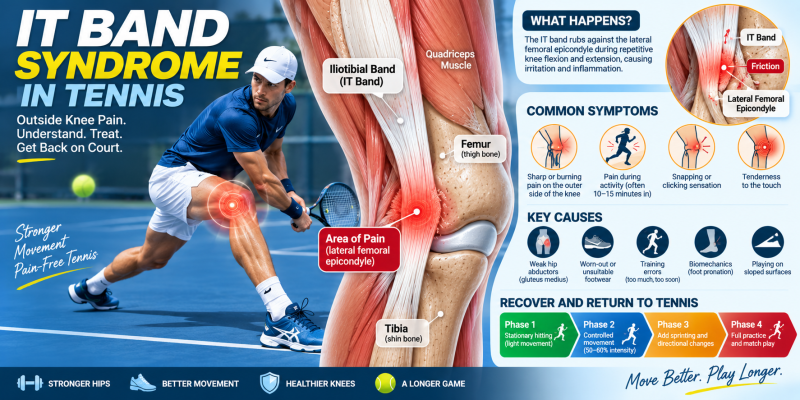
Iliotibial Band Syndrome (ITBS) is a common overuse condition that causes pain on the outside of the knee. It occurs when repeated loading of the iliotibial band and surrounding tissues produces irritation or compression near the outer part of the knee, particularly during repetitive bending and straightening.
The iliotibial band (IT band) is a strong band of connective tissue extending along the outside of the thigh from the hip region toward the upper tibia. It helps transmit forces between the hip and knee and contributes to lower-limb stability.
For tennis players, ITBS can develop because tennis repeatedly demands:
-
Explosive lateral movement
-
Sprinting and recovery steps
-
Sudden deceleration
-
Repeated lunging
-
Split steps
-
Direction changes
-
Repetitive knee flexion and extension
Tennis doctor perspective: Outside knee pain that repeatedly appears during court movement should not automatically be dismissed as a simple "tight IT band." Other conditions—including meniscus, LCL, tendon, and bone injuries—can produce similar symptoms.
IT Band Syndrome Symptoms
1. Pain on the Outside of the Knee
The most characteristic symptom is pain around the lateral side of the knee, often near the outer femoral epicondyle.
Players may describe the pain as:
-
Sharp
-
Burning
-
Aching
-
Stabbing
2. Pain During Tennis
Symptoms may initially appear only after several minutes of activity.
A player might begin practice feeling normal and then develop lateral knee pain as the session continues.
3. Pain With Repetitive Movement
Activities involving repeated knee bending and straightening can aggravate symptoms.
For tennis players, this may include:
-
Baseline rallies
-
Sprinting
-
Repeated recovery steps
-
Defensive scrambling
-
Lateral shuffling
4. Pain With Downhill Running
Downhill running can increase symptoms because of the greater knee flexion demands.
While this is more commonly discussed in runners, it can also help reveal an underlying lateral-knee loading problem in athletes.
5. Clicking or Snapping Sensation
Some athletes report a snapping or clicking sensation around the outside of the knee.
However, clicking is not specific to ITBS, so persistent mechanical symptoms should be evaluated rather than automatically attributed to the IT band.
6. Local Tenderness
Tenderness may be present around the outer knee, particularly near the lateral femoral epicondyle.
What Causes IT Band Syndrome in Tennis Players?
ITBS usually develops when repetitive loading exceeds the body's ability to adapt and recover.
Repetitive Court Movement
Tennis players perform hundreds or thousands of repeated movements during training and competition.
Constant:
Load → bend → push → recover → change direction
can gradually irritate the tissues around the lateral knee.
Weak or Poorly Controlled Hip Muscles
Hip muscle weakness or poor neuromuscular control may contribute to excessive movement of the thigh and knee during running and cutting.
Important muscles include:
-
Gluteus medius
-
Gluteus maximus
-
Hip abductors
-
Deep hip stabilizers
-
Core musculature
The goal is not simply to make these muscles "strong"; they need to control the pelvis and leg effectively during high-speed tennis movements.
Training Errors
One of the most common contributors is a sudden increase in workload.
Examples include:
-
Playing more matches
-
Adding additional training days
-
Increasing court time
-
Suddenly increasing sprinting
-
Returning too quickly after a break
-
Beginning tournament preparation too aggressively
Foot and Lower-Limb Mechanics
Foot pronation and other biomechanical factors may influence how forces travel through the lower limb.
However, biomechanics should be assessed individually rather than assuming that one foot type is the cause of ITBS.
Worn Tennis Shoes
Tennis shoes gradually lose their cushioning, traction, and structural support.
A worn shoe can alter movement mechanics and may contribute to excessive lower-limb loading.
Court Surface
Playing consistently on surfaces with unusual slope or banking may alter lower-limb loading.
This is less relevant to most standard tennis courts but can become important when athletes repeatedly train on non-level surfaces.
How Is IT Band Syndrome Diagnosed?
ITBS is primarily a clinical diagnosis.
A sports medicine physician, physical therapist, or other qualified clinician will evaluate:
-
Exact pain location
-
Activity-related symptoms
-
Hip strength
-
Knee movement
-
Running mechanics
-
Single-leg control
-
Foot mechanics
-
Range of motion
-
Other possible causes of lateral knee pain
Physical Examination
The clinician may palpate the area around the lateral femoral epicondyle and assess how symptoms change with controlled knee movement.
Noble Compression Test
The Noble compression test may be used as part of the clinical examination.
Pain reproduced around the lateral knee during the maneuver can support the diagnosis, but no single special test should be considered definitive by itself.
Ober Test
The Ober test may be used to assess the movement of the hip and lateral soft tissues.
It should be interpreted as part of the complete examination rather than as a standalone diagnostic test for ITBS.
Does IT Band Syndrome Need an MRI?
Usually, not for a straightforward case.
Imaging may become appropriate when:
-
Symptoms are unusually severe
-
The diagnosis is uncertain
-
Conservative treatment fails
-
There was significant trauma
-
Mechanical symptoms are present
-
Another injury is suspected
MRI or X-ray may help evaluate other causes of lateral knee pain, including:
-
Meniscus injury
-
LCL injury
-
Stress fracture
-
Osteochondral injury
-
Arthritis
-
Other soft-tissue conditions
IT Band Syndrome Treatment
The primary goal is to reduce aggravating loads while restoring the capacity of the hip, knee, and lower limb to handle tennis movement.
1. Relative Rest
You do not necessarily need to stop all physical activity.
Instead, temporarily reduce movements that repeatedly reproduce your symptoms.
For a tennis player, this may mean reducing:
-
Full-court scrambling
-
Sprinting
-
Aggressive lateral movement
-
Repeated defensive drills
-
Long hitting sessions
Low-impact exercise can often be maintained if it does not aggravate symptoms.
2. Ice for Symptom Relief
Ice after activity may provide temporary relief during an acute flare.
It is best viewed as a symptom-management strategy, not the primary treatment for the underlying movement or loading problem.
3. Hip and Core Strengthening
Rehabilitation commonly emphasizes:
-
Gluteus medius strengthening
-
Gluteus maximus strengthening
-
Hip abductor exercises
-
Single-leg control
-
Core stability
-
Progressive lower-limb strengthening
Useful exercises may include:
-
Lateral band walks
-
Side-lying hip abduction
-
Step-downs
-
Single-leg bridges
-
Controlled single-leg squats
-
Split squats
-
Loaded carries
Exercises should progress from controlled movements to tennis-specific loading.
4. Improve Movement Mechanics
Strength alone is not enough.
A tennis player should learn to control the pelvis, hip, knee, and foot during:
Split step → acceleration → deceleration → lateral movement → recovery
This is particularly important before returning to high-intensity court play.
5. Soft-Tissue Work
Massage, manual therapy, or other soft-tissue techniques may temporarily reduce discomfort or improve movement.
Foam rolling can be used around the gluteal muscles, tensor fasciae latae, and surrounding musculature when appropriate.
Aggressively rolling directly over a painful IT band is not necessary and may irritate an already sensitive area.
6. Medication
NSAIDs may sometimes be used for short-term pain management when medically appropriate.
They should be used according to professional guidance, particularly for athletes with medical conditions or medications that may make NSAIDs inappropriate.
Can You Play Tennis With IT Band Syndrome?
Sometimes, but the answer depends on symptom severity and your ability to modify the workload.
A player with mild symptoms may be able to perform modified tennis while beginning rehabilitation.
However, repeatedly pushing through increasing lateral knee pain is not a good long-term strategy.
If your pain consistently becomes worse as the session continues or is significantly worse afterward, your current workload may be exceeding your capacity.
Tennis doctor rule: If you cannot control your lateral movement without pain, don't test the knee by repeatedly performing the exact movement that provokes it.
IT Band Syndrome Prevention
Build Hip Strength
Maintain regular conditioning for:
-
Gluteus medius
-
Gluteus maximus
-
Hip abductors
-
Core muscles
Progress Training Gradually
Avoid sudden increases in:
-
Court hours
-
Match frequency
-
Sprinting
-
Footwork drills
-
Tournament workload
A gradual increase gives the body time to adapt.
Maintain Tennis Footwork
Efficient footwork can reduce awkward reaching and uncontrolled deceleration.
Practice:
-
Split-step timing
-
Lateral shuffling
-
Crossover steps
-
Controlled braking
-
Recovery positioning
Replace Worn Tennis Shoes
Monitor your tennis shoes for:
-
Loss of traction
-
Flattened cushioning
-
Excessive outsole wear
-
Reduced lateral stability
-
Structural breakdown
Don't Ignore Early Symptoms
Early lateral knee discomfort is easier to manage than a problem that has progressed through repeated high-load sessions.
Return to Tennis After IT Band Syndrome
Returning to tennis should be progressive and symptom-guided.
Before returning to full-intensity competition, you should ideally be able to:
-
Walk comfortably
-
Climb and descend stairs without significant pain
-
Perform controlled squats
-
Perform a lateral lunge comfortably
-
Jog without increasing symptoms
-
Perform single-leg exercises with good control
-
Accelerate and decelerate without significant pain
-
Perform lateral movement without apprehension
Tennis-Specific Return-to-Play Progression
Phase 1 — Stationary Tennis
Begin with:
-
Stationary hitting
-
Light feeding
-
Mini-tennis
-
Minimal lateral movement
The objective is to reintroduce racket and ball activity without excessive knee loading.
Phase 2 — Controlled Court Movement
Introduce:
-
Short lateral movements
-
Controlled recovery steps
-
Light baseline movement
-
Low-intensity rallies
Keep the intensity around 50–60% initially, depending on symptoms and rehabilitation status.
Phase 3 — Dynamic Tennis Movement
Progress toward:
-
Wider balls
-
Faster lateral shuffling
-
Acceleration
-
Deceleration
-
Direction changes
-
More realistic baseline movement
Increase only one or two variables at a time—such as duration, intensity, or movement range.
Phase 4 — Match Preparation
Introduce:
-
Point construction
-
Controlled points
-
Practice sets
-
Higher-intensity movement
-
Full-court drills
Competitive match play should come after the knee has demonstrated that it can tolerate repeated multidirectional movement.
The 24-Hour Tennis Test
One of the best ways to monitor your return is to evaluate the knee during the session, immediately afterward, and the following morning.
If the knee remains comfortable during activity but becomes substantially more painful later that day or the next morning, the workload may have progressed too quickly.
A small, stable level of symptoms may be acceptable in some rehabilitation programs, but progressively increasing pain is a signal to reduce the load and reassess.
IT Band Syndrome vs. Other Causes of Outside Knee Pain
Not every case of lateral knee pain is ITBS.
| Condition | Possible Clues |
|---|---|
| IT Band Syndrome | Activity-related pain on the outside of the knee |
| Lateral Meniscus Injury | Joint-line pain, catching, locking or twisting pain |
| LCL Sprain | Pain after trauma or force applied to the outer knee |
| Patellofemoral Pain | Pain around or behind the kneecap |
| Stress Injury | Increasing pain with impact or weight-bearing |
| Tendon Problems | Localized pain associated with specific loading |
A proper examination is important when symptoms do not follow a typical ITBS pattern.
When Should a Tennis Player See a Doctor?
Seek medical evaluation if you experience:
-
Severe lateral knee pain
-
Significant swelling
-
Inability to bear weight
-
Knee instability
-
Locking or repeated catching
-
Pain following a significant collision or twisting injury
-
Pain at rest or during the night
-
Persistent symptoms despite reducing activity
-
Symptoms that continue to worsen
A sudden traumatic knee injury should not automatically be labeled IT Band Syndrome.
Tennis Doctor's Bottom Line
IT Band Syndrome can be frustrating for tennis players because the athlete may feel perfectly capable of playing at the beginning of a session, only to develop increasing pain after repeated lateral movement.
The answer is rarely simply "stretch the IT band."
A successful recovery usually requires a combination of appropriate load management, hip and lower-limb strengthening, movement retraining, gradual exposure to tennis-specific demands, and correction of relevant training or equipment factors.
The ultimate goal is not merely to eliminate pain while resting.
The goal is to build a knee and lower limb capable of repeatedly handling the demands of tennis:
Split step → sprint → brake → change direction → hit → recover → repeat.
When you can perform those movements confidently without significant pain during or after play, you are much closer to a durable return to competitive tennis.