Tennis Doctor & Tennis Expert Guide
If you've ever played a long tennis match with a burning sensation on your heel or the ball of your foot, you know how quickly a tiny blister can become a major problem.
Tennis puts unusual demands on the feet. Every serve, split step, lateral cut, sudden stop, and change of direction creates friction and pressure between your foot, sock, and tennis shoe.
The result can be a hot spot that develops into a painful fluid-filled blister.
The good news?
Most tennis blisters are preventable—and most uncomplicated blisters heal with simple protection and time.
Quick Overview
A friction blister is a small pocket of fluid that forms between layers of skin after repeated friction, pressure, and shear forces.
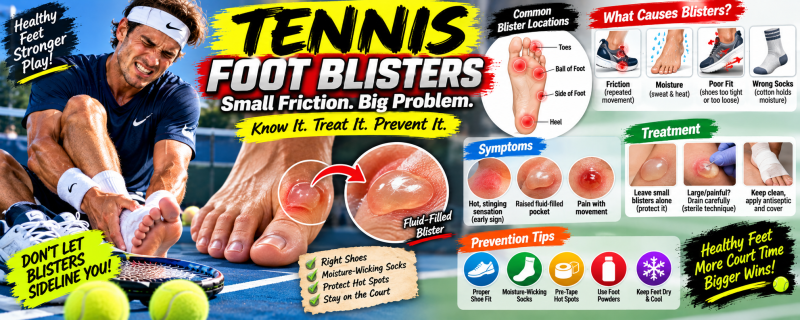
For tennis players, common locations include:
-
Heels
-
Toes
-
Ball of the foot
-
Sides of the feet
-
Areas underneath the forefoot
These are exactly the areas experiencing repeated loading during explosive tennis movement.
A small blister may seem harmless during warm-up, but after an hour of lateral movement, it can become painful enough to change your footwork.
And once your footwork changes, your entire tennis game can change with it.
What Does a Tennis Blister Feel Like?
1. The Hot Spot Comes First
Before you see a blister, you may notice:
-
Burning
-
Stinging
-
Heat
-
Tenderness
-
A sensation that something is rubbing
-
Localized discomfort during movement
Tennis doctor's tip
Don't wait for the bubble.
If your heel starts feeling unusually hot during a match, that's your warning signal.
Stop briefly and inspect the area.
A few minutes of prevention can save you from a painful blister later.
2. The Classic Fluid-Filled Blister
The next stage is usually a raised pocket of fluid underneath the outer layer of skin.
It may contain clear fluid.
If small blood vessels are damaged by friction or pressure, the blister can contain blood instead.
Blood blisters can appear dark red, purple, or almost black.
3. Pain During Tennis Movement
The blister may hurt when you:
-
Push off
-
Sprint
-
Stop suddenly
-
Slide
-
Change direction
-
Split-step
-
Land after a jump
This is why foot blisters can become particularly disruptive in tennis.
Tennis isn't just forward movement.
Your feet are constantly accelerating, braking and changing direction.
Why Do Tennis Players Get Foot Blisters?
1. Friction
The biggest culprit is repeated rubbing between:
Foot → Sock → Shoe
Every time your foot moves inside the shoe, mechanical forces act on the skin.
During tennis, those forces can become intense because of rapid lateral movement.
2. Sweat, Heat and Moisture
Sweaty feet can make the skin softer and more vulnerable to friction.
That's especially important during:
-
Long matches
-
Hot weather
-
Humid conditions
-
Indoor sessions
-
Tournament days
-
Multiple matches in one day
Keeping the feet reasonably dry and using moisture-wicking socks can help reduce friction and chafing.
3. Poor Tennis Shoe Fit
A shoe can create problems in two opposite ways.
Too Tight
A tight shoe can:
-
Compress the toes
-
Create pressure points
-
Increase rubbing
-
Restrict natural toe movement
Too Loose
A loose shoe allows the foot to slide.
That means more:
Movement → friction → heat → blister risk
The goal is a secure heel and midfoot with adequate room for your toes.
4. New Tennis Shoes
New shoes can be particularly dangerous if you immediately wear them for a long match.
The shoe may feel comfortable for 15 minutes.
Then, after 90 minutes of repeated movement, a previously unnoticed pressure point can become a blister.
My tennis-player rule:
Never test completely new shoes for the first time in an important match.
Wear them for shorter sessions first and identify any rubbing points.
5. Socks Matter More Than Many Players Think
Your socks are part of your foot-protection system.
Moisture-wicking synthetic or wool-blend athletic socks can help manage sweat and friction. The American Academy of Dermatology specifically recommends nylon or moisture-wicking socks for blister prevention.
Some players also benefit from double-layer socks.
However, the most important factor is the combination of:
Sock + shoe fit + foot movement + moisture control.
How Do You Know If It's a Simple Blister?
A typical friction blister has:
-
A localized fluid-filled bubble
-
A clear or sometimes bloody appearance
-
A history of friction or pressure
-
Localized tenderness
-
A recognizable relationship to footwear or activity
Most straightforward friction blisters can be recognized clinically without sophisticated testing.
However, not every foot blister is caused by tennis friction.
Repeated or unexplained blistering deserves medical assessment because other skin conditions can also produce blisters.
How Should Tennis Players Treat a Blister?
Small and Intact: Don't Pop It
This is one of the most important rules.
Leave an intact blister alone whenever possible.
The skin covering the blister provides a natural protective barrier.
Instead:
-
Keep the area clean.
-
Protect it with a soft dressing.
-
Reduce the friction causing the problem.
-
Consider a hydrocolloid blister dressing.
-
Avoid returning to the activity that caused the blister until it has sufficiently healed.
The NHS and American Academy of Dermatology both recommend protecting uncomplicated blisters rather than routinely popping them.
What About a Large, Painful Blister?
A very large blister can make walking or playing tennis extremely uncomfortable.
In some circumstances, a healthcare professional may drain a large or painful blister using sterile technique.
If a blister needs drainage, the roof of the blister should generally be left intact because it protects the underlying skin while it heals.
Important
I would not recommend casually puncturing a blister with a household needle before a match.
Breaking the skin creates another opportunity for infection.
If the blister is unusually large, extremely painful, recurrent, or you have conditions that increase infection risk, get medical advice rather than trying to manage it yourself.
What If the Blister Has Already Torn?
If a blister has opened during tennis:
Step 1 — Clean Your Hands
Wash your hands before touching the area.
Step 2 — Clean the Skin
Gently clean the area with soap and water.
Step 3 — Don't Rip Away the Remaining Skin
The remaining blister roof can help protect the exposed tissue underneath.
Step 4 — Cover It
Use a sterile dressing or appropriate blister dressing to protect the area from further friction.
The NHS specifically advises against peeling away the remaining skin from a burst blister.
Watch for Infection
This is where a simple tennis blister can become a medical problem.
Seek medical attention if you develop:
-
Increasing redness
-
Increasing warmth
-
Pus or yellow/green drainage
-
Increasing swelling
-
Worsening pain
-
Redness spreading away from the blister
-
Fever or feeling unwell
An infected blister should not simply be covered up and ignored.
How Can Tennis Players Prevent Blisters?
Prevention is much easier than trying to play through an open blister.
1. Find Your Hot Spots
Every tennis player should know where their feet tend to develop friction.
Common locations include:
-
Back of the heel
-
Little toe
-
Big toe
-
Ball of the foot
-
Inside edge of the forefoot
Once you know your hot spot, protect it before the match.
2. Use the Right Tennis Socks
Look for:
-
Moisture-wicking material
-
Proper fit
-
Minimal bunching
-
Appropriate cushioning
-
Good heel retention
If one pair isn't enough, some athletes find that a double-layer system reduces friction.
3. Get Your Tennis Shoe Fit Right
A good tennis shoe should:
-
Hold your heel securely
-
Prevent excessive foot sliding
-
Give the toes adequate room
-
Match your foot width
-
Provide appropriate lateral stability
If your forefoot is wide, don't force your foot into a narrow shoe simply because you like the model.
A tennis shoe should fit your foot—not the other way around.
4. Use Friction Protection
For known problem areas, some players use:
-
Blister pads
-
Moleskin
-
Athletic tape
-
Petroleum jelly
-
Anti-chafing products
The AAD notes that soft bandages, padding, powder and petroleum jelly can help reduce friction in areas prone to blisters.
5. Don't Ignore Sweat
If your feet become extremely sweaty during tennis, experiment with:
-
Moisture-wicking socks
-
Changing socks during long sessions
-
Breathable footwear
-
Appropriate foot-drying products
The goal isn't to make your feet completely dry.
It's to reduce excessive moisture and friction.
The Tennis Shoe Test
Before using a new pair in competition:
Session 1
Wear them for a short, easy session.
Session 2
Increase the duration.
Session 3
Test them with more lateral movement.
Session 4
Use them for a longer practice.
Only after you know the shoe doesn't create hot spots should you consider using it for an important match.
What About Playing Through a Blister?
Here's the tennis-expert perspective:
Pain is information.
If a blister is small, protected and not worsening, you may be able to continue activity depending on the circumstances.
But if every lateral movement is producing sharp pain, continuing to play can turn a small blister into an open wound.
That creates:
More pain → altered footwork → poorer movement → potentially more stress elsewhere.
Sometimes the smartest tennis decision is to stop before the problem becomes bigger.
Return to Tennis After a Blister
There isn't one exact number of days that applies to every blister.
A small uncomplicated blister may improve relatively quickly, while a larger or torn blister can take longer.
The AAD notes that many blisters heal on their own within one to two weeks, while the NHS notes that many heal within about a week. Healing time depends on the size, location and whether the blister remains intact or becomes an open wound.
Before returning to high-intensity tennis, ask:
Can I walk normally?
Can I perform a split step without significant pain?
Can I push sideways without sharp discomfort?
Can I wear my tennis shoe without the area being repeatedly irritated?
Is the skin protected and healing rather than becoming more damaged?
If the answer is no, you're probably not ready for full-intensity tennis.
Your First Session Back
Don't immediately play a three-hour competitive match.
Start with:
Phase 1
Easy warm-up and movement.
Phase 2
Mini-tennis.
Phase 3
Controlled baseline rallies.
Phase 4
Moderate lateral movement.
Phase 5
Gradually increase intensity.
Phase 6
Return to competitive play when the foot tolerates the workload.
And inspect the blister afterward.
If the skin looks worse after every session, your workload or footwear setup needs to change.
Tennis Doctor's Prevention Checklist
Before stepping onto the court, ask:
☑ Are my shoes properly fitted?
☑ Are my socks dry?
☑ Do I have a known hot spot?
☑ Have I protected that area?
☑ Are these new shoes?
☑ Am I playing longer than usual?
☑ Is today's weather unusually hot or humid?
☑ Do I have a spare pair of socks?
That final question is surprisingly useful during tournaments.
The Tennis Expert's Bottom Line
Foot blisters may look like a minor injury, but for a tennis player they can become a major movement problem.
The formula is simple:
Reduce friction.
Control moisture.
Wear properly fitted shoes.
Protect hot spots early.
Don't routinely pop intact blisters.
Keep broken blisters clean and covered.
Return to tennis progressively.
And remember:
The best blister treatment is often the blister you never allow to develop.
Your feet are the foundation of every split step, sprint, stop and change of direction.
Protect your feet—and you protect your tennis game.
When Should You See a Doctor?
Get medical advice if:
-
The blister is very painful or repeatedly returns.
-
It becomes increasingly red, warm or swollen.
-
Pus develops.
-
Pain is getting worse rather than better.
-
You develop fever or feel unwell.
-
Blisters appear without an obvious friction-related cause.
-
You have multiple unexplained blisters.
-
You have a medical condition or medication that increases your infection or wound-healing risk.
These situations can require more than routine blister care.
Medical Disclaimer
This article is educational and does not replace an examination or individualized advice from a qualified healthcare professional. If a blister appears infected, is unusually painful, keeps returning, or does not behave like a typical friction blister, seek medical evaluation.