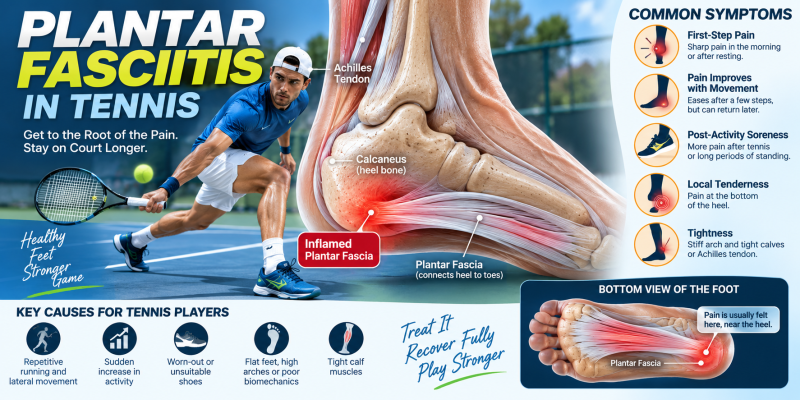
Plantar fasciitis is one of the most common causes of heel pain in athletes. For tennis players, the repetitive combination of running, split steps, explosive push-offs, lateral movement, sudden stopping, and hard-court impact can place substantial stress on the plantar fascia.
The plantar fascia is a strong band of connective tissue running along the bottom of the foot from the heel toward the toes. It helps support the arch and assists with shock absorption and propulsion during walking and running.
Despite its name, plantar fasciitis is not always simply an inflammatory condition. In persistent cases, the problem often involves repetitive overload and degenerative changes within the plantar fascia.
Tennis doctor perspective: Heel pain should not be ignored just because it improves after you start moving. That classic "first-step pain" can be an early warning that the plantar fascia is being overloaded.
Plantar Fasciitis Symptoms
1. First-Step Heel Pain
The classic symptom is sharp or stabbing pain underneath the heel, particularly with the first steps in the morning.
The pain may also occur after getting up following a long period of sitting.
2. Pain That Improves With Movement
Many players notice that the pain becomes less intense after walking for several minutes.
However, the discomfort may return after prolonged standing, walking, training, or playing tennis.
3. Post-Tennis Soreness
A tennis player may feel relatively comfortable during the beginning of a session but develop increased heel or arch pain afterward.
This delayed soreness is an important sign that the foot may not be tolerating the current training load.
4. Localized Heel Tenderness
A clinician may find tenderness near the plantar fascia's attachment to the heel bone, particularly around the medial calcaneal tubercle.
5. Arch and Calf Tightness
Players may also experience tightness through the arch, calf, or Achilles tendon.
Limited ankle dorsiflexion can increase the mechanical demand placed on the plantar fascia during movement.
What Causes Plantar Fasciitis in Tennis Players?
Plantar fasciitis usually develops from repetitive loading that exceeds the foot's ability to recover and adapt.
Repetitive Court Loading
Tennis involves thousands of repeated movements:
- Split steps
- Sprinting
- Lateral shuffling
- Sudden stopping
- Explosive push-offs
- Direction changes
- Jumping and landing
Each movement places mechanical stress through the foot and plantar fascia.
Sudden Increase in Training
One of the most common problems I see in athletes is increasing training volume too quickly.
Examples include:
- Playing more matches than usual
- Adding additional practice sessions
- Returning suddenly after a long break
- Increasing running mileage
- Starting intensive tournament preparation
The tissue may not have enough time to adapt to the increased workload.
Foot Structure and Biomechanics
Certain foot characteristics can increase mechanical stress, including:
- Flat feet
- High arches
- Excessive pronation
- Abnormal walking or running mechanics
However, having one of these characteristics does not automatically mean you will develop plantar fasciitis.
Tight Calf Muscles
Restricted ankle movement can increase tension through the plantar fascia during the push-off phase.
For tennis players, this can become particularly important because explosive court movement repeatedly requires the ankle and foot to generate force.
Worn-Out or Unsuitable Shoes
Tennis shoes lose cushioning and structural support with use.
Playing in worn-out shoes—or using running shoes that are not designed for the lateral demands of tennis—may increase foot discomfort and alter how forces are distributed.
How Is Plantar Fasciitis Diagnosed?
Plantar fasciitis is usually diagnosed through a medical history and physical examination.
A clinician will typically evaluate:
- Location of pain
- Morning or first-step symptoms
- Heel tenderness
- Ankle range of motion
- Calf flexibility
- Foot strength
- Walking and running mechanics
- Tennis-specific movement patterns
Other Causes of Heel Pain Must Be Considered
Not every case of heel pain is plantar fasciitis.
A clinician may need to consider:
- Calcaneal stress fracture
- Heel fat-pad problems
- Nerve irritation or entrapment
- Achilles-related disorders
- Tendon problems
- Other foot and ankle conditions
Persistent, severe, or unusual heel pain deserves proper evaluation.
X-Ray
X-rays may be used when a clinician wants to evaluate the bones or rule out conditions such as a stress fracture or arthritis.
A heel spur may appear on an X-ray, but the presence of a heel spur does not prove that it is causing the pain.
Ultrasound or MRI
Ultrasound can sometimes demonstrate plantar fascia thickening and structural changes.
MRI may be considered when the diagnosis is uncertain, symptoms are unusually severe, another injury is suspected, or conservative treatment has not produced adequate improvement.
Plantar Fasciitis Treatment
The majority of tennis players can initially be treated without surgery.
The most important principle is to reduce excessive load while progressively rebuilding the capacity of the foot and lower leg.
1. Relative Rest and Activity Modification
You do not necessarily need complete bed rest.
Instead, temporarily reduce activities that significantly aggravate symptoms, such as:
- Long tennis sessions
- Repeated sprinting
- Excessive jumping
- Hard-court running
- Aggressive lateral movement
Low-impact activities may be substituted when they can be performed comfortably.
2. Ice for Symptom Relief
Ice or a cold bottle rolled gently under the foot may provide short-term pain relief after activity.
It should be viewed as a symptom-management tool rather than the treatment that repairs the underlying problem.
3. Calf and Plantar Fascia Stretching
A rehabilitation program may include targeted stretching for:
- Gastrocnemius
- Soleus
- Achilles complex
- Plantar fascia
Stretching should be controlled and should not repeatedly provoke significant pain.
4. Strengthening
Progressive strengthening is an important part of recovery.
Exercises may target:
- Calf muscles
- Plantar flexors
- Foot intrinsic muscles
- Tibialis muscles
- Quadriceps
- Hamstrings
- Hip stabilizers
For tennis players, the goal is not simply to make the foot pain-free—it is to make the entire lower limb capable of handling repeated court forces.
5. Orthotics and Footwear
Some players benefit from:
- Over-the-counter arch supports
- Custom orthotics
- Heel cups
- Supportive tennis shoes
Orthotics should complement rehabilitation rather than replace it.
6. Night Splints
A night splint can keep the ankle and foot in a controlled position while sleeping.
Some patients with persistent morning pain may benefit from this approach.
Advanced Treatment for Chronic Plantar Fasciitis
When symptoms persist despite an appropriate rehabilitation program, a sports medicine physician, podiatrist, or orthopedic specialist may discuss additional treatment options.
Extracorporeal Shock Wave Therapy
ESWT uses mechanical sound waves to stimulate tissue response and is sometimes used for chronic plantar fasciopathy that has not responded adequately to conservative treatment.
Injections
Injections may occasionally be considered for selected patients.
However, corticosteroid injections around the plantar fascia require careful consideration because repeated or poorly placed injections can have complications, including weakening of the fascia.
PRP
Platelet-rich plasma (PRP) is sometimes considered for chronic plantar fasciopathy.
Evidence is mixed, and it should not be viewed as a guaranteed solution. The decision should be individualized after conventional rehabilitation has been appropriately attempted.
Surgery
Surgery is rarely necessary.
Plantar fascia release may be considered only in carefully selected patients with persistent, function-limiting symptoms despite many months of appropriate non-operative treatment.
Plantar Fasciitis Prevention for Tennis Players
Prevention begins with controlling training load and maintaining the capacity of the foot and lower leg.
Increase Court Time Gradually
Avoid sudden increases in:
- Match frequency
- Practice duration
- Running volume
- Tournament workload
- High-intensity footwork
Maintain Calf Flexibility
Regular calf mobility work can help maintain adequate ankle movement.
Strengthen the Feet
Do not neglect the small muscles of the foot.
Progressive foot and calf strengthening can improve the ability of the lower limb to tolerate repeated loading.
Replace Worn Tennis Shoes
There is no universal mileage number at which every tennis shoe must be replaced.
Instead, monitor:
- Worn outsole patterns
- Compressed cushioning
- Loss of stability
- Visible structural deterioration
- Increasing foot or heel discomfort
Choose Tennis-Specific Shoes
Tennis shoes are designed for the sport's lateral movements and court-specific demands.
Running shoes are designed primarily for forward movement and generally should not be used as a substitute for tennis footwear during regular court play.
Can You Play Tennis With Plantar Fasciitis?
Sometimes—but it depends on the severity and how your symptoms respond to activity.
A player with mild symptoms may be able to continue modified tennis while simultaneously undergoing rehabilitation.
However, continuing to play through progressively worsening pain is not a good strategy.
If your heel pain is:
- Increasing from session to session
- Changing your running mechanics
- Affecting your footwork
- Causing significant morning pain
- Making you avoid pushing off the injured foot
then your training load should be reassessed.
Tennis doctor rule: Don't judge the foot only by how it feels during the first 10 minutes of hitting. Pay attention to how it responds later that day and the following morning.
Return to Tennis After Plantar Fasciitis
Returning to tennis should be criteria-based rather than based only on a fixed number of days or weeks.
Before progressing to full competition, you should ideally be able to:
- Walk normally without significant pain
- Perform normal daily activities comfortably
- Have substantially improved morning pain
- Perform calf raises without significant symptoms
- Jog without worsening heel pain
- Perform controlled lateral movements
- Complete tennis-specific footwork without significant pain
- Recover without a major increase in symptoms the following morning
Four-Phase Return-to-Play Program
Phase 1 — Low-Impact Conditioning
Begin with activities such as:
- Cycling
- Swimming
- Controlled strength training
- Gentle mobility exercises
The objective is to maintain fitness without repeatedly irritating the plantar fascia.
Phase 2 — Light Tennis Drills
Progress to:
- Shadow tennis
- Mini-tennis
- Gentle footwork
- Controlled court movement
Keep the session relatively short and monitor symptoms afterward.
Phase 3 — Full-Court Rallying
Gradually introduce:
- Baseline rallying
- Wider movement
- Controlled lateral shuffling
- Moderate acceleration
- Deceleration
- More realistic recovery movements
Do not immediately jump from light hitting to full-intensity match play.
Phase 4 — Competitive Tennis
Once the foot tolerates progressively harder sessions without a significant symptom flare, gradually return to:
- Point play
- Practice sets
- Full training
- Competitive matches
Aggressive sliding and maximal court coverage should be among the final demands to reintroduce, particularly for players competing on hard courts.
The 24-Hour Response Test
One of the most useful concepts for tennis players recovering from plantar fasciitis is the next-day response.
If you increase your court workload and your heel is substantially more painful that evening or the following morning, the previous session may have exceeded your current tissue capacity.
That does not necessarily mean you have caused new damage, but it is a signal to adjust the training load.
A successful rehabilitation program should gradually increase what your foot can tolerate without repeatedly producing significant symptom flares.
When Should a Tennis Player See a Doctor?
Get evaluated if you have:
- Severe heel pain
- Difficulty walking normally
- Significant swelling or bruising
- Pain following a specific traumatic event
- Persistent pain despite activity modification
- Increasing pain over several weeks
- Pain at rest or at night
- Numbness or tingling
- Pain that does not follow the typical plantar fasciitis pattern
A sudden onset of severe heel pain after a sprint, jump, or forceful push-off should not automatically be assumed to be plantar fasciitis.
Plantar Fasciitis vs. Other Causes of Heel Pain
Several conditions can produce similar symptoms.
Condition
Typical Clues
Plantar fasciitis
First-step pain and tenderness under the heel
Calcaneal stress fracture
Increasing pain with weight-bearing and impact
Heel fat-pad problem
Pain directly beneath the heel, often worse with hard surfaces
Achilles disorder
Pain toward the back of the heel
Nerve irritation
Burning, tingling, numbness, or radiating pain
Other foot injuries
Symptoms may follow trauma or unusual loading
Correct diagnosis matters because treatment and return-to-play decisions can be very different.
United States Clinical Care
In the United States, plantar fasciitis may initially be evaluated by a primary care physician, sports medicine physician, physical therapist, podiatrist (DPM), or orthopedic specialist, depending on the symptoms and healthcare system.
For persistent or complicated cases, referral to a clinician experienced in foot and ankle sports injuries can help identify contributing factors and develop an individualized rehabilitation plan.
Insurance requirements, referrals, and coverage for services such as custom orthotics or specialized procedures vary between plans.
Tennis Doctor's Bottom Line
Plantar fasciitis is not simply a "heel pain problem." For a tennis player, it is often a signal that the foot and lower limb are being exposed to more repetitive loading than they can currently tolerate.
The solution is rarely just rest and ice.
The long-term goal is to reduce excessive irritation, restore mobility, progressively strengthen the foot and calf, address training-load problems, and rebuild the ability to perform tennis-specific movements.
Most importantly, don't return to full competition simply because the pain has temporarily disappeared.
Your foot needs to demonstrate that it can tolerate split steps, acceleration, braking, lateral movement, repeated push-offs, and full-court tennis without a significant flare afterward.
A smarter return to tennis is usually faster—and safer—than repeatedly pushing through pain and restarting the recovery process.