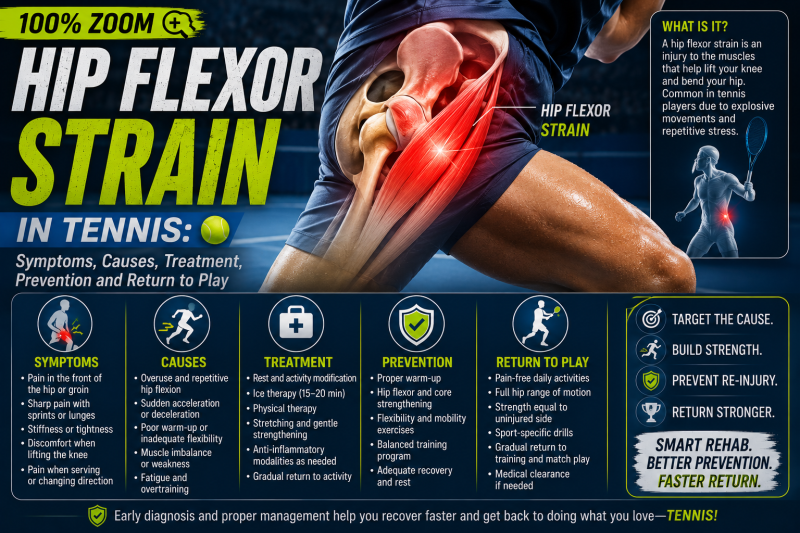
Hip flexor strains are an important tennis injury because the hip flexors are repeatedly loaded during sprinting, lunging, rapid deceleration, open-stance groundstrokes and explosive changes of direction. In elite tennis, the iliopsoas complex is particularly important because it contributes to both powerful hip flexion and lumbopelvic control.
Quick Overview
A hip flexor strain is an overstretching or tearing of one or more muscles responsible for flexing the hip. The most commonly involved structures include:
- Iliopsoas — psoas major and iliacus
- Rectus femoris — part of the quadriceps that crosses the hip
- Sartorius
- Tensor fasciae latae
In tennis, symptoms may develop suddenly during an explosive movement or gradually through repetitive loading.
The severity can range from a mild muscle injury to a significant partial tear.
Why Tennis Places Stress on the Hip Flexors
Modern tennis demands repeated cycles of:
Split step → acceleration → braking → lateral movement → deep hip flexion → rotation → explosive recovery
An open-stance forehand, for example, can place substantial demands on the loaded hip while the athlete simultaneously generates rotational force through the pelvis and trunk.
At ATP level, heavy topspin, wide-ball recovery, aggressive court positioning and rapid directional changes can increase cumulative hip and pelvic loading.
Symptoms
Typical symptoms of a hip flexor strain include:
- Pain at the front of the hip or upper thigh
- Pain when lifting the knee
- Discomfort during running or sprinting
- Pain during lunging
- Pain when getting up from a seated position
- Reduced hip strength
- Tightness or stiffness around the front of the hip
- Tenderness over the involved muscle
- Pain when hitting while reaching for a wide ball
- Pain during explosive changes of direction
A more significant tear may produce sudden sharp pain, weakness and difficulty continuing to play.
Tennis-Specific Symptoms
A player may notice pain particularly during:
- Explosive first-step acceleration
- Recovery after a wide forehand
- Deep open-stance positions
- High-speed lateral movement
- Lunging toward a short ball
- Serve loading and landing
- Rapid transition from defense to attack
Causes
Hip flexor strains generally occur when the muscle is exposed to a force that exceeds its ability to tolerate the load.
Common Tennis Causes
1. Sudden acceleration
A powerful sprint requires rapid hip flexion and extension. If the muscle is fatigued or insufficiently prepared, injury risk increases.
2. Rapid deceleration
Braking forces place significant eccentric demands on the muscles controlling the hip and pelvis.
3. Wide-ball recovery
Explosive lateral movement followed by rapid recovery toward the center of the court creates substantial loading through the hip flexors and surrounding musculature.
4. Deep open-stance positions
Modern open-stance groundstrokes require considerable hip mobility, pelvic rotation and lower-body strength.
5. Fatigue
As fatigue develops, movement mechanics can deteriorate and the athlete may compensate through the hip flexors, trunk or adductors.
6. Training-load errors
Sudden increases in court time, sprint work, match volume or strength training can exceed tissue capacity.
The Modern Tennis Kinetic Chain
Elite tennis movement cannot be considered purely a hip-flexor problem.
The hip works as part of a connected system:
Foot → ankle → knee → hip → pelvis → core → trunk → shoulder → arm
The iliopsoas contributes not only to hip flexion but also to control of the relationship between the lumbar spine and pelvis.
When the athlete repeatedly performs high-speed movements, restrictions or weakness elsewhere in the kinetic chain can increase the workload placed on the hip flexors.
Core and pelvic control are therefore important components of rehabilitation.
Iliopsoas and Rectus Femoris
Two structures deserve particular attention.
Iliopsoas
The iliopsoas is a major hip flexor and consists primarily of the psoas major and iliacus.
It is heavily involved in:
- Hip flexion
- Sprinting
- Knee drive
- Pelvic control
- Rapid directional changes
Rectus Femoris
The rectus femoris crosses both the hip and knee. It therefore contributes to:
- Hip flexion
- Knee extension
- Sprinting
- Lunging
- Explosive court movement
Because it crosses two joints, it can be particularly stressed during high-speed movements requiring simultaneous hip and knee positioning.
Diagnosis
Diagnosis begins with a detailed history and physical examination by a qualified sports-medicine professional.
The clinician may evaluate:
- Location of pain
- Mechanism of injury
- Hip range of motion
- Hip-flexor strength
- Pain with resisted hip flexion
- Muscle tenderness
- Running and movement mechanics
- Lumbar spine and pelvic function
When Imaging Is Needed
Many mild strains can be diagnosed clinically.
However, MRI or ultrasound may be considered when:
- Pain is severe
- There is substantial weakness
- A significant tear is suspected
- Symptoms persist
- The injury repeatedly returns
- The diagnosis is uncertain
- The athlete is an elite competitor requiring detailed tissue assessment
The Mimicry and Overlap Problem
Anterior hip pain in a tennis player does not automatically mean a simple hip flexor strain.
Other conditions can produce similar symptoms, including:
- Femoroacetabular impingement (FAI)
- Acetabular labral injury
- Iliopsoas tendinopathy
- Iliopsoas bursitis
- Adductor injury
- Rectus femoris injury
- Sports hernia/athletic pubalgia
- Lumbar spine-related pain
This distinction becomes particularly important when an athlete experiences recurrent anterior hip pain despite appropriate rehabilitation.
Persistent or recurrent symptoms should therefore be reassessed rather than repeatedly treated as a simple muscle strain.
Treatment
Treatment depends on the severity of the injury and the athlete's symptoms.
1. Acute Phase
Initially, the objective is to reduce aggravating loads while maintaining appropriate movement.
A player may need to temporarily reduce:
- Sprinting
- Explosive lateral movement
- Deep lunges
- Sliding
- High-intensity open-stance hitting
- Match play
The emphasis should be on relative rest rather than prolonged complete inactivity when clinically appropriate.
Pain and swelling should be monitored, and rehabilitation should be guided by a sports-medicine professional.
2. Restore Mobility
Once acute symptoms settle, rehabilitation can progressively address:
- Hip mobility
- Hip extension
- Pelvic control
- Lumbar mobility
- Iliopsoas flexibility
- Quadriceps flexibility
- Adductor mobility
Aggressive stretching should generally be avoided during the early painful phase.
3. Strengthening
Strength rehabilitation can progress from low-load exercises toward tennis-specific loading.
Examples may include:
- Isometric hip-flexor exercises
- Controlled resisted hip flexion
- Glute strengthening
- Split squats
- Step-ups
- Lunges
- Single-leg exercises
- Core stabilization
- Progressive eccentric loading
The goal is not simply to make the hip flexor stronger—it is to restore the entire lumbo-pelvic-hip system.
Functional Rehabilitation
As strength improves, rehabilitation should become increasingly tennis-specific.
A typical progression may be:
Walking → jogging → running → acceleration → deceleration → lateral movement → tennis footwork → controlled hitting → high-intensity hitting → practice → competition
Exercises such as controlled deceleration lunges and multidirectional movement drills can progressively reproduce the demands of competitive tennis.
Prevention
Hip-flexor injury prevention should focus on load management, strength, mobility and movement quality.
Key Strategies
Progress training gradually
Avoid sudden increases in:
- Court hours
- Sprint volume
- Match frequency
- Gym workload
- High-intensity movement drills
Strengthen the hips and core
Include progressive exercises for:
- Hip flexors
- Gluteal muscles
- Adductors
- Hamstrings
- Quadriceps
- Abdominals and trunk
Develop deceleration ability
A tennis player must not only accelerate quickly but also brake efficiently.
Controlled deceleration training can reduce excessive stress during changes of direction.
Maintain appropriate mobility
Hip mobility should support the player's movement demands without relying on excessive stretching.
Warm up properly
A tennis-specific warm-up can progressively prepare the athlete for:
Mobility → activation → acceleration → multidirectional movement → tennis-specific intensity
Return to Tennis
Return to tennis should be criteria-based rather than determined solely by the number of days since injury.
Before returning to full competition, the player should demonstrate:
- Minimal or no pain
- Full or near-full hip range of motion
- Restored hip-flexor strength
- Good single-leg control
- Ability to accelerate without symptoms
- Ability to decelerate without symptoms
- Pain-free lateral movement
- Ability to perform tennis-specific lunges
- Ability to tolerate repeated changes of direction
- Ability to hit groundstrokes and serves at progressively higher intensity
Progressive Return-to-Court Program
Stage 1 — Light court movement
Easy hitting with limited movement and controlled intensity.
Stage 2 — Moderate movement
Introduce wider balls, controlled lateral movement and moderate acceleration.
Stage 3 — High-intensity tennis
Progress toward full-speed movement, deep lunges, recovery steps and explosive changes of direction.
Stage 4 — Practice match
Simulate competitive workloads while monitoring symptoms during and after training.
Stage 5 — Competition
Return to tournament play when the athlete can tolerate the expected match workload without significant symptoms or functional deficits.
Clinical Perspective: Elite ATP Tennis
Hip-flexor injuries at professional level require particular attention because returning too quickly can expose the athlete to repeated high-speed loading before the tissue has regained sufficient capacity.
A player may feel comfortable during ordinary walking or light hitting but still experience symptoms when required to:
- Chase a wide ball
- Stop suddenly
- Change direction
- Recover explosively
- Hit from a deep open stance
- Repeat these movements hundreds of times during a match
Therefore, absence of pain during simple activity is not necessarily equivalent to readiness for ATP-level competition.
Elite rehabilitation should progressively reproduce the speed, volume and multidirectional demands of professional tennis.
Rafael Nadal and Iliopsoas Injury: A High-Profile Example
Rafael Nadal's 2023 Australian Open injury is a prominent example of how an anterior hip/iliopsoas injury can affect an elite tennis player's ability to compete. Nadal was diagnosed with a grade-2 injury of the iliopsoas muscle of his left hip following the tournament.
His case illustrates an important point for tennis medicine: an apparently localized hip injury can have major consequences for movement, serving, court coverage and the ability to repeatedly perform explosive actions.
It also demonstrates why elite athletes require careful imaging, load management and a structured rehabilitation process rather than simply waiting for pain to disappear.
Importantly, an individual professional player's treatment should not be generalized to every hip-flexor strain. Treatments such as injections or surgery depend on the specific diagnosis and clinical circumstances.
Key Takeaway
A hip flexor strain can look like a relatively simple muscle injury, but in tennis it can involve a much larger hip–pelvis–core kinetic chain.
For recreational and professional players alike, successful recovery requires:
Accurate diagnosis → appropriate load reduction → mobility → progressive strength → eccentric capacity → multidirectional movement → tennis-specific loading → gradual return to competition
For recurrent anterior hip pain, clinicians should also investigate possible underlying conditions such as FAI, labral pathology or iliopsoas tendinopathy, rather than repeatedly treating the problem as an isolated muscle strain.
The goal is not simply to become pain-free—it is to rebuild the capacity required to accelerate, decelerate, rotate and recover repeatedly at tennis speed.