
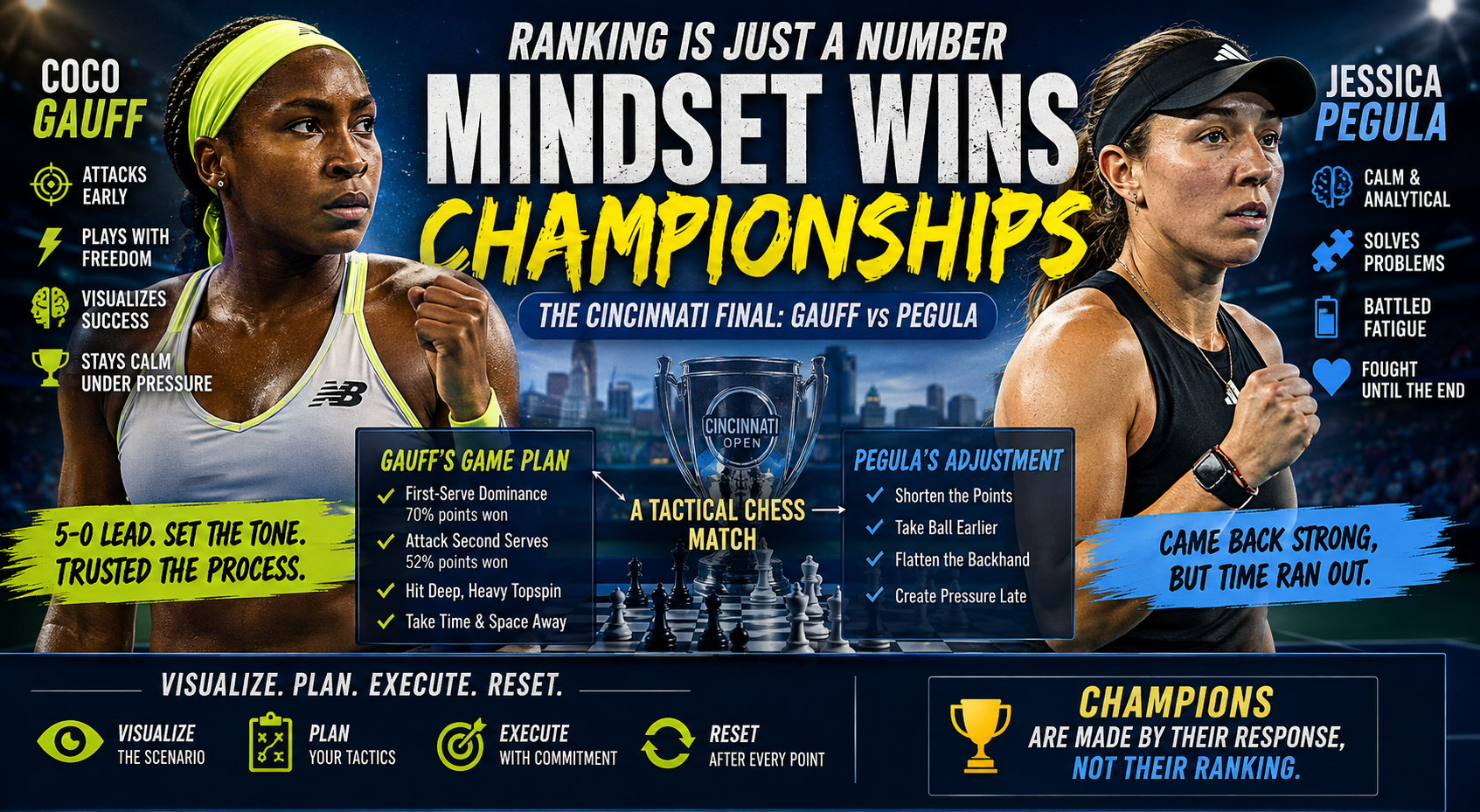
A higher ranking can tell us where a player stands on paper. It cannot determine who wins the next ball. The Cincinnati Open final between Coco Gauff and Jessica Pegula offered a powerful lesson in competitive tennis: ranking, reputation, and recent form matter—but mindset, tactical execution, emotional control, and preparation can matter even more when the match begins.
Gauff’s victory over Pegula was not simply a story of one player hitting harder than another. It was a psychological and tactical chess match in which Gauff established the conditions of the match before Pegula could fully settle into hers.
The Ranking Is Not the Match
Pegula entered the contest as the higher-ranked player, which could naturally create the expectation that she should control the match.
But rankings are built from accumulated results. A tennis match is decided in real time.
The player standing across the net does not care about ranking points when a 30-all point arrives. The scoreboard does not care who is ranked higher. Every point becomes its own problem.
That is why Gauff's approach was so important.
Rather than playing as if she needed to prove she deserved to win, Gauff appeared to embrace an attacking mindset: take control early, trust the game plan, and force Pegula to react.
That mentality produced an immediate advantage.
Gauff raced to a 5-0 lead, putting Pegula under pressure before the American could establish her normal rhythm from the baseline.
Different Minds, Different Starting Points
The contrast between the two players was fascinating.
Coco Gauff: Attack the Match
Gauff's strongest mental approach was one of assertion and freedom.
Instead of waiting for Pegula to make mistakes, she looked to create uncomfortable situations herself.
Her mindset was essentially:
Take the initiative before the opponent takes it from you.
Her athleticism, heavy topspin, movement, and ability to defend and counterattack gave her multiple ways to control the match.
Once she gained the early lead, she had something extremely valuable in tennis: scoreboard pressure on her opponent.
Pegula was no longer simply trying to play good tennis. She was trying to solve a problem.
Jessica Pegula: Solve the Problem
Pegula's style is different.
She is known for her composure, efficiency, and ability to make tactical adjustments. Her tennis often resembles problem-solving: identify what is not working, make a correction, and gradually change the direction of the match.
That approach can be extremely effective.
But there was another factor: the physical and emotional cost of her semifinal against Iga Świątek.
After a long and demanding semifinal, Pegula had less recovery time than an ideal preparation window would provide.
That matters because tennis is not purely mental.
The brain makes decisions, but the body has to execute them.
When fatigue accumulates, footwork becomes slightly slower, reaction time can decrease, and the ability to maintain concentration through long rallies becomes harder.
Visualization Before the Match
One of the most important lessons for competitive players is what happens before the first ball is struck.
Visualization is not about imagining an easy victory.
A better visualization routine is to imagine the situations that are likely to occur—and mentally rehearse the response.
Before a major final, Gauff could visualize:
-
Pegula attacking early.
-
Long baseline exchanges.
-
Difficult service games.
-
Losing an early break.
-
Serving for the championship.
-
Facing a break point.
-
Hearing the crowd become louder.
-
Making an unforced error.
-
Feeling nervous late in the match.
-
Having to reset after losing momentum.
The goal is not to create a fantasy in which everything goes perfectly.
The goal is to create familiarity with pressure.
When the difficult moment arrives, the player can think:
“I've already been here in my mind.”
That can make the situation feel less threatening.
Visualization Is About the Process, Not the Trophy
A dangerous form of visualization is imagining yourself holding the trophy repeatedly while ignoring the difficult points required to reach it.
A better tennis visualization focuses on actions:
See the first serve.
See the split step.
See the ball deep to the opponent's backhand.
See yourself recovering toward the center.
See yourself staying composed after an error.
See yourself playing the next point instead of thinking about the previous one.
This type of visualization creates a process-oriented mindset.
The player is not trying to predict the future.
The player is preparing the mind to execute under uncertainty.
The Tactical Chess Match
Once the match began, Gauff's tactical objective became clear: deny Pegula time and rhythm.
Heavy, deep shots can push an opponent backward and make it more difficult to attack.
At the same time, pressure on the second serve can prevent the receiver from comfortably beginning the point.
This creates a chain reaction:
Deep ball → opponent moves backward → shorter reply → attacking opportunity.
Gauff's aggression therefore wasn't simply about hitting harder.
It was about controlling space and time.
That is one of the most important tactical principles in tennis.
The player who controls where the opponent hits from often controls what the opponent can do with the next shot.
Pegula's Adjustment
Pegula did not simply surrender.
As the match progressed, she attempted to shorten rallies, take the ball earlier, and strike through the court more aggressively.
That adjustment helped her recover some momentum.
This is where the match became a psychological battle.
When a player is down significantly, the first objective is not necessarily to win the entire match immediately.
It is to change the next five minutes.
Pegula's adjustment helped her do exactly that.
She began creating pressure and eventually broke Gauff while Gauff was serving for the championship.
Suddenly, the match had a different emotional atmosphere.
The Most Important Moment: 5-2
This was arguably the greatest psychological test for Gauff.
Leading 5-2 and serving for the championship creates a unique pressure.
The brain knows the finish line is close.
That can produce tension:
“I'm almost there.”
And ironically, thinking about winning can interfere with the actions required to win.
Gauff briefly wobbled.
But the critical difference was what happened next.
She did not allow one lost service game to become an emotional collapse.
She reset.
That ability to reset is one of the foundations of championship tennis.
The Champion's Mental Reset
The best competitors do not necessarily avoid negative emotions.
They learn how to recover from them quickly.
A player can feel nervous and still execute.
A player can make an error and still play the next point correctly.
A player can lose a lead and still regain control.
Gauff's response after being broken demonstrated this principle.
Instead of allowing Pegula's comeback to become a psychological avalanche, Gauff immediately shifted attention back to the next game.
She broke back at love and closed the match.
That sequence delivered an important lesson:
The ability to reset can be more valuable than the ability to dominate.
What Tennis Players Can Learn
The Cincinnati final offers a useful mental framework for players at every level.
1. Don't Play the Ranking
Your opponent's ranking is information—not destiny.
Respect the opponent, but focus on the ball.
2. Have a Game Plan Before You Walk Onto the Court
Know what you want to accomplish.
For example:
-
Attack the second serve.
-
Keep the opponent behind the baseline.
-
Target a specific wing.
-
Change direction only when the ball allows it.
-
Make the opponent hit one more ball.
3. Visualize Problems, Not Just Success
Imagine yourself facing adversity.
Then visualize the response.
Missed serve → breathe → routine → next serve.
Lost break → reset → next game.
Long rally → stay patient → recover position.
4. Play the Point in Front of You
Don't play the trophy.
Don't play the ranking.
Don't play yesterday's match.
Play this point.
5. Momentum Can Change Quickly
A 5-0 lead can become 5-3.
A 5-2 lead can become 5-4.
Tennis is full of momentum swings.
Champions understand that a temporary loss of momentum is not the same thing as losing the match.
6. Fatigue Changes the Mental Game
Pegula's semifinal effort demonstrated another important truth.
Physical recovery influences mental performance.
When the body is tired, concentration becomes more expensive.
Therefore, recovery, hydration, nutrition, sleep, and preparation are not separate from mental toughness.
They support it.
The Deeper Lesson
The Cincinnati final was a reminder that tennis is played with two opponents: the person across the net and the person inside your own head.
Pegula's higher ranking could not protect her from Gauff's aggressive start.
Gauff's early dominance could not protect her from nerves at 5-2.
Both players experienced different forms of pressure.
The difference was how those pressures were handled.
Gauff created the match she wanted early.
Pegula attempted to solve it.
And when Pegula finally created an opening, Gauff demonstrated the most important skill of all:
she reset before the problem became bigger than the moment.
That is championship tennis.
The Champion Mindset
For recreational players, junior competitors, college athletes, and professionals, the lesson is simple:
Prepare your mind before you prepare your racket.
Visualize the difficult moments.
Know your tactical priorities.
Accept that momentum will change.
Don't become emotionally attached to the scoreboard.
And when something goes wrong, don't ask:
“How did I lose that point?”
Ask:
“What do I need to do on the next one?”
Because the match is rarely decided by the point you just lost.
It is often decided by what you do after you lose it.
Rankings measure history.
Tactics control the present.
Mindset determines how you respond when the match becomes difficult.
And in championship tennis, that response can make all the difference.