Modern tennise has entered a new era of precision, discipline, and relentless efficiency. In this generation of elite players, few names represent that evolution more clearly than Jannik Sinner. Calm under pressure, mechanically clean in movement, emotionally controlled, and devastatingly repeatable from the baseline, Sinner has become one of the most feared players in world tennis.
Some fans call him “a robot.”
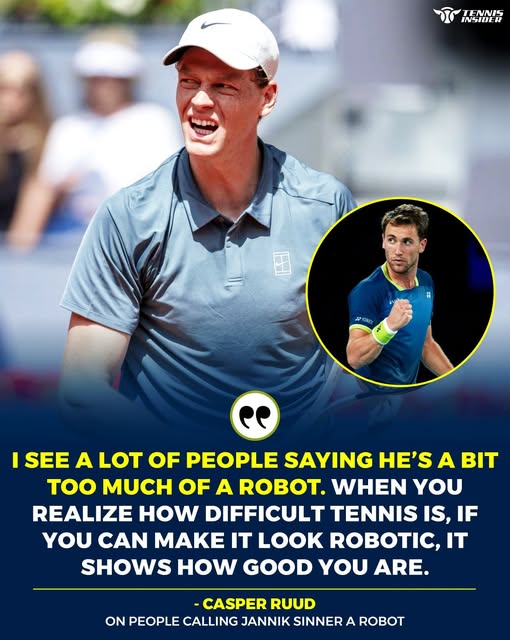
But according to Casper Ruud, that label is not criticism — it is praisee.
Ruud explained it perfectly:
“When you realize how difficult tennis is, if you can make it look robotic, it shows how good you are.”
That statement captures the essence of Sinner’s greatness.
Because tennis is chaos.
The sport demands split-second decisions, explosive movement, emotional endurance, tactical adaptation, and technical precision while under extreme pressure. To make all of that appear effortless and repeatable is one of the hardest achievements in sports.
Jannik Sinner has mastered that art.
What many casual fans mistake for robotic emotion is actually elite control. What appears repetitive is actually world-class discipline. And what looks simple is the product of thousands of hours of technical refinement, movement training, mental preparation, and tactical intelligence.
From a coaching perspective in the United States, many elite trainers now view Sinner as one of the most technically advanced players of the modern era.
Not because he plays with flashy emotion.
But because he removes unnecessary chaos from the game.
That is championship tennis.
The Meaning Behind “Robot Tennis”
When people describe Sinner as robotic, they usually refer to several visible characteristics:
- His calm facial expressions
- His repetitive shot mechanics
- His efficient movement
- His ability to hit the same quality ball repeatedly
- His emotional control during pressure moments
- His consistency from rally to rally
But in elite tennis, those are not weaknesses.
Those are superpowers.
At the highest level, matches are often decided by who can maintain technical quality under stress. Most players experience emotional fluctuations that affect timing, shot selection, and movement.
Sinner minimizes those fluctuations better than almost anyone.
That is why he looks machine-like.
Not because he lacks emotion.
But because he controls it.
Why Simplicity Is Harder Than Flash
One of the biggest misconceptions in tennis is that spectacular shot-making equals greatness.
In reality, coaches often teach the opposite.
The best players are usually the ones who simplify the game.
Sinner’s tennis is built on repeatable fundamentals:
- Clean contact points
- Balanced footwork
- Compact mechanics
- Early preparation
- Efficient recovery movement
- Smart court positioning
- High percentage aggression
From a USA coaching perspective, Sinner represents the modern ideal of “controlled aggression.”
He does not waste movement.
He does not overhit.
He does not panic.
He does not chase highlight shots unnecessarily.
Instead, he pressures opponents through relentless quality.
That consistency slowly breaks opponents mentally.
Sinner’s Background in Skiing and Athletic Balance
One of the hidden reasons behind Sinner’s elite movement is his early athletic background.
Before fully committing to tennis, Sinner was an outstanding skier.
That background shaped several physical abilities that now define his game.
1. Exceptional Balance
Skiing develops dynamic balance unlike almost any other sport.
Athletes learn to stabilize while moving rapidly through changing terrain and angles.
On the tennis court, this gives Sinner incredible body control during:
- Sliding
- Direction changes
- Open-stance hitting
- Defensive recovery
- Weight transfer
Even when stretched wide, Sinner often remains balanced through contact.
That is extremely difficult.
2. Rapid Anticipation Skills
Skiers constantly read terrain ahead at high speed.
That improves anticipation and reaction timing.
In tennis, Sinner reads opponent body language exceptionally well.
He often appears to move early because he recognizes patterns before opponents fully execute shots.
Elite anticipation creates the illusion of effortless movement.
3. Lower-Body Strength and Stability
Ski training develops powerful legs and core stability.
This allows Sinner to:
- Absorb pace
- Redirect power
- Recover explosively
- Maintain balance during long rallies
His lower-body foundation is one of the strongest in professional tennis.
Why Sinner’s Movement Is So Efficient
Many athletic players move fast.
Very few move efficiently.
This is what separates Sinner.
A USA performance coach would immediately notice several elite movement characteristics in his game.
Minimal Extra Steps
Sinner rarely wastes movement.
His footwork is clean and economical.
Every recovery step has purpose.
Early Court Positioning
Instead of relying only on speed, he positions himself intelligently before shots arrive.
That saves energy.
Controlled Sliding
On hard courts and clay, Sinner slides under control without losing balance.
This allows him to transition smoothly from defense into offense.
Recovery Discipline
After hitting, Sinner recovers immediately to optimal positioning.
Many players admire his ball striking.
Coaches admire his recovery habits.
The “Repeatability” That Terrifies Opponents
Elite tennis is not about producing one brilliant shot.
It is about reproducing high-level execution hundreds of times during a match.
This is where Sinner becomes frightening.
His ball quality rarely disappears.
Opponents know:
- The depth will remain heavy
- The pace will remain consistent
- The movement will remain sharp
- The rally pressure will continue
- The errors will stay low
That creates enormous mental fatigue.
Players feel trapped because Sinner gives very few free points.
Over time, opponents often begin pressing too hard.
That leads to mistakes.
Sinner’s Forehand: Controlled Violence
One reason Sinner dominates baseline exchanges is his forehand mechanics.
The shot combines:
- Explosive racket-head speed
- Compact preparation
- Efficient weight transfer
- Excellent timing
- Balance through contact
But the most impressive part is not raw power.
It is repeatability.
Many players can hit one massive forehand.
Sinner can hit twenty in a row with similar pace and depth.
That consistency suffocates opponents.
The Backhand That Changes Rally Direction
Sinner’s two-handed backhand is one of the cleanest in tennis.
Technically, it is remarkably stable.
He uses it to:
- Redirect pace
- Change direction early
- Attack crosscourt angles
- Neutralize heavy topspin
- Take time away from opponents
The backhand is especially dangerous because Sinner strikes it so early.
That robs opponents of recovery time.
From a coaching standpoint, his timing is elite.
Emotional Control: The Modern Champion Trait
Old-school tennis often celebrated emotional intensity.
Modern tennis increasingly rewards emotional efficiency.
Sinner represents this evolution perfectly.
He does not waste energy arguing, panicking, or reacting dramatically after errors.
Instead:
- He resets quickly
- He focuses on patterns
- He stays tactically disciplined
- He maintains emotional neutrality
This frustrates opponents because they see no emotional openings.
Casper Ruud understands this deeply.
That is why he considers the “robot” label a compliment.
When players remain calm under pressure, it usually means they are mentally stronger than the situation around them.
Why Opponents Feel Suffocated Against Sinner
Many players describe playing Sinner as exhausting.
Not only physically.
Mentally.
Why?
Because he constantly applies structured pressure.
Depth Pressure
Sinner consistently pins opponents deep behind the baseline.
Pace Pressure
He hits through the court without needing reckless risk.
Directional Pressure
He changes direction suddenly off both wings.
Time Pressure
He takes the ball early and shortens reaction windows.
Emotional Pressure
He rarely shows panic.
That combination creates relentless stress.
The Intelligence Behind the “Robot”
Sinner’s game is not robotic because it lacks thinking.
It is robotic because decision-making has become highly refined.
Elite Tennis IQ means:
- Recognizing patterns quicklye
- Choosing high-percentage targets
- Managing momentum intelligently
- Understanding court geometry
- Knowing when to defend or attack
Sinner processes these decisions rapidly and calmly.
That is elite intelligence under pressure.
The USA Coaching Perspective on Sinner
Across American academies and high-performance programs, coaches increasingly use Sinner as a technical model for younger players.
Why?
Because his game is sustainable.
Some flashy styles are difficult to maintain physically over long careers.
Sinner’s structure is efficient:
- Compact mechanics
- Efficient movement
- Controlled aggression
- Repeatable timing
- Smart energy use
This is the future of elite tennis development.
Young players are now taught not only to hit harder, but to play cleaner.
Sinner embodies that philosophy.
How Sinner Makes Difficult Tennis Look Easy
Casper Ruud’s quote is powerful because it reveals something casual fans often miss.
Tennis is incredibly difficult.
Even professionals struggle to:
- Maintain balance at full speed
- Time the ball perfectly
- Recover after explosive movement
- Control emotions
- Adapt tactically
- Sustain focus for hours
Sinner makes these things look natural.
That illusion of simplicity is actually proof of mastery.
The greatest athletes often appear effortless because they remove visible struggle.
Comparison to Other Tennis Legends
Every era has players described as machine-like.
Novak Djokovic
Djokovic built his greatness through:
- Elastic defense
- Mental endurance
- Technical precision
- Relentless consistency
Roger Federer
Federer’s effortless movement created the illusion of simplicity.
Rafael Nadal
Nadal overwhelmed opponents through physical intensity and discipline.
Jannik Sinner
Sinner combines elements of all three:
- Djokovic-like stability
- Federer-like timing
- Nadal-like discipline
But he expresses them in a uniquely modern style.
The Hidden Work Behind the Calm Exterior
Sinner’s composure is not accidental.
It comes from preparation.
Elite players train:
- Movement patterns
- Recovery habits
- Breathing control
- Mental routines
- Tactical repetition
- Pressure simulations
The calm fans see on court is built through exhausting daily work.
That is why coaches respect players like Sinner so deeply.
Why Fans Misunderstand Quiet Competitors
Sports culture often celebrates visible emotion.
But many elite competitors are internally intense while externally calm.
Sinner belongs in that category.
His focus is inward:
- Reading patterns
- Maintaining balance
- Executing tactics
- Managing rhythm
That internal concentration reduces emotional distraction.
Quiet competitors are often misunderstood because their intensity is controlled rather than displayed.
Sinner’s Return Game: Silent Destruction
One underrated area of Sinner’s dominance is his return game.
He consistently:
- Neutralizes powerful serves
- Redirects returns deep
- Starts rallies aggressively
- Applies immediate baseline pressure
This forces servers into uncomfortable second-ball situations.
Many matches are decided before rallies fully begin.
Sinner understands this perfectly.
Why His Physical Conditioning Is Elite
Sinner’s body transformation over recent seasons has elevated his game significantly.
He now combines:
- Strength
- Endurance
- Flexibility
- Explosive recovery
- Injury resilience
Modern tennis requires extraordinary physical preparation.
Sinner’s lean athleticism allows him to sustain high-intensity baseline pressure for long periods without dramatic drop-offs.
Tactical Adaptation: More Than Just Power
One reason Sinner continues improving is his growing tactical flexibility.
Earlier in his career, he relied heavily on pure baseline pace.
Now he incorporates:
- Better net play
- Smarter point construction
- Improved defense
- Variety in trajectory
- More selective aggression
This evolution is crucial for long-term dominance.
The Psychological Fear Factor
Elite opponents know something dangerous about Sinner:
He rarely beats himself.
That creates pressure before matches even begin.
When players believe they must produce extraordinary tennis just to compete, they often overpress.
Sinner’s consistency creates psychological stress long before crucial moments arrive.
The Future of Tennis May Look Like Sinner
The modern game is evolving toward:
- Efficiency
- Repeatability
- Physical sustainability
- Tactical intelligence
- Controlled aggression
Sinner may represent the blueprint for the next generation.
Not every future champion will copy his style exactly.
But many will study:
- His movement efficiency
- His emotional control
- His technical discipline
- His balance
- His anticipation
- His recovery habits
Great Highlights of Sinner’s “Robot-Like” Game
Highlight 1: Calm Under Pressure
Even in major finals, Sinner’s emotional stability remains remarkable.
He rarely allows momentum swings to affect his mechanics.
Highlight 2: Baseline Precision
His ability to repeatedly strike deep aggressive groundstrokes with low error rates is world-class.
Highlight 3: Elite Movement Balance
Thanks partly to his skiing background, his balance during defensive recovery is extraordinary.
Highlight 4: Rapid Anticipation
He reads opponent patterns early and moves efficiently before shots fully develop.
Highlight 5: Physical Endurance
His ability to sustain intensity deep into matches separates him from many rivals.
Final Thoughts
Jannik Sinner being called a “robot” says more about his greatness than his personality.
Because real tennis is messy.
It is emotional, exhausting, chaotic, and brutally difficult.
To make that environment appear calm, repeatable, and controlled is one of the highest forms of mastery in professional sports.
Casper Ruud understood this perfectly.
When tennis looks robotic, it often means the player has reached an extraordinary level of discipline and refinement.
Sinner’s balance from skiing, elite anticipation, movement efficiency, compact mechanics, emotional control, and relentless consistency have created one of the most complete modern players in the world.
From a USA coaching perspective, he represents the future:
A player who combines athletic intelligence, technical repeatability, tactical maturity, and mental composure into one devastating package.
He is not robotic because he lacks humanity.
He is robotic because he has mastered repetition under pressurre.
And in elite tennis, that may be the highest compliment of all.