Quick Overview
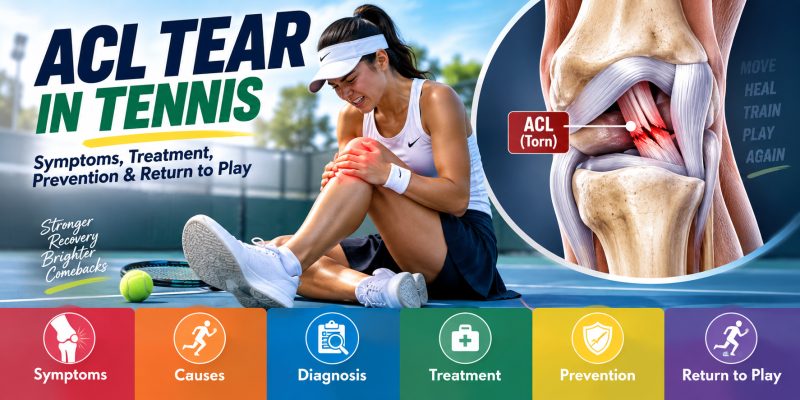
An ACL (anterior cruciate ligament) tear is a significant knee injury that can affect tennis players during sudden stops, changes of direction, pivoting, jumping, or awkward landings.
The ACL helps control forward movement and rotational stability of the knee. A partial or complete tear can cause pain, swelling, instability, and difficulty performing explosive tennis movements.
ACL injuries can be treated with structured rehabilitation, surgery, or a combination of approaches depending on the individual injury, knee stability, athletic goals, and associated damage.
Symptoms
Common symptoms of an ACL tear include:
- A sudden popping sensation or sound in the knee
- Rapid swelling, often within several hours
- Knee pain and tenderness
- Difficulty putting weight on the leg
- Reduced knee range of motion
- A feeling that the knee is unstable or “giving way”
- Difficulty pivoting, stopping, or changing direction
- Reduced confidence during athletic movements
Swelling and pain may improve after the initial injury, but instability can remain, particularly during tennis-specific movements.
Causes
ACL tears commonly occur through a non-contact mechanism, although contact injuries can also happen.
Tennis-related causes include:
- Sudden changes of direction
- Rapid deceleration
- Pivoting with the foot planted
- Awkward landing after a jump
- Sudden stopping while chasing a ball
- Poor landing mechanics
- Contact or collision with another player
Fatigue may also contribute by reducing neuromuscular control and movement quality.
Diagnosis
Diagnosis typically involves:
1. Medical History
The clinician will ask how the injury occurred, whether a pop was felt or heard, and how quickly swelling developed.
2. Physical Examination
The knee is evaluated for swelling, range of motion, tenderness, and instability. Tests such as the Lachman test, anterior drawer test, and pivot-shift test may help assess ACL function.
3. Imaging
MRI is commonly used to confirm an ACL injury and identify associated injuries involving the meniscus, cartilage, or other knee structures. X-rays may be used to evaluate bone injury or other causes of knee symptoms.
Treatment
Treatment depends on whether the ACL tear is partial or complete, the degree of instability, associated injuries, and the player's goals.
Rehabilitation
Structured physical therapy may focus on:
- Reducing pain and swelling
- Restoring full knee extension and flexion
- Regaining quadriceps strength
- Strengthening the hamstrings and gluteal muscles
- Improving balance and proprioception
- Developing landing and deceleration mechanics
- Progressive running and change-of-direction training
Some people can return to sport without ACL reconstruction, particularly when the knee remains stable and their sporting demands are compatible with non-operative management.
ACL Reconstruction
For athletes who want to return to high-level pivoting sports such as tennis and have persistent instability, ACL reconstruction may be recommended.
Rehabilitation following reconstruction is extensive and progresses through multiple stages. The exact timeline varies according to the surgery, associated injuries, healing, strength recovery, and functional testing.
Prevention
ACL injury risk may be reduced through neuromuscular and strength training programs that emphasize:
- Proper landing technique
- Controlled deceleration
- Single-leg strength
- Hamstring and quadriceps strength
- Hip and glute strength
- Balance and coordination
- Safe cutting and pivoting mechanics
- Adequate warm-up
- Progressive conditioning
- Fatigue management
Tennis players should particularly practice controlled stopping and directional changes, because these movements place substantial demands on knee stability.
Return to Tennis
Returning to tennis after an ACL injury should be criteria-based rather than determined solely by time.
A progressive return may follow this sequence:
Pain and swelling control → full range of motion → strength recovery → balance and neuromuscular control → running → acceleration/deceleration → lateral movement → tennis-specific drills → practice → competition
Before returning to competitive tennis, the player should demonstrate:
- Full or near-full knee motion
- No significant swelling
- Minimal or no pain
- Strong quadriceps and hamstrings
- Good single-leg control
- Controlled landing and deceleration
- Ability to accelerate and stop safely
- Ability to perform lateral movements and tennis-specific changes of direction
- Psychological confidence in the injured knee
After ACL reconstruction, return to competitive tennis often takes many months, and returning too early can increase the risk of reinjury. The treating orthopedic or sports-medicine team should determine when the athlete has met the appropriate strength and functional criteria.
Important: An ACL tear is a major knee injury. A sudden pop followed by rapid swelling, instability, or difficulty bearing weight should be evaluated by a qualified sports-medicine or orthopedic professional.