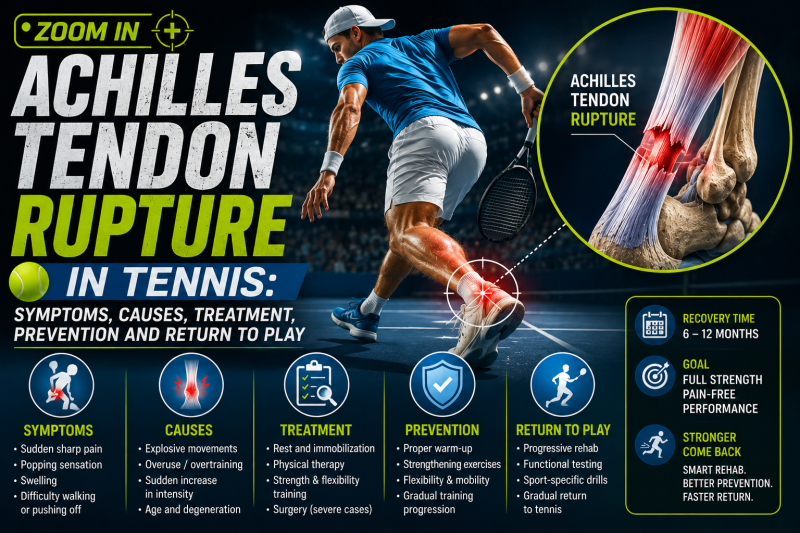
An Achilles tendon rupture is a serious tennis injury involving a complete or near-complete tear of the Achilles tendon, the strong tendon connecting the calf muscles to the heel bone.
The injury can occur during an explosive tennis movement such as a powerful push-off, sprint, sudden change of direction, or landing. Although Achilles ruptures are relatively uncommon compared with ankle sprains and calf strains, they can be highly significant because the tendon is essential for transmitting force from the calf to the foot.
For competitive and professional tennis players, treatment requires careful protection of the tendon followed by progressive rehabilitation. Returning to tennis too early can increase the risk of weakness, re-rupture, or long-term loss of explosive performance.
Symptoms
An Achilles tendon rupture often produces a sudden and unmistakable sensation in the back of the ankle or lower leg.
Common symptoms include:
-
Sudden sharp pain in the Achilles region
-
A loud or noticeable "pop"
-
Feeling as though someone kicked or struck the back of the ankle
-
Difficulty pushing off the injured foot
-
Difficulty walking normally
-
Swelling around the Achilles tendon and ankle
-
Bruising that may develop around the ankle or lower leg
-
Weakness when attempting to stand on the toes
-
Inability or significant difficulty performing a single-leg heel raise
-
A visible or palpable gap in the tendon in some cases
Pain may decrease relatively quickly after the initial injury, but this does not mean the tendon has healed. Loss of push-off strength is one of the major functional signs.
Causes
Achilles tendon rupture usually occurs when the tendon is exposed to a sudden, high force that exceeds its capacity.
Common Tennis Mechanisms
In tennis, rupture can occur during:
-
Explosive acceleration
-
Sudden defensive movements
-
A powerful push-off from the baseline
-
Rapid lateral movement
-
Sudden changes of direction
-
Jumping and landing
-
Aggressive serving movements
-
Returning from a wide position on the court
A typical mechanism involves the player attempting to accelerate while the ankle is forced upward and the calf muscles contract strongly.
Risk Factors
Risk can increase with:
-
Previous Achilles tendon problems
-
Increasing age
-
Sudden increases in training volume
-
Poor calf strength or endurance
-
Inadequate conditioning
-
Limited ankle mobility
-
Previous lower-limb injury
-
Sudden return to intense tennis after inactivity
-
Certain medications, particularly systemic or local corticosteroid exposure, which should be discussed with a physician
Diagnosis
An Achilles rupture requires prompt medical assessment.
A sports physician or orthopedic specialist will usually begin with a physical examination.
Thompson Test
The Thompson test is commonly used. The clinician squeezes the calf while observing the movement of the foot. Abnormal or absent plantarflexion can indicate an Achilles rupture.
Functional Examination
The clinician may also evaluate:
-
Ability to walk
-
Push-off strength
-
Single-leg heel-raise ability
-
Achilles tendon continuity
-
Swelling and bruising
-
The location and size of any tendon gap
Ultrasound or MRI
Diagnostic ultrasound can help visualize the tendon and determine the location and extent of the rupture.
MRI may be used when the diagnosis is uncertain or when more detailed anatomical information is needed for treatment planning.
A suspected Achilles rupture should not be treated like a routine calf strain. The athlete should stop playing and obtain medical evaluation.
Treatment
Treatment depends on factors including the player's age, activity level, tendon characteristics, rupture location, functional demands, and medical assessment.
The two major treatment approaches are non-operative rehabilitation and surgical repair followed by rehabilitation.
Early Protection
Immediately after injury, the priority is to protect the tendon.
Depending on medical assessment, treatment may include:
-
Immobilization in a position that reduces tension on the Achilles
-
Crutches or protected weight bearing
-
Swelling management
-
Avoiding aggressive stretching
-
Avoiding running, jumping and explosive movements
The injured player should not attempt to "test" the tendon by sprinting or repeatedly pushing off the foot.
Non-Operative Treatment
Some Achilles ruptures can be successfully managed without surgery using a structured functional rehabilitation program.
Modern non-operative protocols generally involve early protection followed by progressively increasing tendon loading under professional supervision.
The foot is initially protected in a plantar-flexed position, followed by gradual restoration of ankle motion and progressive strengthening.
Surgical Treatment
Surgical repair may be considered for athletes with high functional demands, certain types of complete rupture, or specific clinical circumstances.
Surgery reconnects the torn tendon, after which the athlete enters a structured rehabilitation program.
Surgery does not eliminate the need for rehabilitation. The tendon still requires months of biological healing and progressive loading before high-level tennis is safe.
The decision between surgical and non-surgical treatment should be made with an orthopedic or sports-medicine specialist.
Rehabilitation
Achilles rehabilitation should be criteria-based rather than based solely on the calendar.
Phase 1: Protection and Early Recovery
Early weeks
Goals include:
-
Protecting the healing tendon
-
Controlling swelling
-
Restoring safe mobility
-
Maintaining general fitness without stressing the tendon
-
Preventing excessive muscle loss
Weight bearing and ankle movement are progressed according to the treating clinician's protocol.
Aggressive calf stretching should generally be avoided during the early healing period.
Phase 2: Progressive Strength
As healing progresses, rehabilitation introduces progressively greater calf loading.
Exercises may include:
-
Isometric calf contractions
-
Double-leg heel raises
-
Progressive seated calf raises
-
Standing calf raises
-
Controlled eccentric loading
-
Progressive resistance training
Both the gastrocnemius and soleus must be rebuilt because the entire calf-Achilles complex contributes to tennis acceleration and court movement.
Phase 3: Advanced Strength and Power
The player gradually progresses toward:
-
Heavy calf strengthening
-
Single-leg heel raises
-
Loaded calf raises
-
Lower-limb strength training
-
Balance and proprioception
-
Progressive plyometric exercises
-
Hopping drills
-
Landing mechanics
-
Acceleration and deceleration training
The objective is not simply to make the tendon pain-free. The player needs sufficient strength, power, endurance and confidence to tolerate the repeated loading demands of tennis.
Phase 4: Tennis-Specific Rehabilitation
Once appropriate strength and impact tolerance have been established, tennis activities can gradually return.
A typical progression may include:
Stage 1: Walking and controlled court movement
Stage 2: Light straight-line jogging
Stage 3: Progressive running
Stage 4: Controlled acceleration and deceleration
Stage 5: Lateral movement and tennis footwork
Stage 6: Shadow swings and controlled hitting
Stage 7: Groundstrokes with progressive movement
Stage 8: Controlled point construction
Stage 9: Practice sets and match simulation
Stage 10: Competitive tennis
The exact progression must be individualized by the rehabilitation team.
Prevention
An Achilles rupture cannot always be prevented, but tennis players can reduce risk by developing adequate lower-limb capacity.
Build Calf Strength
Regularly train both:
-
Straight-knee calf strength for the gastrocnemius
-
Bent-knee calf strength for the soleus
Progress from bodyweight exercises toward appropriately loaded strengthening.
Increase Training Gradually
Avoid sudden jumps in:
-
Court time
-
Sprinting
-
Plyometric work
-
Match frequency
-
High-intensity conditioning
The tendon needs time to adapt to increasing loads.
Warm Up Properly
A tennis warm-up should progressively prepare the athlete for:
-
Running
-
Split steps
-
Acceleration
-
Lateral movement
-
Deceleration
-
Jumping
Maintain Whole-Leg Strength
Achilles protection is not only about the Achilles.
Strong:
-
Calves
-
Hamstrings
-
Quadriceps
-
Glutes
-
Hip muscles
-
Core
help the player absorb and produce force efficiently.
Return to Tennis
Returning to tennis after Achilles tendon rupture is a long-term rehabilitation process, not a simple return-after-X-weeks injury.
Many athletes require many months before returning to unrestricted sport, and high-level tennis players may require additional time to regain explosive performance.
A player should not return simply because the tendon feels comfortable during everyday walking.
Important Return-to-Tennis Criteria
Before unrestricted tennis, rehabilitation should demonstrate appropriate:
-
Calf strength
-
Single-leg heel-raise capacity
-
Calf endurance
-
Ankle range of motion
-
Jumping tolerance
-
Hopping ability
-
Acceleration capacity
-
Deceleration control
-
Lateral movement ability
-
Tennis-specific movement confidence
-
Ability to tolerate progressive court sessions
The injured and uninjured legs should be compared using objective performance testing where available.
Why Professional Tennis Requires Extra Caution
ATP and WTA-level tennis places extraordinary demands on the Achilles tendon.
A player may need to repeatedly:
-
Split step
-
Accelerate
-
Stop suddenly
-
Push laterally
-
Recover toward the center
-
Change direction
-
Jump
-
Land
-
Produce explosive first-step power
A tendon that is strong enough for walking may still be inadequately prepared for these repeated high-speed demands.
The final stages of rehabilitation therefore need to reproduce the speed, intensity and unpredictability of competitive tennis.
The Biggest Mistake: Returning Too Soon
One of the biggest mistakes after Achilles tendon rupture is judging recovery only by pain.
Pain can improve while substantial deficits in calf strength, power and endurance remain.
The goal should be more than simply returning to the court.
The goal is to restore enough strength, tendon capacity, explosiveness, movement quality and confidence to withstand competitive tennis.
When to Seek Medical Attention
If a tennis player experiences a sudden pop in the back of the ankle, feels as though they were kicked in the Achilles region, or suddenly loses the ability to push off the foot, they should stop playing and seek prompt medical assessment.
An Achilles rupture is a significant injury and should not be self-diagnosed as a simple calf strain or "Tennis Leg."
Final Takeaway
An Achilles tendon rupture is one of the most serious lower-limb injuries a tennis player can experience.
Successful recovery requires:
Accurate diagnosis → tendon protection → progressive loading → strength restoration → plyometric training → running → tennis-specific movement → controlled return to competition.
For competitive players, the return-to-tennis decision should be based on functional capacity and objective rehabilitation criteria, not simply the number of months since the injury.
A carefully progressed rehabilitation program gives the player the best opportunity to return to tennis while minimizing the risk of reinjury and restoring the explosive movement required for high-level play.
This article is educational and does not replace an examination by a qualified sports physician, orthopedic specialist, or physical therapist.