
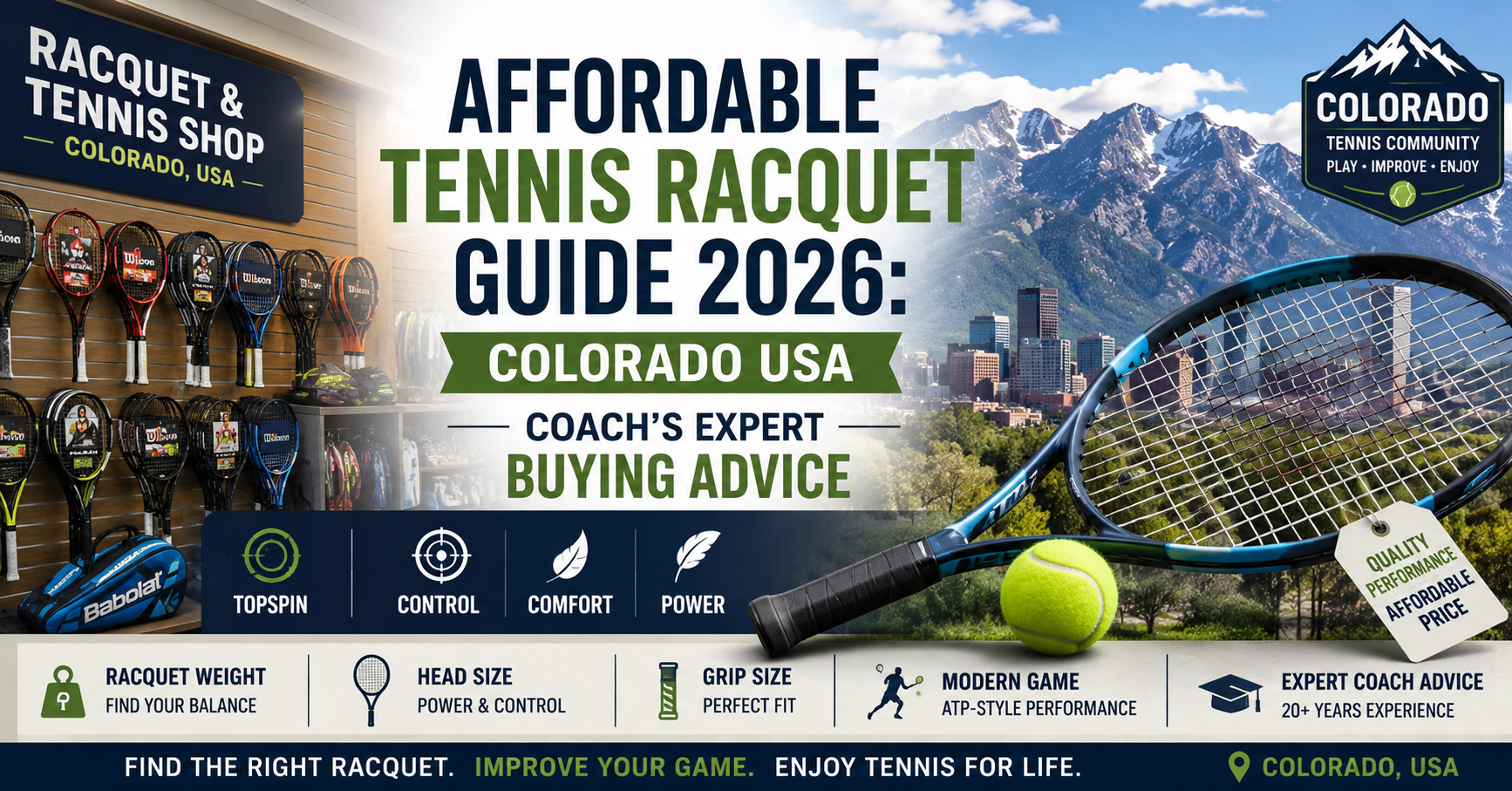
Why Choosing an Affordable Tennis Racquet Matters
Buying your first tennis racquet can feel overwhelming. Walk into any tennis shop in Colorado and you will see dozens of models promising more spin, more power, and more control. The truth is simple: most recreational players do not need a $300 professional racquet to improve their game.
After coaching competitive juniors, adult beginners, and league players for more than 20 years, I have seen many players improve faster with affordable tennis racquets that match their skill level correctly. The best racquet is not always the most expensive one. It is the racquet that helps you swing confidently, develop modern ATP-style technique, and stay comfortable during long practice sessions.
Today’s affordable racquets are significantly better than budget racquets from 10 years ago. Manufacturers now include advanced graphite blends, vibration reduction systems, and larger sweet spots even in lower price categories. That means players in Colorado can now find quality performance racquets without spending a fortune.
Whether you play in Denver, Colorado Springs, Boulder, or local mountain communities, this guide will help you choose the right affordable tennis racquet for your game.
What Makes a Tennis Racquet Affordable?
An affordable tennis racquet usually falls between $80 and $180. This range gives players solid quality without entering premium professional pricing.
Here is a simple breakdown:
| Price Range | Type of Racquet | Best For |
|---|---|---|
| Under $80 | Entry-level aluminum | Casual beginners |
| $80–$180 | Affordable performance racquets | Most recreational players |
| $180–$300+ | Premium advanced racquets | Competitive players |
The sweet spot for most players is the middle category. These racquets offer:
- Better comfort
- Improved topspin potential
- Stable control
- Modern ATP-style performance
- Longer durability
Why Colorado Tennis Players Need the Right Racquet
Tennis conditions in Colorado are unique because of altitude and dry weather. Balls travel faster at higher elevation, especially in cities like Denver.
This affects racquet choice in several ways:
Faster Ball Speed
At altitude, the ball flies through the air quicker. Players often need slightly more control-oriented racquets to keep shots inside the lines.
Dry Climate
Colorado’s dry air can make tennis balls bounce higher and feel livelier. Racquets with balanced control and comfort help players manage this.
Outdoor Wind Conditions
Wind is common in many Colorado tennis locations. Lightweight racquets that are too unstable may struggle in windy conditions.
Understanding Tennis Racquet Weight
Weight is one of the most important factors when choosing an affordable tennis racquet.
Lightweight Racquets
Best For:
- Beginners
- Juniors transitioning to adult frames
- Players with slower swings
Benefits:
- Easier to maneuver
- Helps create faster swings
- Less tiring initially
Drawbacks:
- Less stability
- Can feel too powerful
- Harder against heavy hitters
Typical weight:
- 255g–285g unstrung
Midweight Racquets
Best For:
- Intermediate players
- Most recreational adults
- Players learning topspin
Benefits:
- Balanced power and control
- Better stability
- Easier transition to advanced tennis
Typical weight:
- 285g–305g unstrung
This is usually the ideal range for affordable performance racquets.
Heavy Racquets
Best For:
- Advanced players
- Strong hitters
- Competitive athletes
Benefits:
- Excellent control
- Stability on fast shots
- Better plow-through
Drawbacks:
- Demands stronger technique
- Harder for beginners
Typical weight:
- 305g+
Understanding Head Size
Head size changes how forgiving and powerful the racquet feels.
Oversize Heads (105–115 sq in)
Benefits:
- Larger sweet spot
- Easier power
- More forgiveness
Best For:
- Beginners
- Seniors
- Casual players
Drawbacks:
- Less precision
- Harder to develop advanced control
Midplus Heads (98–104 sq in)
This is the modern ATP-inspired category.
Benefits:
- Balance of control and power
- Better spin production
- Improved shot precision
Best For:
- Intermediate players
- Improving beginners
- Competitive recreational players
Most affordable performance racquets fall into this range.
Smaller Heads (95–97 sq in)
Benefits:
- Maximum control
- Precise targeting
Drawbacks:
- Smaller sweet spot
- Requires excellent timing
Best For:
- Advanced players
Choosing the Correct Grip Size
Grip size is commonly ignored by beginners, but it strongly affects comfort and injury prevention.
Common Grip Sizes
| Grip Size | Measurement |
|---|---|
| 4 1/8 | Small hands |
| 4 1/4 | Average women |
| 4 3/8 | Average men |
| 4 1/2 | Larger hands |
Why Grip Size Matters
Using the wrong grip can cause:
- Wrist pain
- Tennis elbow
- Poor racquet control
- Reduced topspin production
A proper grip allows relaxed hand pressure while maintaining control during modern ATP-style swings.
Affordable Racquet Features That Actually Matter
Many players get distracted by marketing terms. Instead, focus on these practical performance areas.
Topspin Potential
Modern tennis is built around topspin. ATP professionals generate heavy spin to control aggressive shots.
Features that improve topspin:
- Open string patterns
- Faster swing speed
- Midplus head size
- Spin-friendly frame design
Affordable racquets today can generate excellent spin without professional pricing.
Control
Control helps keep the ball inside the lines.
Racquets with better control usually have:
- Slightly smaller heads
- Moderate power levels
- Stable construction
- Balanced weight
Colorado players often benefit from control-oriented frames because altitude increases ball speed.
Comfort
Comfort matters more than many beginners realize.
Stiff or poorly balanced racquets can create arm pain over time.
Comfortable racquets usually feature:
- Flexible frames
- Vibration dampening
- Moderate stiffness ratings
- Balanced weight distribution
If you play multiple times weekly, prioritize comfort.
Power
Power helps players hit deeper shots without excessive effort.
Power-oriented racquets generally have:
- Larger heads
- Lighter frames
- Stiffer construction
Beginners often need moderate power while learning proper mechanics.
Best Affordable Tennis Racquet Types
Instead of chasing exact models, focus on categories that match your level.
Beginner Affordable Racquets
Ideal Features
- 100–105 sq in head
- Lightweight feel
- Comfortable response
- Forgiving sweet spot
Best For:
- New players
- Casual hitters
- Adult beginners
These racquets help players learn modern fundamentals without frustration.
Intermediate Affordable Racquets
Ideal Features
- 98–100 sq in head
- Midweight frame
- Balanced control and power
- Spin-friendly design
Best For:
- League players
- Improving recreational athletes
- Players using topspin regularly
This category offers the best overall value.
Spin-Friendly Affordable Racquets
Modern ATP tennis depends heavily on topspin mechanics.
Spin-focused racquets often feature:
- Open 16x19 string patterns
- Faster handling
- Aerodynamic frame shapes
Best For:
- Baseline players
- Aggressive topspin hitters
- Younger athletic players
Comfortable Affordable Racquets
Some players prioritize arm protection over maximum spin or power.
Comfortable racquets usually offer:
- Softer frame flex
- Shock absorption systems
- Stable construction
Best For:
- Older adults
- Players recovering from injury
- Tennis elbow sufferers
ATP-Style Modern Tennis Influence
Professional tennis has changed dramatically over the last two decades.
Players today use:
- Heavy topspin
- Faster racquet head speed
- Aggressive baseline movement
- Modern windshield-wiper forehands
Affordable racquets now copy many professional design concepts.
However, recreational players should not blindly copy ATP professionals.
Many pros use:
- Extremely heavy racquets
- Tight string setups
- Demanding control frames
For most players in Colorado, a slightly lighter and more forgiving racquet produces better results.
Common Beginner Mistakes When Buying Affordable Racquets
Buying the Cheapest Racquet Available
Very cheap aluminum racquets often vibrate excessively and limit long-term improvement.
Instead, invest in an affordable graphite or graphite-composite frame.
Choosing a Professional Racquet Too Early
Many beginners buy advanced racquets used by touring professionals.
This usually causes:
- Late contact points
- Reduced power
- Arm fatigue
- Poor confidence
Use a racquet that supports your current level.
Ignoring String Quality
Strings strongly affect performance.
Even affordable racquets perform significantly better with quality strings.
Beginners should usually choose:
- Synthetic gut
- Multifilament strings
These provide comfort and easy power.
Picking the Wrong Weight
Extremely light racquets may feel good initially but become unstable as players improve.
Moderate weight often creates better long-term development.
Affordable Tennis Racquet Comparison
Power vs Control Racquets
| Feature | Power Racquets | Control Racquets |
|---|---|---|
| Head Size | Larger | Smaller |
| Swing Effort | Easier | More demanding |
| Depth | Easier | More controlled |
| Topspin | Moderate | Advanced players generate more |
| Best For | Beginners | Experienced players |
Lightweight vs Midweight Racquets
| Feature | Lightweight | Midweight |
|---|---|---|
| Maneuverability | Excellent | Good |
| Stability | Lower | Higher |
| Comfort | Moderate | Better |
| Power | Easier | More balanced |
| Best For | Beginners | Intermediate players |
Practical Buying Advice From a 20-Year Coach
Demo Before Buying
If possible, test racquets before purchasing.
Even racquets with similar specifications can feel completely different.
Focus on Feel, Not Marketing
Ignore exaggerated claims like:
- “Maximum spin technology”
- “Explosive power”
- “Professional precision”
Instead, ask:
- Does it feel comfortable?
- Can I swing naturally?
- Do I control the ball well?
- Does it encourage topspin?
Think Long-Term
Choose a racquet that supports improvement for several years.
Many beginners outgrow ultra-light beginner racquets quickly.
Budget for Strings and Grip Replacement
Do not spend your entire budget on the frame alone.
Important extras include:
- Quality strings
- Overgrips
- Dampeners
- Replacement grips
How Often Should You Replace a Tennis Racquet?
Affordable racquets can last many years if maintained properly.
Replace your racquet when:
- The frame cracks
- It loses structural stability
- Vibrations increase
- Your skill level significantly improves
Most recreational players replace racquets every 4–7 years.
Best Tennis Racquet Setup for Colorado Recreational Players
For most adult players in Colorado, I recommend:
Ideal Setup
Racquet Weight
285g–300g unstrung
Head Size
100 sq in
String Pattern
16x19
Grip Size
Properly fitted to hand size
String Type
Comfortable multifilament or synthetic gut
This setup balances:
- Topspin
- Control
- Comfort
- Power
It also supports modern ATP-style development without excessive difficulty.
Tennis Racquet Maintenance Tips
Avoid Extreme Heat
Never leave your racquet inside a hot car during Colorado summer months.
Heat damages:
- Strings
- Grip material
- Frame integrity
Replace Strings Regularly
Dead strings reduce:
- Spin
- Control
- Comfort
Recreational players should restring at least several times yearly.
Replace Overgrips Frequently
Fresh grips improve:
- Comfort
- Confidence
- Racquet control
Sweaty or slippery grips hurt performance.
FAQs About Affordable Tennis Racquets
What is the best affordable tennis racquet for beginners?
The best beginner racquet usually has:
- A 100–105 sq in head
- Lightweight to midweight balance
- Comfortable graphite construction
Avoid extremely heavy professional racquets early on.
Can affordable racquets still produce topspin?
Yes. Modern affordable racquets can generate excellent topspin, especially when paired with proper technique and spin-friendly strings.
Are expensive tennis racquets worth it?
Not always. Many recreational players perform better using affordable midrange racquets because they are more forgiving and comfortable.
What racquet weight is best for adults?
Most adult recreational players benefit from racquets between 285g and 300g unstrung.
Should beginners use oversized racquets?
Oversized racquets help beginners initially because they provide:
- Larger sweet spots
- Easier depth
- Better forgiveness
However, many players eventually transition to midplus heads.
What grip size should I choose?
Choose a grip that feels secure without excessive squeezing. Using the wrong size may contribute to discomfort or injury.
Final Thoughts on Choosing an Affordable Tennis Racquet
Finding the right affordable tennis racquet is about balance, not hype.
The best racquet helps you:
- Swing confidently
- Learn topspin naturally
- Control the ball consistently
- Stay comfortable during long sessions
- Develop modern ATP-style mechanics
After 20 years of coaching, I can confidently say that most recreational players improve faster with balanced, forgiving racquets rather than demanding professional frames.
Players in Colorado should especially prioritize control, comfort, and spin-friendly performance because altitude conditions naturally increase ball speed.
Remember this simple rule: a racquet should make tennis feel easier, not harder.
Choose a frame that matches your current level, supports long-term development, and encourages confident swings. If you do that, even an affordable tennis racquet can help you play your best tennis for years to come.