
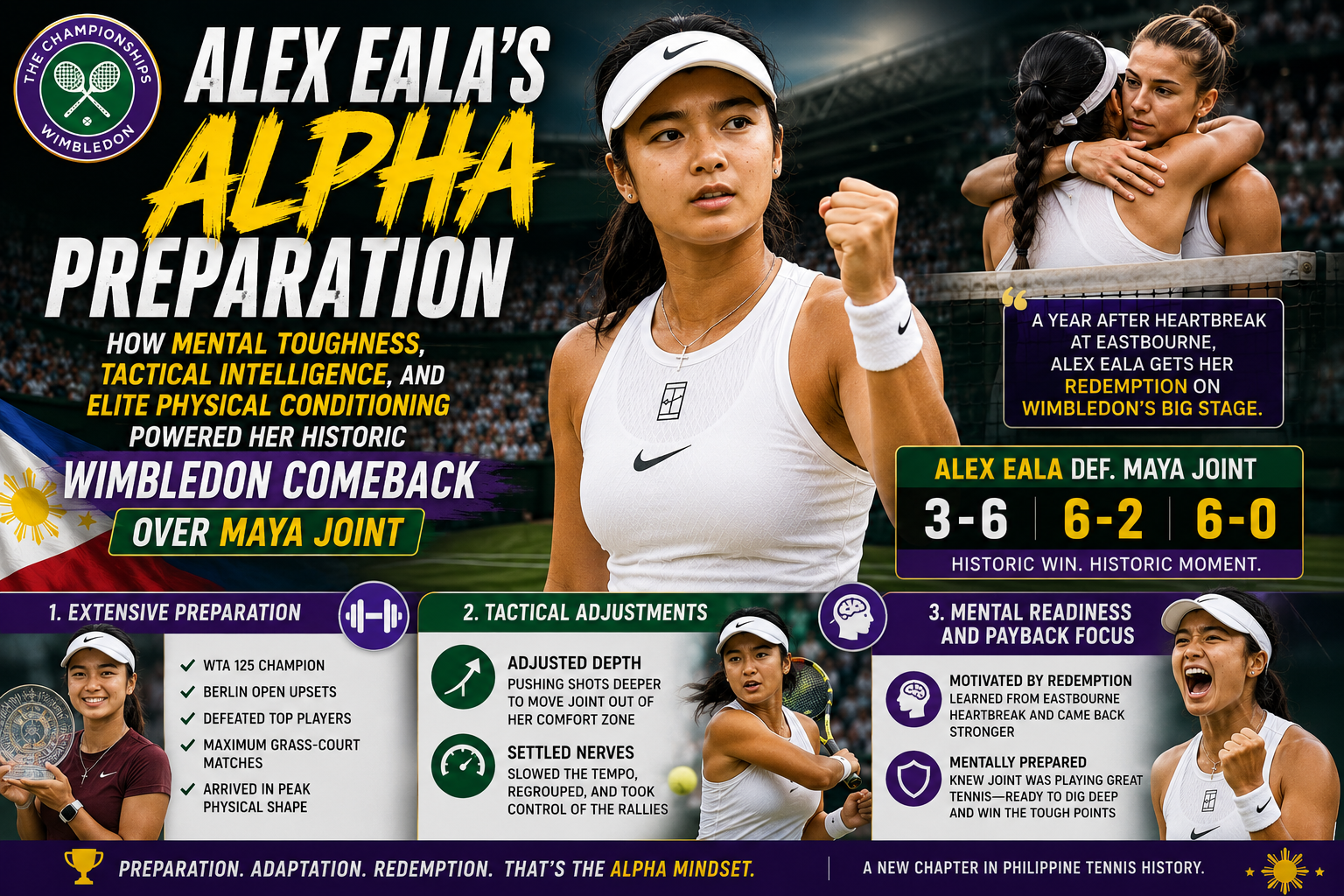
Alex Eala's Alpha Preparation: An ATP Coach Explains the Mental, Physical, and Tactical Blueprint Behind Her Historic Wimbledon Victory Over Maya Joint
Championship matches are rarely won on match day alone.
Long before the first serve is struck, elite players have already laid the foundation through months of disciplined preparation, countless hours on the practice court, physical conditioning, tactical planning, and psychological training. The victory itself is simply the visible result of invisible work.
That perfectly describes Alex Eala's remarkable comeback victory over Maya Joint at Wimbledon.
After dropping the opening set 3-6, Eala produced one of the tournament's most impressive reversals, storming back 6-2, 6-0 to become the first Filipina in history to reach the third round of a Grand Slam singles event.
For casual fans, it appeared to be an incredible comeback.
For ATP coaches, sports scientists, and performance specialists, it was a textbook example of elite preparation meeting elite execution.
Winning from behind against a confident opponent isn't simply about talent.
It requires months of physical development.
It requires tactical adaptability.
Most importantly, it demands complete emotional control.
As every ATP coach understands, champions don't rise to the occasion.
They rise to the level of their preparation.
The Alpha Mindset Begins Before Tournament Week
One of the biggest misconceptions in tennis is that confidence suddenly appears during a tournament.
Professional confidence is built gradually.
Every difficult practice.
Every fitness session.
Every recovery day.
Every tough match contributes another layer of belief.
By the time Eala walked onto Centre Court, her confidence had already been earned.
She knew she had prepared better than ever before.
That quiet confidence became one of the greatest weapons in her comeback.
Physical Preparation: Building a Champion for Grass
Grass is unlike any other tennis surface.
Points are faster.
The ball stays lower.
Movement becomes more explosive.
Reaction time becomes shorter.
Players cannot simply arrive at Wimbledon expecting success.
They must specifically prepare for grass.
Eala's pre-Wimbledon schedule demonstrated exactly how modern professionals build confidence through competition.
Instead of limiting herself to practice sessions, she entered multiple high-level tournaments, allowing her body to adapt naturally to grass-court movement.
Each match improved her timing.
Each victory reinforced her belief.
Each challenge increased her readiness.
ATP strength and conditioning coaches often emphasize that match fitness cannot be replicated inside a gym.
Competition creates unique physical demands.
Decision-making under fatigue.
Explosive recovery between points.
Managing adrenaline.
Maintaining technical consistency despite physical exhaustion.
Eala entered Wimbledon already accustomed to these demands.
Winning Before Wimbledon
Momentum matters.
Leading into Wimbledon, Eala had already demonstrated excellent grass-court form.
Her preparation included:
- Capturing a WTA 125 title.
- Building confidence through multiple victories.
- Developing rhythm on grass.
- Improving movement on low-bouncing courts.
- Increasing match endurance.
Championships build belief.
Every trophy reinforces months of training.
Instead of arriving at Wimbledon searching for confidence, Eala arrived carrying confidence.
That difference is enormous.
Elite athletes perform best when recent success supports long-term preparation.
Learning Through Upset Victories
Perhaps the most valuable part of Eala's preparation came through victories against experienced professionals.
Her impressive wins over players such as Donna Vekić and Elina Svitolina proved she could compete with established stars.
From an ATP coaching perspective, these victories accomplish several things simultaneously.
First, they validate technical improvements.
Second, they reinforce tactical decision-making.
Third, they reduce intimidation when facing higher-ranked opponents.
Young players often lose because they respect opponents too much.
After defeating elite competitors, that fear disappears.
Eala entered Wimbledon believing she belonged on the same court as anyone.
That belief cannot be manufactured.
It must be earned.
Physical Conditioning: The Hidden Advantage
The average tennis fan notices forehands and serves.
Performance coaches notice movement.
Movement wins matches.
Against Maya Joint, Eala displayed remarkable physical endurance.
Even after losing the opening set, her speed remained exceptional.
She chased every ball.
She recovered quickly after wide shots.
She maintained explosive first steps deep into the deciding set.
Professional conditioning extends far beyond cardiovascular fitness.
Elite players train for:
- Acceleration.
- Deceleration.
- Balance.
- Core stability.
- Rotational power.
- Recovery between points.
- Injury prevention.
These physical qualities become especially important on grass, where balance can determine every rally.
Eala appeared stronger as the match progressed.
That is often the clearest sign of outstanding preparation.
The Importance of Court Time
Following her victory, Eala emphasized that she had "put in the hours."
Those words carry significant meaning.
Hours create instincts.
Instincts create confidence.
Confidence produces execution.
Practice is not simply repetition.
Professional players use every training session with purpose.
Serving targets.
Return positioning.
Approach patterns.
Transition movement.
Slice defense.
Grass-court footwork.
By accumulating extensive match play before Wimbledon, Eala allowed these movements to become automatic.
Automatic decisions are faster.
Faster decisions win points.
Tactical Preparation: Having Multiple Plans
One hallmark of elite competitors is entering matches with more than one strategy.
Many amateur players rely on a single style.
If it fails, they have no alternatives.
Professionals prepare multiple tactical options before stepping on court.
Against Maya Joint, Eala understood she might need adjustments.
When the Australian dominated the opening set, Eala did not panic.
She simply moved to Plan B.
This ability reflects excellent coaching preparation.
Great players anticipate challenges before they happen.
Tactical Adjustment No. 1: Increasing Shot Depth
One of the most noticeable changes came through improved rally depth.
In the first set, Joint frequently controlled the baseline.
By striking deeper during the second set, Eala gradually pushed her opponent farther behind the court.
Depth creates pressure without increasing risk.
Balls landing near the baseline reduce attacking opportunities while maintaining safe margins over the net.
Professional coaches constantly stress that depth often matters more than raw power.
Eala executed this principle brilliantly.
Tactical Adjustment No. 2: Slowing the Tempo
Momentum can overwhelm young players.
Instead of matching Joint's emotional intensity, Eala deliberately slowed the match mentally.
She took more time between points.
She reset her breathing.
She focused on one rally at a time.
This subtle change stabilized her emotions.
Sports psychologists refer to this as emotional regulation.
Elite performers understand that slowing the mind often speeds up performance.
Once Eala regained emotional balance, her tennis naturally improved.
Tactical Adjustment No. 3: Extending Rallies
Joint entered the match aggressively.
Instead of attempting immediate winners, Eala encouraged longer exchanges.
Long rallies test patience.
They also expose decision-making under pressure.
As rallies lengthened, Eala's consistency began wearing down her opponent.
Every extra shot increased pressure.
Eventually, Joint started forcing lower-percentage winners.
That shift proved decisive.
Mental Preparation: The Power of Redemption
Perhaps the strongest emotional factor entering the match was unfinished business.
Their previous meeting at Eastbourne ended painfully for Eala.
She came agonizingly close to victory before suffering a heartbreaking defeat.
Many athletes would approach the rematch seeking revenge.
Champions approach rematches seeking improvement.
That distinction is important.
Revenge creates tension.
Improvement creates clarity.
Rather than obsessing over the previous loss, Eala used it as valuable information.
She learned.
She adapted.
She returned stronger.
Turning Pain Into Fuel
Every elite athlete experiences disappointment.
Grand Slam champions lose finals.
Olympic medalists miss podiums.
Hall of Fame players suffer devastating defeats.
What separates champions isn't avoiding pain.
It's transforming pain into motivation.
Eala's Eastbourne disappointment became preparation rather than trauma.
Instead of fearing another close finish, she embraced the opportunity to rewrite the story.
That psychological transformation represents tremendous maturity.
Respect Without Fear
Eala understood exactly what she faced.
Maya Joint had entered Wimbledon in outstanding form and was riding enormous confidence after a major upset earlier in the tournament.
Rather than underestimating her opponent, Eala respected her strengths.
Respect, however, never became fear.
Professional competitors prepare by honestly evaluating opponents while maintaining confidence in their own abilities.
That balance is essential.
Too much confidence becomes arrogance.
Too much respect becomes hesitation.
Eala found the perfect middle ground.
Digging Deep During Pressure
The final set score of 6-0 can be misleading.
Several early games featured exhausting deuce battles.
Those moments required exceptional concentration.
Physical fatigue combines with emotional pressure during extended games.
Many matches are decided not by spectacular winners but by who maintains discipline during marathon points.
Eala repeatedly trusted her patterns.
She resisted forcing risky shots.
She remained patient.
Winning those close games ultimately broke Joint's resistance.
Once momentum shifted completely, the scoreboard accelerated.
Emotional Control Under Pressure
One of the most impressive aspects of Eala's performance was her body language.
She rarely showed frustration.
She celebrated appropriately.
She maintained positive posture.
Sports psychologists frequently emphasize that emotions influence decision-making.
Negative emotions narrow attention.
Positive emotions expand awareness.
By staying emotionally composed, Eala preserved the clarity needed to execute tactical adjustments.
That emotional discipline proved just as valuable as her technical skills.
Confidence Built Through Preparation
There is an important difference between hoping to win and expecting to compete well.
Hope depends on circumstances.
Preparation creates expectation.
Because Eala knew she had trained extensively, competed successfully, and developed physically, she never lost belief after the first set.
Confidence built through preparation survives adversity.
Confidence built only through results often disappears after setbacks.
The comeback reflected months of work, not one emotional speech.
Lessons for Every Tennis Player
Players of every age can learn valuable lessons from Eala's preparation.
Prepare before confidence is needed.
Confidence comes from work completed before competition begins.
Play matches, not just practice.
Competitive experience develops instincts impossible to simulate in training.
Expect adjustments.
No match unfolds exactly as planned.
Great players prepare multiple solutions.
Use losses as education.
Defeats reveal opportunities for improvement.
They should never define future performance.
Train the mind as seriously as the body.
Mental endurance determines outcomes when physical abilities become equal.
The ATP Coach's Perspective
Watching this performance through the eyes of an ATP coach reveals something profound.
Alex Eala did not suddenly become mentally tougher during the second set.
She had already developed that resilience months earlier.
She did not magically discover better movement.
She had built it through conditioning.
She did not invent tactical adjustments on the spot.
She and her coaching team had prepared multiple options long before match day.
Everything visible on Centre Court originated from invisible preparation.
That is the hidden reality of championship tennis.
Looking Ahead: Carrying Momentum Forward
Momentum in Grand Slam tournaments can be incredibly powerful.
Each victory reinforces confidence.
Each challenge strengthens belief.
Facing the world's best players now becomes another opportunity rather than an intimidating obstacle.
The habits developed during preparation remain valuable regardless of opponent.
Discipline.
Adaptability.
Fitness.
Mental resilience.
These qualities travel from match to match.
Whether competing against rising stars or Grand Slam champions, they remain the foundation of sustained success.
Final ATP Coach Analysis
Alex Eala's comeback victory over Maya Joint was not a lucky turnaround.
It was the product of a complete performance system built on physical excellence, tactical intelligence, emotional resilience, and relentless preparation.
Her grass-court schedule gave her confidence.
Her fitness allowed her to outlast an aggressive opponent.
Her tactical adjustments shifted momentum after losing the opening set.
Her mental discipline transformed a painful Eastbourne memory into motivation rather than fear.
Most importantly, she demonstrated one of the defining traits of elite competitors: the ability to solve problems under pressure without abandoning her identity.
Champions are not made in moments of celebration.
They are built in quiet training sessions, difficult workouts, disappointing defeats, and disciplined recovery.
Against Maya Joint, Alex Eala showed that every hour of preparation had a purpose.
The historic Wimbledon victory was simply the moment the world finally saw the results of work that had been taking shape for months.
If this performance is an indication of her continued growth, the tennis world may be witnessing the emergence of a player capable of consistently challenging for Grand Slam titles. The Alpha mindset she displayed against Maya Joint was not merely about winning one match—it was about proving that elite preparation, unwavering belief, and intelligent adaptation can overcome even the toughest challenges on tennis's biggest stage.