
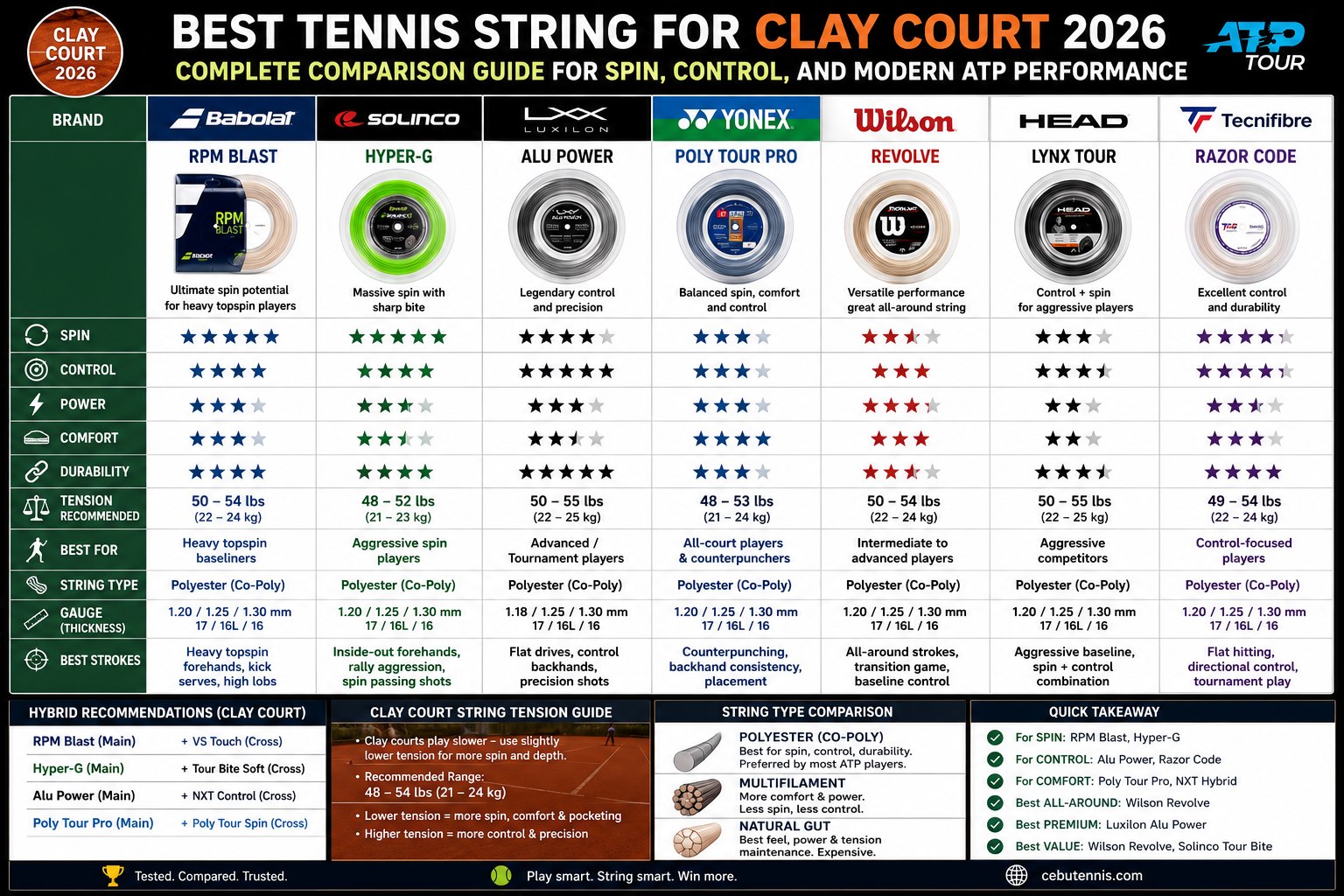
Clay court tennis is a completely different world compared to hard courts and grass. The slower bounce, longer rallies, higher topspin exchanges, and physical sliding movement place unique demands on every part of a player’s equipment — especially the tennis strings.
On clay, strings become one of the biggest performance factors because they directly influence:
- Topspin production
- Ball control
- Depth management
- Defensive recovery shots
- Heavy rally tolerance
- Feel during long exchanges
Modern clay-court tennis is dominated by aggressive topspin baseline patterns inspired by ATP and WTA professionals. Players today need strings that can create heavy spin while maintaining control during extended rallies.
This complete guide explains the best tennis strings for clay courts, including:
- Polyester vs multifilament comparisons
- String tension strategies
- Modern ATP-inspired setups
- Example setups like Alexandra Eala string tension style
- Best brands to buy in the USA
- Special stroke advantages for each string
- Recommended hybrid combinations
- Spin and control comparisons
Why Clay Court Tennis Needs Different Strings
Clay courts slow down the ball significantly compared to hard courts.
This changes:
- Rally length
- Ball height
- Recovery time
- Footwork rhythm
- Spin effectiveness
Because rallies become longer, players rely heavily on:
- Heavy topspin
- Controlled aggression
- High net clearance
- Defensive consistency
The wrong strings can cause:
- Loss of control
- Floating balls
- Weak spin production
- Excessive arm fatigue
- Poor depth management
Clay rewards players who can generate RPMs and shape the ball aggressively.
That is why polyester strings dominate modern clay court tennis.
Understanding Tennis String Types
Before choosing the best clay court string, players must understand the major string categories.
Polyester Strings
Polyester strings are the most popular choice for advanced clay court players.
Benefits:
- Massive topspin
- Excellent control
- Lower power
- Strong durability
- Aggressive swing tolerance
Weaknesses:
- Can feel stiff
- Less arm-friendly
- Tension drops over time
Best for:
- Intermediate to advanced players
- Heavy topspin hitters
- Aggressive baseliners
Multifilament Strings
Multifilament strings prioritize comfort and power.
Benefits:
- Soft feel
- Arm comfort
- Easy depth
- Better touch
Weaknesses:
- Less spin
- Lower durability
- Reduced control during heavy rallies
Best for:
- Beginners
- Older players
- Arm-sensitive players
Natural Gut Strings
Natural gut remains one of the most premium string materials.
Benefits:
- Elite feel
- Exceptional power
- Strong tension maintenance
- Comfortable response
Weaknesses:
- Expensive
- Less durable on clay
- Sensitive to moisture
Best for:
- Advanced all-court players
- Hybrid setups
Hybrid String Setups
Hybrid setups combine two different strings.
Most common:
- Polyester mains
- Multifilament or gut crosses
Benefits:
- Better comfort
- Improved spin
- Controlled power balance
Modern ATP players frequently use hybrid combinations.
Why Polyester Strings Dominate Clay Courts
Clay courts reward spin-heavy tennis.
Polyester strings help players:
- Generate higher RPMs
- Control aggressive swings
- Attack with heavy topspin
- Defend with shape and height
- Create kicking bounce
Modern ATP clay tennis revolves around:
- Heavy forehands
- Extreme spin angles
- Physical baseline exchanges
Polyester strings support this style perfectly.
Alexandra Eala Style String Tension Example
Alexandra Eala represents the modern aggressive clay-court baseline style developing in women’s tennis.
Young modern players inspired by ATP clay specialists often use:
- Medium-low polyester tension
- Spin-focused setups
- Controlled launch angles
Typical clay-court inspired setup examples:
- Polyester strings
- Around 48–52 lbs tension
- Slightly lower tension for heavier spin and pocketing
Lower tensions help:
- Increase ball bite
- Improve topspin rotation
- Add depth control
- Enhance defensive recovery shots
Many modern players now avoid extremely high tensions because today’s polyester strings already provide excellent control.
Best Tennis String Brands for Clay Court
1. Luxilon
Luxilon is one of the most respected polyester string brands in professional tennis.
Popular for:
- ATP-level control
- Spin performance
- Precision response
Best strokes:
- Heavy topspin forehand
- Aggressive backhand drives
- Baseline counterpunching
Best for:
- Advanced players
- Tournament competitors
Popular models:
- ALU Power
- 4G
- Element
2. Babolat
Babolat dominates clay-court culture because of its spin-focused identity.
Popular for:
- Massive topspin
- Explosive RPM generation
- Aggressive baseline play
Best strokes:
- High-kicking forehand
- Heavy topspin passing shots
- Clay-court defensive lobs
Popular models:
- RPM Blast
- RPM Rough
- VS Touch hybrid
Best for:
- Spin-heavy players
- Clay specialists
3. Solinco
Solinco became extremely popular among younger aggressive players.
Strengths:
- Massive spin
- Sharp ball bite
- Excellent control
Best strokes:
- Heavy-angle forehands
- Aggressive crosscourt rallies
- ATP-style backhand acceleration
Popular models:
- Hyper-G
- Confidential
- Tour Bite
Best for:
- Modern aggressive baseliners
4. Wilson Strings
Wilson offers balanced performance strings with comfort and control.
Strengths:
- Versatility
- Controlled feel
- Reliable tension response
Best strokes:
- Flat backhands
- Controlled rally shots
- Transition offense
Popular models:
- Revolve
- NXT hybrid
- Luxilon collaborations
Best for:
- Intermediate competitors
5. Yonex Strings
Yonex is famous for precision and feel.
Strengths:
- Excellent feedback
- Smooth response
- Balanced spin
Best strokes:
- Two-handed backhand timing
- Precision rally construction
- Counterpunching defense
Popular models:
- Poly Tour Pro
- Poly Tour Rev
Best for:
- Technical players
Best Tennis Strings for Topspin on Clay
Babolat RPM Blast
One of the most famous clay-court strings in the world.
Strengths:
- Massive RPM generation
- Heavy kicking bounce
- Extreme topspin trajectory
Ideal strokes:
- High net-clearance forehands
- Defensive heavy topspin
- Sharp crosscourt angles
Best for:
- Aggressive clay players
Solinco Hyper-G
Hyper-G became extremely popular among modern spin hitters.
Strengths:
- Sharp bite
- Controlled launch angle
- Aggressive rotation
Ideal strokes:
- ATP forehand acceleration
- Inside-out forehands
- Baseline aggression
Best for:
- Competitive juniors
- Advanced baseliners
Luxilon ALU Power
ALU Power remains legendary in professional tennis.
Strengths:
- Elite control
- Clean feel
- Reliable response
Ideal strokes:
- Flat aggressive backhands
- Precision down-the-line shots
- Controlled offense
Best for:
- Advanced players
Best String Tension for Clay Courts
Clay courts usually favor slightly lower tensions than hard courts.
Common tension range:
- 48–54 lbs
Why lower tension works:
- Better pocketing
- More spin production
- Higher launch angle
- Easier depth generation
Low Tension Advantages
Lower tensions help:
- Increase comfort
- Add spin
- Improve defensive play
- Create heavier ball trajectory
Best for:
- Heavy topspin players
- Clay grinders
High Tension Advantages
Higher tensions help:
- Increase precision
- Flatten trajectories
- Improve directional accuracy
Best for:
- Flat hitters
- Offensive strikers
String Comparison: Power vs Spin vs Control
| String | Spin | Control | Power | Comfort |
|---|---|---|---|---|
| RPM Blast | Excellent | Excellent | Medium | Medium |
| Hyper-G | Excellent | Very High | Medium-Low | Medium |
| ALU Power | High | Elite | Medium | Medium |
| Poly Tour Pro | High | High | Medium | Good |
| Wilson Revolve | Medium-High | Good | Medium | Good |
Best Strings for Different Playing Styles
Aggressive Baseliner
Best strings:
- RPM Blast
- Hyper-G
Why:
- Massive topspin
- Heavy trajectory
- Excellent control
Counterpuncher
Best strings:
- Poly Tour Pro
- ALU Power
Why:
- Reliable precision
- Controlled defense
- Smooth response
All-Court Player
Best strings:
- Wilson hybrid setups
- Luxilon hybrids
Why:
- Balanced touch
- Net control
- Transition versatility
Junior Clay Court Competitors
Young players need:
- Arm-friendly control
- Spin assistance
- Reasonable durability
Best options:
- Softer polyester hybrids
- Medium tension setups
Common Clay Court String Mistakes
Using Extremely High Tension
Many players over-tighten polyester strings.
This can cause:
- Arm pain
- Reduced spin
- Dead feel
Using Old Dead Polyester
Dead poly loses elasticity.
This reduces:
- Control
- Comfort
- Spin response
Choosing Power Strings Without Control
Clay rewards control first.
Excessively powerful strings can:
- Launch balls long
- Hurt consistency
Best Hybrid Setups for Clay Courts
Polyester + Multifilament
Benefits:
- Better comfort
- Controlled spin
- Easier depth
Best for:
- Intermediate players
Polyester + Natural Gut
Professional-level setup.
Benefits:
- Elite feel
- Massive spin
- Strong tension maintenance
Best for:
- Advanced tournament players
ATP Influence on Clay Court Strings
Modern ATP tennis transformed string technology.
Players now create:
- Extreme topspin RPMs
- Heavy kick bounce
- Violent forehand acceleration
Strings evolved to support:
- Faster swing speeds
- Aggressive rotational mechanics
- Open stance hitting
Today’s polyester strings are far more advanced than older generations.
How Often Should You Replace Clay Court Strings?
Frequent clay players should restring:
- Every 2–6 weeks depending on play frequency
Competitive players may restring:
- Weekly
- Before tournaments
Dead strings reduce:
- Spin
- Comfort
- Control
Weather Effects on Clay Court Strings
Hot weather:
- Increases string liveliness
- Reduces tension stability
Cold weather:
- Makes strings stiffer
- Lowers power
Clay court players often adjust tension slightly based on weather conditions.
Best Budget Tennis Strings for Clay
Affordable high-performance options:
- Solinco Tour Bite
- Wilson Revolve
- Yonex Poly Tour Pro
These strings offer:
- Strong spin
- Good durability
- Excellent value
Best Premium Strings for Clay
Premium elite options:
- Luxilon ALU Power
- Babolat RPM Blast
- Natural gut hybrids
Best for:
- Tournament competitors
- Advanced players
Recommended SEO URL
https://cebutennis.com/best-tennis-string-for-clay-court
Alternative strong SEO URLs:
- https://cebutennis.com/clay-court-tennis-strings-guide
- https://cebutennis.com/best-polyester-strings-for-clay
- https://cebutennis.com/top-clay-court-tennis-strings
- https://cebutennis.com/rpm-blast-vs-hyper-g-clay-court
Final Verdict: What Is the Best Tennis String for Clay Court?
The best clay-court tennis string depends heavily on:
- Playing style
- Swing speed
- Skill level
- Comfort needs
- Spin preference
Best Overall Clay Court String
Babolat RPM Blast
Why:
- Elite topspin
- Heavy kick bounce
- ATP-inspired performance
- Excellent clay-court aggression
Best Control String
Luxilon ALU Power
Why:
- Precise feel
- Clean response
- Trusted by professionals
Best Spin String
Solinco Hyper-G
Why:
- Massive RPM generation
- Sharp bite
- Excellent aggressive control
Best Comfort Option
Yonex Poly Tour Pro
Why:
- Softer feel
- Good spin
- Easier arm response
Best Value String
Wilson Revolve
Why:
- Balanced performance
- Affordable pricing
- Good durability
Modern clay court tennis continues evolving toward heavier topspin, aggressive baseline patterns, and ATP-style movement. Choosing the right string setup can dramatically improve:
- Ball control
- Spin production
- Shot confidence
- Rally consistency
- Match endurance
The right clay-court string is not only about power or spin. It is about creating the perfect balance between:
- RPM generation
- Precision
- Comfort
- Durability
- Tactical confidence
Players who understand string technology gain a major advantage on clay courts because every extra rotation, bounce height, and control margin matters during long physical rallies.