A Tennis Doctor and Sports Medicine Expert Explains How to Manage Persistent Tendon Pain
Introduction
Chronic tendinitis can be one of the most frustrating injuries for a tennis player. You may feel fine during the first few minutes of practice, only to develop pain in your elbow, shoulder, wrist, knee, or Achilles tendon as the session continues.
For recreational players and competitive athletes, persistent tendon pain can affect everything from a powerful serve to a simple backhand or quick sprint toward the net.
As a tennis doctor and sports medicine expert, I want you to understand an important principle: You should not ignore recurring tendon pain or assume that playing through it will make it stronger.
The good news is that many tendon conditions can improve with the right diagnosis, appropriate load management, and progressive rehabilitation.
This comprehensive guide explains chronic tendinitis, its symptoms, causes, treatment options, prevention strategies, and how to safely return to tennis.
Quick Overview
-
Medical term: Chronic tendinopathy is often more accurate than chronic tendinitis for persistent tendon pain and structural changes.
-
What is a tendon? A strong band of connective tissue that attaches muscle to bone and transfers force.
-
Common tennis injury sites: Elbow, shoulder, wrist, knee, and Achilles tendon.
-
Main causes: Repetitive loading, sudden training increases, inadequate recovery, and reduced tendon capacity.
-
Common symptoms: Localized pain, stiffness, tenderness, and reduced performance.
-
Treatment: Activity modification, progressive strengthening, physical therapy, and appropriate medical care.
-
Return to tennis: Gradual, based on symptoms, strength, movement, and sport-specific tolerance.
Important Medical Distinction
The terms tendinitis, tendinosis, and tendinopathy are sometimes used interchangeably, but they do not mean exactly the same thing.
Tendinitis traditionally refers to inflammation of a tendon.
Tendinosis refers to degenerative changes within tendon tissue.
Tendinopathy is a broader term commonly used for tendon pain and dysfunction, including persistent cases where structural changes and impaired load tolerance may be present.
Long-standing tendon pain is not always caused by active inflammation. This is why treatment should focus on the specific diagnosis and restoring tendon capacity rather than simply trying to eliminate inflammation.
What Is Chronic Tendinitis?
Chronic tendinitis refers to persistent tendon pain or dysfunction that develops over time. In tennis players, it is often associated with repeated loading of the same muscle-tendon structures.
Every time you serve, hit a forehand, perform a backhand, or sprint toward a ball, your tendons transfer force between muscles and bones.
Normally, tendons adapt to training by remodeling their tissue and becoming better able to handle load.
Problems may develop when the demands placed on the tendon repeatedly exceed its current ability to recover and adapt.
This can lead to:
-
Persistent pain.
-
Reduced tendon load tolerance.
-
Changes in tendon structure.
-
Reduced strength and performance.
-
Repeated flare-ups during tennis.
A chronic tendon problem does not necessarily mean the tendon is permanently damaged. Many players improve when the training load is adjusted and rehabilitation is properly managed.
Common Types of Chronic Tendinitis in Tennis Players
1. Tennis Elbow
Lateral Elbow Tendinopathy
Tennis elbow is one of the most recognizable tendon conditions associated with racquet sports.
It commonly affects the tendons on the outer side of the elbow, especially the common extensor tendon.
Symptoms
-
Pain on the outside of the elbow.
-
Discomfort when gripping a racquet.
-
Pain during a one-handed backhand.
-
Tenderness when lifting objects.
-
Pain when extending the wrist.
-
Reduced grip strength.
Why It Happens
Repeated gripping, wrist extension, backhand strokes, and excessive training volume may contribute to the problem.
However, tennis elbow can also occur in people who do not play tennis.
Tennis Doctor’s Advice
Do not automatically blame your racquet or backhand technique. A proper assessment should consider your training load, strength, technique, equipment, and other possible causes of elbow pain.
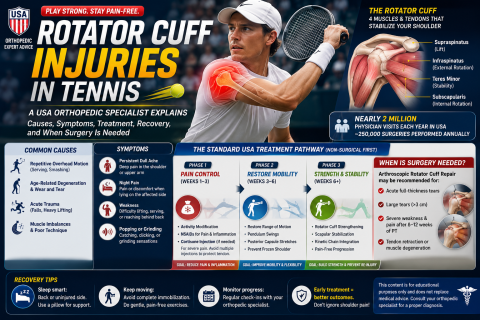
2. Rotator Cuff Tendinopathy
The rotator cuff is a group of muscles and tendons that help stabilize and move the shoulder.
Tennis players place substantial demands on the shoulder during:
-
Serves.
-
Overhead smashes.
-
High forehands.
-
Repeated practice.
-
Powerful racquet acceleration.
Symptoms
-
Pain when serving.
-
Discomfort while raising the arm.
-
Shoulder stiffness.
-
Pain when reaching overhead.
-
Reduced serving power.
-
Pain during or after practice.
Causes
Rotator cuff problems may be associated with repetitive overhead loading, inadequate shoulder strength, sudden increases in serving volume, and other shoulder conditions.
Shoulder pain is not always caused by tendinitis. A clinical examination is important to distinguish tendon problems from other injuries.
3. Wrist Tendinopathy
The wrist plays an important role in racquet control, grip, and stroke production.
Repeated wrist movement and gripping may aggravate wrist tendons.
Common Symptoms
-
Wrist pain during forehands.
-
Pain during serves.
-
Discomfort when gripping the racquet.
-
Tenderness around the wrist.
-
Pain after long practice sessions.
-
Reduced confidence in hitting powerful strokes.
Wrist pain can also result from ligament injuries, joint problems, or other conditions. Persistent symptoms should be assessed rather than assumed to be tendinitis.
4. Patellar Tendinopathy
Jumper’s Knee
The patellar tendon connects the kneecap to the shinbone.
Although often associated with jumping sports, tennis players may experience patellar tendon problems because of repeated:
-
Sprinting.
-
Lunging.
-
Jumping.
-
Sudden stops.
-
Explosive changes of direction.
Symptoms
-
Pain below the kneecap.
-
Stiffness after sitting.
-
Pain during jumping.
-
Discomfort during lunges.
-
Pain when accelerating or stopping.
-
Reduced lower-body performance.
Patellar tendinopathy can become persistent when the knee is repeatedly exposed to more load than it can currently tolerate.
5. Achilles Tendinopathy
The Achilles tendon connects the calf muscles to the heel bone.
Tennis places high demands on this tendon because of repeated acceleration, deceleration, and pushing off the ground.
Symptoms
-
Pain above the heel.
-
Morning stiffness.
-
Pain during running.
-
Discomfort when changing direction.
-
Tenderness along the tendon.
-
Reduced ability to push off.
Achilles tendon problems may occur in the middle portion of the tendon or near its attachment to the heel. These conditions may require different rehabilitation approaches.
Symptoms of Chronic Tendinitis
Chronic tendinopathy often develops gradually. Some players notice mild discomfort for weeks or months before realizing that the problem is affecting their tennis.
1. Localized Pain
Pain usually develops around the affected tendon.
It may feel like:
-
A dull ache.
-
Sharp pain during movement.
-
Burning discomfort.
-
Pain after exercise.
-
Tenderness during specific strokes.
For example, a tennis player with elbow tendinopathy may experience pain when gripping the racquet or hitting a backhand.
2. Stiffness After Rest
Tendon stiffness is common in some conditions, especially after periods of inactivity.
A player with Achilles tendinopathy may notice discomfort during the first few steps in the morning.
A player with shoulder or elbow symptoms may feel stiff when beginning practice.
3. Pain During or After Tennis
Some athletes feel comfortable during the warm-up but develop pain during the main session.
Others experience soreness several hours later or the following morning.
This delayed response is important. A tennis session that feels acceptable at the time may still have exceeded the tendon’s current capacity.
4. Tenderness
Pressing directly over the affected tendon may reproduce pain.
A clinician can use tenderness, movement, and resistance testing to help identify the painful structure.
5. Swelling or Tendon Thickening
Some tendon conditions cause localized swelling or thickening.
However, not every chronic tendon problem produces visible swelling.
6. Reduced Strength
Tendon pain can interfere with force production.
You may notice:
-
A weaker serve.
-
Reduced grip strength.
-
Difficulty pushing off.
-
Pain when lifting objects.
-
Reduced endurance.
-
Difficulty completing long matches.
When Symptoms Become Serious
Seek medical assessment if you experience sudden severe pain, a pop or snap, a visible deformity, or sudden loss of function.
These symptoms may indicate a tendon tear or rupture rather than ordinary chronic tendinopathy.
What Causes Chronic Tendinitis in Tennis?
1. Repetitive Overuse
Tennis involves repeated loading of the same structures.
A single practice session may include hundreds of strokes, serves, and changes of direction.
If the workload repeatedly exceeds the tendon’s ability to adapt, symptoms may develop.
Examples include:
-
Playing tennis every day without sufficient recovery.
-
Adding too many serving sessions.
-
Increasing match duration quickly.
-
Repeating painful strokes.
-
Returning to competition too soon after an injury.
The issue is not simply how often you play. It is the balance between training demand, recovery, and current tendon capacity.
2. Sudden Increases in Training Load
One of the most common mistakes I see in tennis players is increasing several training variables at the same time.
For example:
A player normally practices twice a week. They suddenly begin playing five days a week, add intense serving drills, and enter a tournament.
This may create a significant increase in tendon stress.
A safer approach is to increase training gradually and monitor how your body responds.
3. Poor Stroke Mechanics
Technique may influence how forces are distributed through the body.
Examples of factors that may contribute to excessive tendon loading include:
-
Poor timing.
-
Late contact with the ball.
-
Excessive wrist action.
-
Inadequate leg drive.
-
Poor shoulder control.
-
Repeated off-balance strokes.
However, pain alone does not prove that your technique is incorrect.
A qualified tennis coach can assess your stroke mechanics, while a clinician can evaluate the injury itself.
4. Equipment Factors
Equipment may influence how forces are transmitted to your body.
Possible factors include:
-
Racquet grip size.
-
Racquet weight and balance.
-
String setup and tension.
-
Footwear.
-
Court surface.
-
Worn-out shoes.
Equipment adjustments may help some players, but changing equipment alone does not guarantee recovery.
5. Age-Related Changes
Tendons change with age.
Some players may experience changes in elasticity, tissue structure, and the ability to adapt to sudden increases in training load.
This does not mean older tennis players must stop competing.
It means that strength training, gradual progression, and recovery become increasingly important.
6. Inadequate Conditioning
Weak supporting muscles or poor movement control may increase the demands placed on certain tendons.
For example, insufficient lower-body strength may cause a player to rely excessively on the arm during strokes and serves.
A well-rounded tennis conditioning program should include strength, mobility, balance, and sport-specific movement.
How Is Chronic Tendinitis Diagnosed?
A sports medicine physician, orthopedic specialist, or physiotherapist can help determine the cause of persistent tendon pain.
Clinical Examination
The clinician may assess:
-
Pain location.
-
When symptoms began.
-
Training history.
-
Tennis movements that aggravate symptoms.
-
Tenderness.
-
Range of motion.
-
Muscle strength.
-
Pain during resisted movements.
-
Whether another condition may explain the symptoms.
Many tendon conditions can initially be assessed through a clinical examination.
Ultrasound
Ultrasound can help visualize tendon structure, thickening, and some tears.
It may also be useful for dynamic assessment of certain tendons.
MRI
MRI provides detailed images of soft tissues.
It may be considered when:
-
The diagnosis is uncertain.
-
Symptoms persist despite appropriate treatment.
-
A significant tear is suspected.
-
Deeper structures need to be assessed.
Important Imaging Reminder
An abnormal tendon on an ultrasound or MRI does not automatically mean it is the source of pain.
Some people have tendon changes without symptoms.
The imaging findings should be interpreted together with your medical history and examination.
Treatment for Chronic Tendinitis
Treatment should be individualized according to the tendon involved, severity of symptoms, and your goals as a tennis player.
The main goal is to restore function and improve the tendon’s ability to tolerate the demands of tennis.
1. Relative Rest and Activity Modification
Complete rest is not always necessary.
Instead, reduce the activities that significantly aggravate your symptoms.
For a tennis player, this may include:
-
Reducing serving volume.
-
Avoiding full-power strokes temporarily.
-
Shortening practice sessions.
-
Reducing match frequency.
-
Avoiding painful explosive movements.
-
Taking recovery days.
You can often maintain fitness through other activities that do not aggravate the tendon.
My advice: Rest from aggravating loads, but keep the rest of your body active when it is safe.
2. Physical Therapy
Progressive strengthening is a key part of rehabilitation for many chronic tendon conditions.
A physical therapist may design exercises that gradually improve:
-
Strength.
-
Load tolerance.
-
Movement control.
-
Joint function.
-
Sport-specific performance.
Isometric Exercises
These involve contracting a muscle without significant joint movement.
They may be useful in certain rehabilitation programs, particularly when movement is painful.
Eccentric Exercises
Eccentric exercise involves producing force while the muscle lengthens.
These exercises are commonly used for certain tendon conditions, including some Achilles tendon rehabilitation programs.
However, eccentric exercise is not automatically the best treatment for every tendon injury.
Heavy Slow Resistance
Controlled resistance training may be used to progressively increase tendon and muscle capacity.
The exercises and loading schedule should be appropriate for your specific injury.
Tennis-Specific Rehabilitation
Eventually, rehabilitation should include the movements required for tennis:
-
Gripping the racquet.
-
Shoulder rotation.
-
Serving.
-
Lateral movement.
-
Sprinting.
-
Stopping.
-
Repeated rallies.
The tendon must gradually regain the ability to handle these demands.
3. Stretching and Mobility
Mobility exercises may help address limitations in surrounding muscles and joints.
Examples include:
-
Shoulder mobility.
-
Forearm flexibility.
-
Calf mobility.
-
Hip mobility.
Stretching should not force a painful tendon into an aggravating position.
4. Ice and Heat
Ice may temporarily help with pain after activity.
Heat may feel helpful before movement for some players.
These methods are mainly for symptom management. They do not replace progressive rehabilitation or repair tendon degeneration by themselves.
5. Medications
Over-the-counter pain relievers, including NSAIDs, may help some people with short-term pain.
However, they do not correct the underlying tendon capacity problem.
NSAIDs may not be appropriate for everyone, especially people with certain stomach, kidney, cardiovascular, or medication-related risks.
Ask a qualified healthcare professional or pharmacist before using them.
6. PRP Injections
Platelet-rich plasma, or PRP, involves preparing a concentrated portion of the patient’s blood and injecting it into a targeted area.
PRP may be considered for selected tendon conditions.
However, evidence varies by tendon, diagnosis, and treatment protocol.
It should not automatically replace a structured rehabilitation program.
7. Extracorporeal Shockwave Therapy
Shockwave therapy may be used for selected chronic tendon conditions.
It is not appropriate for every injury, and outcomes can vary.
Discuss whether it is suitable for your specific diagnosis with a qualified clinician.
8. Corticosteroid Injections
Corticosteroid injections may provide short-term relief in some conditions.
However, repeated injections around certain tendons may carry risks, including tendon weakening and rupture.
They should be discussed carefully with a qualified clinician.
Prevention: How to Protect Your Tendons
1. Increase Training Gradually
Avoid sudden increases in:
-
Practice duration.
-
Match frequency.
-
Serving volume.
-
Sprinting.
-
Intensity.
If you normally play twice a week, do not immediately jump into intense daily tennis.
2. Warm Up Before Tennis
A practical warm-up may include:
-
Brisk walking.
-
Easy jogging.
-
Dynamic leg movements.
-
Shoulder circles.
-
Controlled racquet swings.
-
Progressive hitting.
-
Gradual serving intensity.
Begin with lower-intensity movement before increasing the demands.
3. Strengthen the Entire Body
Tennis players should train more than just the hitting arm.
Important areas include:
-
Rotator cuff.
-
Forearm and wrist muscles.
-
Core and trunk.
-
Glutes.
-
Quadriceps.
-
Calves.
-
Hip muscles.
-
Balance and coordination.
4. Review Your Technique
A qualified tennis coach can assess your:
-
Serve mechanics.
-
Backhand technique.
-
Forehand timing.
-
Footwork.
-
Movement efficiency.
-
Use of the kinetic chain.
The goal is to improve efficiency and distribute force appropriately.
5. Allow Recovery
Recovery is part of training.
Adequate sleep, nutrition, hydration, and rest between demanding sessions help support your overall ability to train.
6. Do Not Ignore Repeated Pain
If your tendon hurts every time you play tennis, investigate the cause.
Repeatedly masking pain and continuing the same aggravating workload may make rehabilitation more difficult.
Safe Return to Tennis After Chronic Tendinitis
Returning to tennis should be based on your symptoms, strength, movement control, and ability to tolerate tennis-specific activity.
There is no single recovery timeline that applies to every tendon condition.
Stage 1: Control Symptoms
Begin with daily activities and rehabilitation exercises at a manageable level.
The goal is to move and exercise without a major increase in symptoms.
Stage 2: Restore Strength
Progressively strengthen the affected muscle-tendon unit.
Examples:
-
Forearm strengthening for elbow tendinopathy.
-
Rotator cuff strengthening for shoulder problems.
-
Calf raises for Achilles rehabilitation.
-
Quadriceps and hip strengthening for patellar tendon problems.
Stage 3: Tennis-Specific Drills
When your clinician considers the tendon ready, gradually introduce:
-
Shadow swings.
-
Mini-tennis.
-
Light baseline rallying.
-
Controlled serves.
-
Longer rally sessions.
-
Moderate-intensity practice.
-
Match play.
Increase the demands gradually rather than increasing duration, intensity, and frequency all at once.
Stage 4: Return to Competition
Before returning to full competitive tennis, aim to demonstrate:
-
Tolerable symptoms during daily activities.
-
Adequate strength.
-
Good movement control.
-
Ability to complete tennis-specific drills.
-
No significant symptom flare after training.
-
Confidence in the affected limb.
Your clinician should help determine whether you are ready for competition.
Example Return-to-Tennis Schedule
This is an illustrative progression, not a prescribed medical rehabilitation plan.
Stage 1 — Movement
Walking, rehabilitation exercises, and light shadow swings.
Stage 2 — Light Tennis
Short mini-tennis sessions and easy rallying.
Stage 3 — Build Intensity
Longer sessions, controlled serves, and movement drills.
Stage 4 — Competition
Return to full matches when clinically ready.
Tennis Doctor’s Reminder: If symptoms worsen significantly during or after a session, reduce the workload and seek professional guidance.
When Should a Tennis Player See a Doctor?
Seek professional assessment if:
-
Tendon pain persists or repeatedly returns.
-
Pain limits your serve, forehand, backhand, running, or daily activities.
-
You experience increasing swelling.
-
You notice reduced strength.
-
Normal movements become difficult.
-
Symptoms do not improve with appropriate activity modification.
-
You suspect a tendon tear.
Warning Signs of a Possible Tendon Rupture
Seek urgent medical assessment if you experience:
-
Sudden severe pain.
-
A pop or snap.
-
Sudden loss of function.
-
A visible deformity.
-
Sudden inability to push off with the foot.
-
Sudden inability to raise the arm.
-
Sudden inability to extend the knee.
Do not attempt to play through a suspected rupture.
Frequently Asked Questions
Can chronic tendinitis heal completely?
Many people improve with appropriate treatment and rehabilitation.
Recovery depends on the tendon involved, severity of symptoms, duration of the condition, training load, and other health factors.
Some tendon conditions require months of rehabilitation.
Can I still play tennis with chronic tendinitis?
Some players can continue modified tennis while rehabilitating.
You may need to reduce intensity, duration, or specific strokes.
If symptoms worsen during or after play, seek professional guidance.
Is chronic tendinitis the same as tendinosis?
No.
Tendinitis traditionally refers to inflammation, while tendinosis refers to degenerative tendon changes.
Tendinopathy is a broader term used for tendon pain and dysfunction.
Is eccentric exercise the best treatment?
Eccentric exercises are useful for some tendon conditions.
However, not every tendon injury responds identically.
Progressive resistance training should be individualized to the diagnosis and your current capacity.
Can changing racquet strings cure tennis elbow?
Changing racquet strings or adjusting equipment may help some players.
However, equipment changes alone are not a guaranteed cure.
Rehabilitation, technique, and workload management remain important.
How long should I stop playing tennis?
There is no universal rest period.
Some players need a short reduction in activity, while others require a longer rehabilitation program.
The decision should be based on symptoms, function, and the specific tendon diagnosis.
Can I prevent chronic tendinitis as I get older?
You can reduce your risk by maintaining strength, progressing training gradually, warming up, recovering properly, and responding early to recurring pain.
Age does not mean you must stop playing tennis.
Final Advice From a Tennis Doctor
Chronic tendinitis can be frustrating for any tennis player, especially when you love the game and want to keep competing.
My advice is simple:
Do not wait until tendon pain becomes severe before taking action.
If you notice recurring elbow pain, shoulder discomfort, wrist pain, knee pain, or Achilles stiffness, reduce aggravating loads and seek an appropriate assessment.
A structured rehabilitation program can help restore strength and improve your ability to handle the demands of tennis.
Your goal is not merely to return to the court for one match.
Your goal is to build a body that can continue playing tennis for years.
Play smart. Train progressively. Recover properly. Stay in the game.
Medical Disclaimer
This article is for general educational purposes and is not a substitute for a medical examination, diagnosis, or individualized treatment plan.
Chronic tendon pain can have several causes, including partial tears and other conditions that require different management.
Consult a qualified sports medicine physician, orthopedic specialist, or physiotherapist for persistent symptoms or suspected tendon injury.