
Tennis is often called a physical chess match. You aren't just hitting a ball; you are decoding your opponent’s tendencies, adapting to wind conditions, and rewriting your game plan mid-rally.
To win those crucial adjustment battles—switching from a cross-court rally to a drop shot, or reading a second-serve break point—you need a brain that fires on all cylinders.
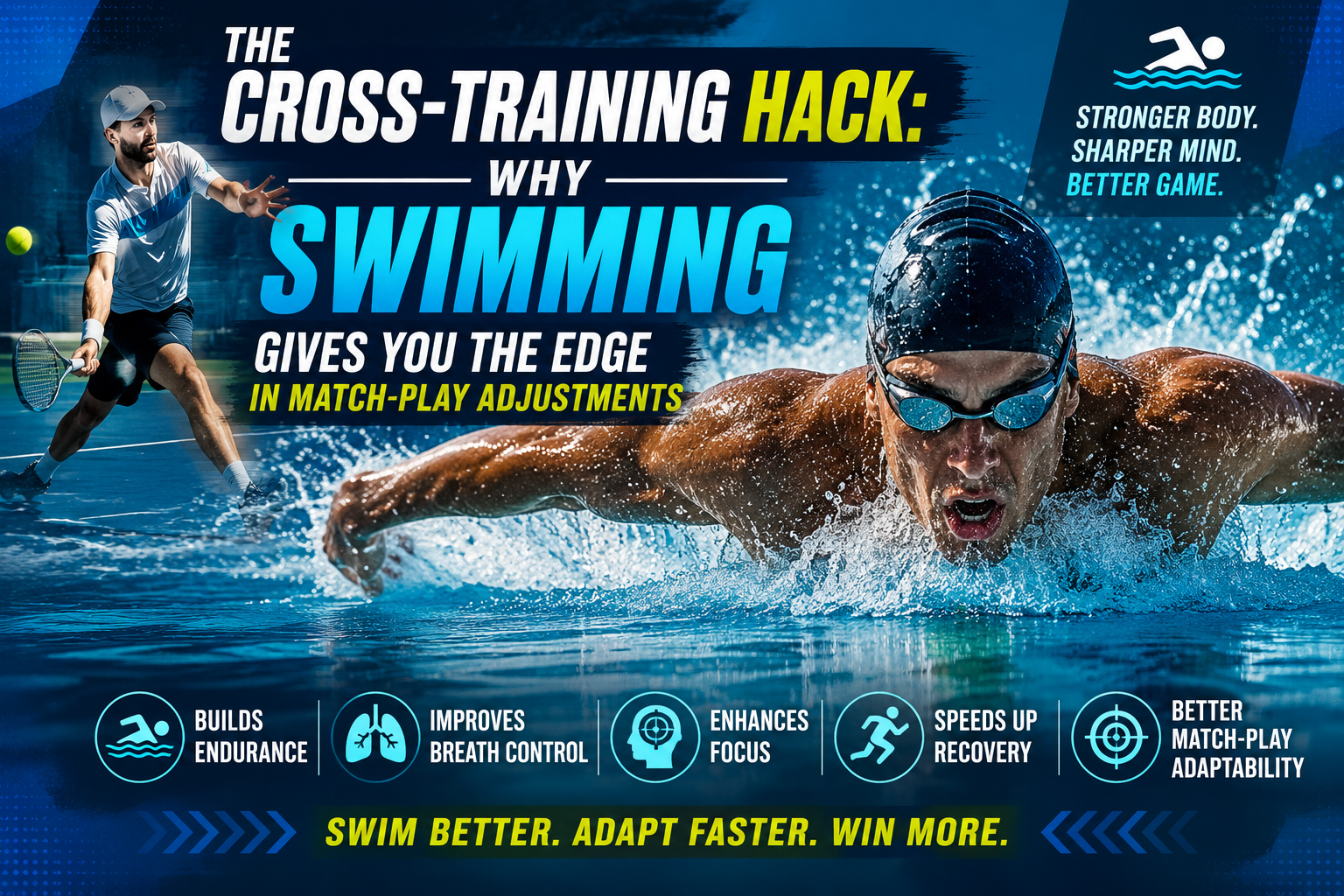
Most players hit the gym for strength and the track for sprints. But if you aren't swimming, you are leaving your cognitive adaptability on the table. Here is why adding swimming to your training regimen is the secret weapon for in-game adjustments.
1. Neuroplasticity: Training Your Brain to Adapt Mid-Match
Swimming is more than just a full-body workout; it is a powerful tool for long-term brain health. Studies show that the rhythmic, coordinated movement of swimming improves memory, learning, and overall cognitive performance by increasing blood flow to the brain and encouraging the release of proteins that support healthy nerve cells and neuroplasticity.
What does that mean for you on the court?
Neuroplasticity is your brain's ability to rewire itself quickly. When your opponent suddenly changes their rhythm, starts slicing wide, or attacks the net unexpectedly, you have a split second to adjust. A brain strengthened by swimming adapts faster. You will read their body language better, anticipate the angle of the ball sooner, and execute tactical changes (like transitioning from defense to offense) with sharper precision.
2. The "Ice Bath" Effect on the Nervous System (Stay Calm Under Pressure)
Tennis is chaotic. The crowd noise, the pressure of a tiebreak, and the frustration of unforced errors can spike your heart rate and cloud your judgment.
Swimming has a unique calming effect. The act of moving through water, holding your breath, and focusing on rhythmic exhalation actively lowers stress levels and reduces anxiety. It promotes a calmer, more balanced nervous system.
When you integrate swimming into your week, you train your parasympathetic nervous system (the "rest and digest" mode) to activate more readily. During a match, this means you can reset your heart rate between points faster. You'll walk up to the baseline for a crucial second serve with a steadier hand and a clearer mind, rather than a panicked one. That calmness is what allows you to adjust your strategy rationally, rather than choking under the heat.
3. The Sleep-Recovery Loop (Crucial for Tactical Clarity)
We’ve talked about how sleep dictates your hormones and weight, but let’s talk about sleep and strategy. Many swimmers report significantly better sleep quality because consistent exercise helps regulate the body's natural sleep-wake cycle while easing physical and mental tension.
When you swim, you are essentially resetting your internal clock. Better sleep leads to sharper working memory. In the third set, when fatigue sets in and your footwork gets lazy, your memory is what helps you remember the patterns you spotted in the first set. You don't have to re-learn your opponent's weakness; you recall it instantly and exploit it. Swimming gives you that restorative deep sleep, ensuring your tactical database stays sharp until the final point.
4. Physical Resilience Without the Pounding
Match adjustments aren't just mental—they are physical. Adjusting to a heavy topspin forehand requires you to bend your knees deep and explode laterally.
Tennis is notoriously hard on the joints. Swimming strengthens your heart, improves endurance, and builds muscular fitness with minimal impact on the body. By adding swimming to your routine, you build cardiovascular capacity and muscle endurance without stressing your ankles, knees, or shoulders. You will feel lighter on your feet in the 5th set because your body hasn't been ground down by high-impact running alone. This prolonged physical resilience gives you the luxury of having more energy to think about your adjustments, rather than just surviving.
How to Add It to Your Routine
You don’t need to be an Olympic swimmer to reap the benefits.
-
Recovery Day: On your off day from the court, do a 20-30 minute steady lap swim. Focus on breathing control.
-
Warm-Down: After a grueling match, a slow 10-minute swim acts as a full-body flush, removing lactic acid and calming your nervous system after the adrenaline rush.
The Bottom Line:
If you want to beat the player who simply "hits harder," you need to out-think them. Adding swimming to your regimen isn't just about cardio; it is about forging a brain that adjusts faster, a nervous system that stays cooler, and a body that lasts longer. Dive in, and watch your in-game IQ skyrocket.