Tennis Performance | Athletic Development | Movement Intelligence | Sports Science
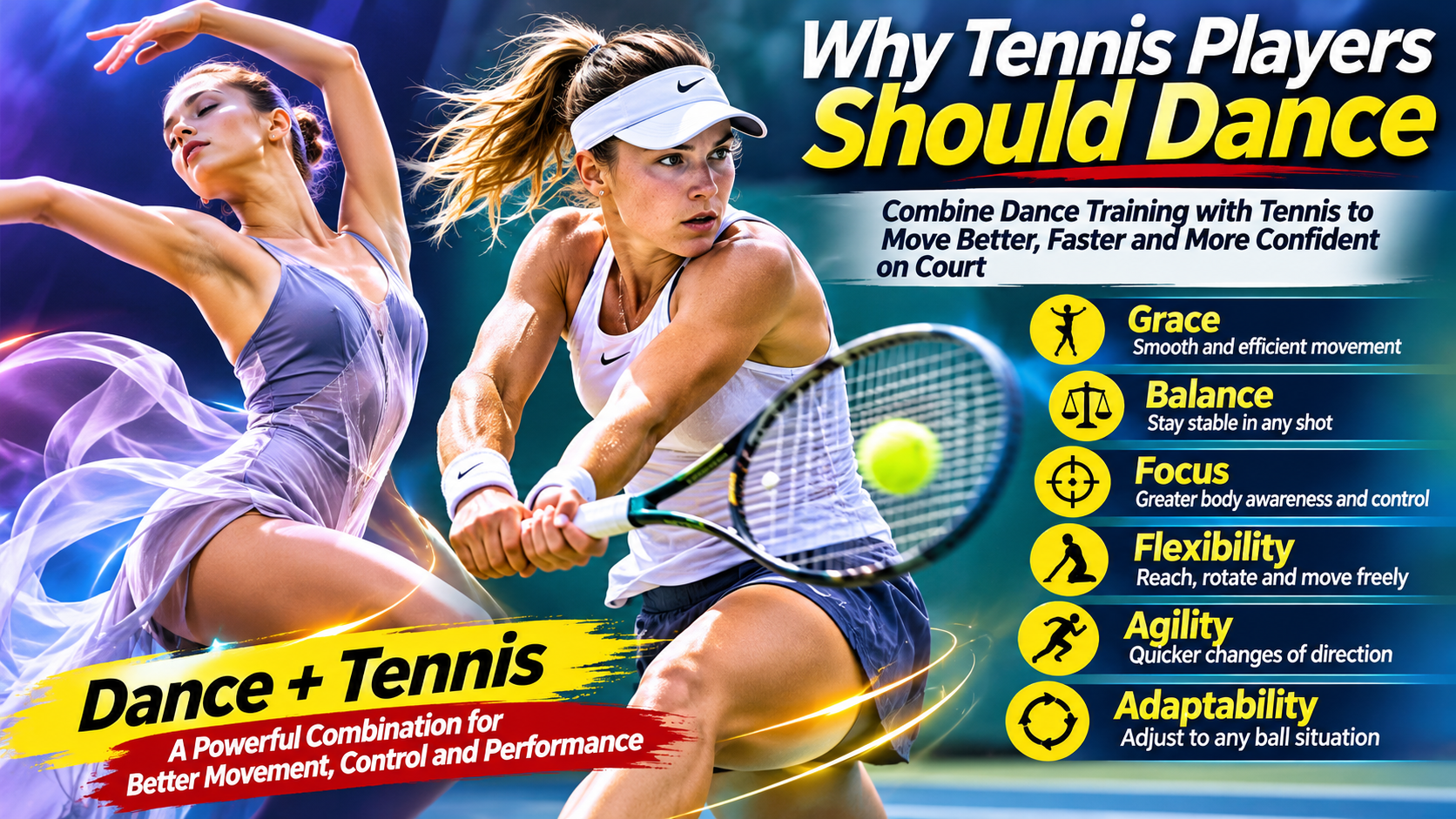
What if the secret to becoming a more graceful, balanced, explosive and unpredictable tennis player is to learn how to dance?
Tennis is not just about hitting a powerful forehand, delivering a fast serve or producing a spectacular backhand. At the highest level, tennis is a sport of movement intelligence.
Every rally demands thousands of small adjustments: stepping forward, moving backward, rotating the hips, changing direction, recovering balance and positioning the body perfectly before making contact with the ball.
This is where dancing becomes an interesting training partner.
Combining tennis with dance can develop qualities that traditional court drills sometimes overlook: rhythm, body awareness, coordination, balance, flexibility, posture and expressive movement.
The objective is simple: train your body to move like an athlete, but with the grace and coordination of a dancer.
1. Grace: Make Every Movement Look Effortless
A technically strong tennis player doesn't waste unnecessary energy.
Watch elite players move around the court. Their movements often appear smooth, controlled and effortless, even when they are sprinting toward a difficult ball.
Dance develops:
-
Better posture and body alignment.
-
Controlled transitions between movements.
-
Smooth weight transfer from one leg to another.
-
Coordination between upper and lower body.
-
Greater awareness of movement efficiency.
Tennis application:
Instead of looking rushed when approaching a difficult ball, you learn to organize your body, maintain posture and prepare your racket more efficiently.
Grace is not about looking beautiful on court. It is about eliminating unnecessary movement.
2. Balance: Stay Stable During Difficult Shots
Balance is one of the most important foundations of tennis.
Imagine hitting a wide forehand while stretching outside the singles sideline. Your body is moving laterally, your outside leg is absorbing force, and your upper body must remain organized.
Without proper balance, your next recovery step becomes slower.
Dance challenges the body to maintain stability while:
-
Standing on one leg.
-
Rotating the hips and torso.
-
Changing direction.
-
Extending the arms and legs.
-
Moving through different levels and positions.
Tennis application:
Better body control can help you recover after wide forehands, maintain stability during defensive backhands and prepare for the next shot.
3. Rhythm: Develop Better Timing and Footwork
Tennis has rhythm.
The split step, adjustment steps, racket preparation, ball contact and recovery all happen in a coordinated sequence.
Dancing trains your ability to recognize rhythm and synchronize different body movements.
For tennis players, this can translate into:
-
More coordinated split-step timing.
-
Better adjustment steps before contact.
-
Improved synchronization between footwork and racket preparation.
-
More natural movement through long rallies.
Think of a rally as a musical sequence. Every incoming ball changes the rhythm, and the player must adjust accordingly.
4. Flexibility: Expand Your Movement Possibilities
Flexibility allows players to reach difficult positions without excessive stiffness.
Dance incorporates controlled stretching, hip mobility, leg extensions, torso rotations and dynamic movement.
These movements can complement tennis conditioning by improving mobility in:
-
Hip flexors and hip rotators.
-
Hamstrings and quadriceps.
-
Ankles and calves.
-
Thoracic spine.
-
Shoulders and upper body.
Tennis application:
Better mobility can help players reach low balls, move into wide defensive positions and rotate more comfortably during groundstrokes.
Remember: flexibility alone does not guarantee injury prevention. Players also need strength and control throughout their available range of motion.
5. Agility: Become Quicker in Every Direction
Tennis is a multidirectional sport. You rarely move in a straight line for very long.
One moment you are sprinting forward for a drop shot. The next moment you are reversing direction to defend a deep lob.
Dance develops movement patterns involving:
-
Lateral steps.
-
Quick directional transitions.
-
Controlled pivots.
-
Rapid foot repositioning.
-
Single-leg coordination.
-
Dynamic weight shifting.
These skills complement tennis-specific agility drills.
Tennis application:
You can become more comfortable transitioning between forward, backward, lateral and diagonal movements.
6. Focus: Train Your Brain to Control Your Body
Dancing requires more than physical ability. You must remember sequences, anticipate the next movement, listen to rhythm and coordinate several body parts simultaneously.
This creates an interesting mental training opportunity for tennis players.
Tennis requires similar abilities:
-
Reading your opponent's racket preparation.
-
Anticipating ball direction.
-
Recognizing changes in ball speed and spin.
-
Adjusting your positioning.
-
Maintaining concentration under pressure.
Dance can challenge your coordination and attention simultaneously.
The goal is to become more aware of your body while remaining responsive to external situations.
7. Adaptability: Prepare for Every Possible Ball Situation
This is perhaps the most interesting connection between dancing and tennis.
A dancer must continuously adapt to different rhythms, positions, directions and sequences.
A tennis player faces the same challenge, but the opponent controls the situation.
Consider these scenarios:
-
Wide forehand: Lateral coordination and balance.
-
Low backhand: Body control and flexibility.
-
Drop shot: Forward acceleration and controlled stopping.
-
Deep defensive ball: Backward movement and spatial awareness.
-
Sudden direction change: Rhythm adjustment and agility.
-
Difficult recovery: Postural stability and weight transfer.
-
High bouncing ball: Timing and coordinated movement.
Dance does not automatically teach tennis-specific reactions. However, it can provide a broader movement foundation that players can transfer into court drills.
8. Rotation and Body Coordination: Improve the Kinetic Chain
Power in tennis is not generated by the arm alone.
A groundstroke involves coordinated movement from the feet through the legs, hips, trunk, shoulders and racket arm.
Dance teaches players to understand how different body segments work together.
This can complement:
-
Hip and shoulder separation.
-
Controlled torso rotation.
-
Dynamic balance during open-stance shots.
-
Weight transfer during groundstrokes.
-
Coordination during overhead movements.
The result we want is not simply more power. It is more efficient movement and better control when generating power.
9. Professional Tennis Inspiration: Jelena Ostapenko and Ballroom Dancing
Jelena Ostapenko is one of the clearest examples of a professional tennis player with a serious dance background.
Ostapenko practiced dancing alongside tennis from childhood. She began dancing at approximately five years old and competed in Latvian ballroom dancing.
In 2017, she discussed how ballroom dancing helped her tennis footwork. She particularly enjoyed samba and described the importance of coordination and small steps.
She eventually chose tennis, winning the French Open in 2017.
Her story provides a fascinating example of how two different movement disciplines can complement each other.
Importantly, this does not establish that dancing alone caused her tennis success. Her achievement also reflects years of tennis-specific training, coaching and competition.
The lesson:
Tennis players don't necessarily need to become professional dancers. They can borrow the movement principles of dance and apply them to their own game.
10. What Does Sports Science Say?
The connection between dance and athletic development is supported by research into physical conditioning and movement.
Some interesting findings:
-
A 2024 systematic review in the Journal of Bodywork and Movement Therapies found that neuromuscular training can improve dancers' balance. The authors recommended at least four weeks of training, with two to three sessions weekly, while noting limitations in study quality.
-
A 2024 systematic review and meta-analysis in the European Journal of Sport Science found that strength and conditioning interventions improved several physical qualities in dancers, including lower-body power, strength and flexibility.
-
Research on tennis players also demonstrates the value of complementary neuromuscular, functional and plyometric conditioning for physical qualities such as agility, speed and dynamic balance.
These studies support the underlying training principles. They do not prove that adding dance directly improves match-winning percentages in professional tennis.
11. The Best Dance Styles for Tennis Players
Not all dance styles provide the same movement challenges. Here are five worth exploring.
1. Samba
Develops rhythmic footwork, quick weight transfers, coordination and hip movement.
Excellent for footwork rhythm.
2. Ballet
Emphasizes posture, body alignment, ankle strength, balance and controlled movement.
Excellent for body control.
3. Hip-hop
Encourages quick transitions, coordination, rhythm and explosive changes of movement.
Excellent for dynamic coordination.
4. Contemporary Dance
Explores body awareness, flexibility, rotation, spatial awareness and controlled transitions.
Excellent for movement awareness.
5. Salsa
Develops rhythm, coordination, directional changes and weight transfer.
Excellent for coordination.
12. Practical Weekly Dance Training Program for Tennis Players
You don't need to spend hours dancing. Start with two short sessions each week.
SESSION A: RHYTHM AND FOOTWORK
-
Warm-up and mobility: 5 minutes.
-
Samba or salsa footwork: 10 minutes.
-
Lateral movement and pivots: 5 minutes.
-
Balance exercises: 5 minutes.
Total: 25 minutes.
SESSION B: FLEXIBILITY AND BODY CONTROL
-
Dynamic warm-up: 5 minutes.
-
Ballet-inspired balance: 5 minutes.
-
Contemporary movement: 10 minutes.
-
Controlled mobility: 5 minutes.
Total: 25 minutes.
Keep the intensity comfortable, avoid painful stretches and adjust the sessions around your tennis workload.
13. The Ultimate Objective: Become a Complete Tennis Athlete
Imagine a player who combines:
-
The strength of a powerful athlete.
-
The balance of a gymnast.
-
The flexibility of a dancer.
-
The coordination of a musician.
-
The reaction speed of a competitive tennis player.
-
The mental discipline of a champion.
This combination creates an exciting approach to athletic development.
However, dancing should complement—not replace—tennis-specific footwork, strength training, reaction drills, conditioning and technical practice.
A tennis player must still learn to read the opponent, anticipate the ball and execute the correct shot under pressure.
The greatest advantage is learning to control your body in situations where your opponent is constantly trying to take away your time and space.
Final Tennis Expert Perspective
Tennis is a beautiful combination of science, athleticism and movement.
Watch the best players in the world. They don't simply run toward the ball. They adjust, rotate, balance, recover and reposition themselves with remarkable coordination.
Their footwork almost looks like choreography.
Dance can teach us something valuable: movement is not just about speed. It is about timing, control, rhythm and knowing exactly where your body needs to be.
Train like a tennis player. Move like a dancer. Compete like a champion.