Quick Overview
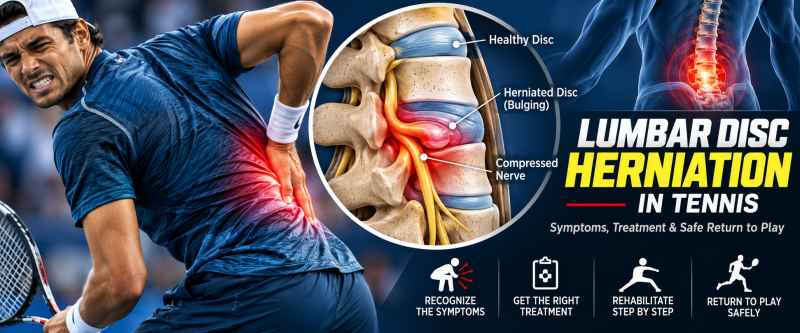
A lumbar disc herniation happens when the soft inner material of a spinal disc pushes through a weakened or torn area of its outer layer. If the herniated disc irritates or compresses a nearby spinal nerve, it can cause symptoms that travel from the lower back into the buttock and leg.
For tennis players, the problem can be especially challenging because tennis repeatedly demands trunk rotation, bending, extension, acceleration, deceleration, and rapid changes of direction.
The serve and overhead are particularly demanding because they combine powerful leg drive with trunk extension and rotation.
Tennis doctor’s advice: Back pain accompanied by pain traveling down the leg, numbness, tingling, or weakness should not automatically be treated as a simple muscle strain. Nerve symptoms deserve proper medical assessment.
What Does a Herniated Disc Feel Like?
Symptoms vary depending on the disc involved and whether a spinal nerve is affected.
Common symptoms can include:
- Sharp or burning lower back pain
- Pain traveling into the buttock or leg
- Sciatica-type pain
- Numbness or tingling in the leg or foot
- Muscle weakness
- Pain that becomes worse with prolonged sitting
- Pain aggravated by coughing or sneezing
- Difficulty performing powerful push-off movements
- Reduced tolerance for bending, lifting, or certain court movements
Some people have a disc herniation without experiencing symptoms at all.
The important issue isn't simply whether an MRI shows a disc bulge.
The clinical question is whether the disc problem matches your symptoms and examination findings.
Why Can Tennis Stress the Lumbar Spine?
Tennis places repeated rotational and compressive loads through the spine.
1. The Tennis Serve
The serve combines:
Leg drive → hip extension → trunk movement → rotation → shoulder and arm acceleration
This is an extremely fast kinetic chain.
If the player repeatedly relies on excessive lumbar movement instead of distributing motion throughout the hips and thoracic spine, the lower back can become overloaded.
2. Repetitive Rotation
Powerful forehands, backhands, serves, and overheads require repeated trunk rotation.
High training volume without sufficient recovery can increase the overall load placed on the spine.
3. Bending and Recovery
Tennis players repeatedly bend, recover, rotate, and accelerate.
The combination of these movements becomes more demanding when performed at high speed or while fatigued.
4. Sudden Deceleration
A player chasing a wide ball may need to stop and change direction within seconds.
An awkward landing, slip, or sudden braking movement can produce an acute back injury.
Disc Herniation vs. Ordinary Tennis Back Strain
This distinction is important.
More Consistent With Muscle-Related Back Pain
- Pain mainly stays in the lower back
- Muscle tightness or spasms
- Localized tenderness
- Pain with certain movements
- No significant numbness or tingling
Possible Nerve Involvement
- Pain extending into the buttock or leg
- Burning or electric-type pain
- Tingling
- Numbness
- Weakness in the leg or foot
- Difficulty lifting the foot or pushing off
These symptoms don't prove that you have a herniated disc, but they warrant professional assessment.
How Is a Lumbar Disc Herniation Diagnosed?
Diagnosis begins with a detailed medical history and physical examination.
A clinician may assess:
- Muscle strength
- Reflexes
- Sensation
- Walking pattern
- Spinal movement
- Straight-leg raise or other nerve-tension tests
- Hip movement
- Location and pattern of pain
MRI
An MRI is the preferred imaging test when imaging is clinically indicated because it can visualize spinal discs, nerves, and other soft tissues.
However, an MRI finding by itself does not establish that the disc is causing the player's symptoms. Disc bulges and degenerative changes can occur in people who have no back pain.
X-Ray
X-rays do not show the disc itself.
They can nevertheless help evaluate bones and other structural problems when a clinician thinks they are necessary.
Treatment for Tennis Players
Most lumbar disc herniations with sciatica can initially be managed without surgery, depending on the severity and neurological findings.
Treatment should be individualized.
Relative Rest
During the painful phase, temporarily reduce activities that significantly increase symptoms.
That may mean taking a break from:
- Serving
- Aggressive groundstrokes
- Heavy lifting
- Repeated bending
- High-intensity lateral movement
But prolonged complete bed rest is generally not the goal.
Comfortable movement and walking are often encouraged when tolerated.
Physical Therapy
A sports physical therapist can develop a progressive rehabilitation program based on the player's symptoms.
Treatment may include:
- Pain-free mobility
- Core and trunk endurance
- Hip strengthening
- Movement-control exercises
- Progressive loading
- Neural mobility when appropriate
- Tennis-specific rotational training
- Gradual return to serving and court movement
There is no single exercise that works for every disc herniation.
For example, some players may respond well to extension-based exercises, while others may find extension aggravating.
The correct exercise direction should be determined from the individual's symptoms and examination rather than automatically prescribing one method to everyone.
Medications
A physician may recommend medications such as NSAIDs for pain and inflammation when appropriate.
Other medications may sometimes be considered for nerve-related pain.
Oral corticosteroids or nerve-pain medications are not appropriate for every player and should only be used under medical guidance.
Medication should support rehabilitation—not replace it.
Epidural Steroid Injections
For selected patients with persistent nerve-root pain, a specialist may consider an epidural steroid injection.
The goal is to reduce inflammation around an irritated nerve and potentially provide enough symptom relief to participate in rehabilitation.
It does not physically repair the herniated disc.
When Is Surgery Needed?
Most players do not automatically need surgery.
Surgery may be considered when there is:
- Progressive or significant neurological weakness
- Severe pain that remains disabling despite appropriate non-surgical treatment
- A structural problem that clearly matches the clinical symptoms
- Certain cases of persistent nerve compression
Cauda Equina Syndrome
This is a medical emergency.
Seek immediate medical attention if severe back symptoms occur with:
- New difficulty controlling urine or bowel movements
- Inability to urinate
- Numbness around the groin, genitals, or inner thighs
- Severe or rapidly worsening weakness in both legs
Do not wait for a tennis appointment or attempt to rehabilitate these symptoms yourself.
Can You Prevent a Herniated Disc?
There is no guaranteed way to prevent every disc herniation.
But tennis players can reduce unnecessary spinal stress through good conditioning and movement habits.
Build Trunk and Hip Strength
Develop strength and endurance in:
- Abdominal muscles
- Obliques
- Glutes
- Hip muscles
- Spinal stabilizers
The goal is not to create a rigid spine.
The goal is to develop a trunk that can control movement while transferring force efficiently.
Improve Serve Mechanics
Work with a qualified tennis coach to make sure your serve uses the entire kinetic chain.
Avoid trying to generate extra power simply by forcing the lower back into extreme extension.
Train Hip and Thoracic Mobility
Good movement through the hips and upper back can help the body distribute rotational demands more effectively.
However, stretching should be individualized. More flexibility isn't automatically better.
Use Proper Lifting Mechanics
Whether you're lifting weights or carrying a heavy tennis bag, use controlled technique and avoid sudden twisting while lifting.
Manage Training Volume
A sudden increase in:
- Serving
- Match play
- Gym training
- Sprinting
- Court time
can increase injury risk.
Build workload progressively and allow sufficient recovery.
Return to Tennis After a Herniated Disc
Returning to tennis should be based on symptoms, neurological function, strength, movement control, and sport-specific tolerance, not simply a fixed number of days.
Phase 1 — Calm the Symptoms
During the acute phase:
- Reduce provocative tennis movements
- Walk as tolerated
- Follow the prescribed treatment plan
- Avoid movements that significantly increase leg symptoms
The priority is to control symptoms and monitor neurological function.
Phase 2 — Rebuild Strength and Movement
Begin appropriate rehabilitation focusing on:
- Core endurance
- Hip strength
- Controlled spinal movement
- Balance
- General conditioning
Importantly, exercises should not consistently reproduce or worsen radiating neurological symptoms.
Phase 3 — Shadow Tennis & Controlled Hitting
Once basic movement is comfortable, progress toward:
- Shadow swings
- Controlled footwork
- Easy groundstrokes
- Short baseline rallies
Initially avoid maximum-power serving and aggressive sliding.
Phase 4 — Tennis-Specific Loading
Gradually reintroduce:
- Faster lateral movement
- Acceleration
- Deceleration
- Direction changes
- More powerful groundstrokes
- Overheads
- Progressive serving
Increase intensity gradually.
Phase 5 — Full Competition
Match play should be the final stage.
Before returning to unrestricted competition, the player should demonstrate adequate strength, movement control, and tolerance for tennis-specific loading.
If neurological symptoms or significant weakness persist, return-to-play decisions should be made with a qualified healthcare professional.
When Should a Tennis Player See a Doctor?
See a healthcare professional if back pain is accompanied by:
- Leg weakness
- Persistent numbness
- Tingling
- Pain traveling below the buttock into the leg
- Difficulty walking normally
- Foot weakness or possible foot drop
- Symptoms that are progressively worsening
- Persistent symptoms that aren't improving
Seek emergency medical attention for new bladder or bowel dysfunction, saddle-area numbness, or rapidly progressing significant weakness.
Tennis Doctor's Bottom Line
Not every tennis player's back pain is a disc herniation—and not every disc herniation requires surgery.
The key is matching the imaging findings to the player's actual symptoms and neurological examination.
For tennis players, recovery should focus on more than simply getting rid of pain.
You need to rebuild the ability to:
Rotate → accelerate → decelerate → change direction → serve → recover.
Return progressively, respect neurological symptoms, and don't attempt to play through significant weakness or worsening leg symptoms.
A strong comeback is not about returning to the court as quickly as possible. It's about returning with the capacity to handle the demands of tennis safely.