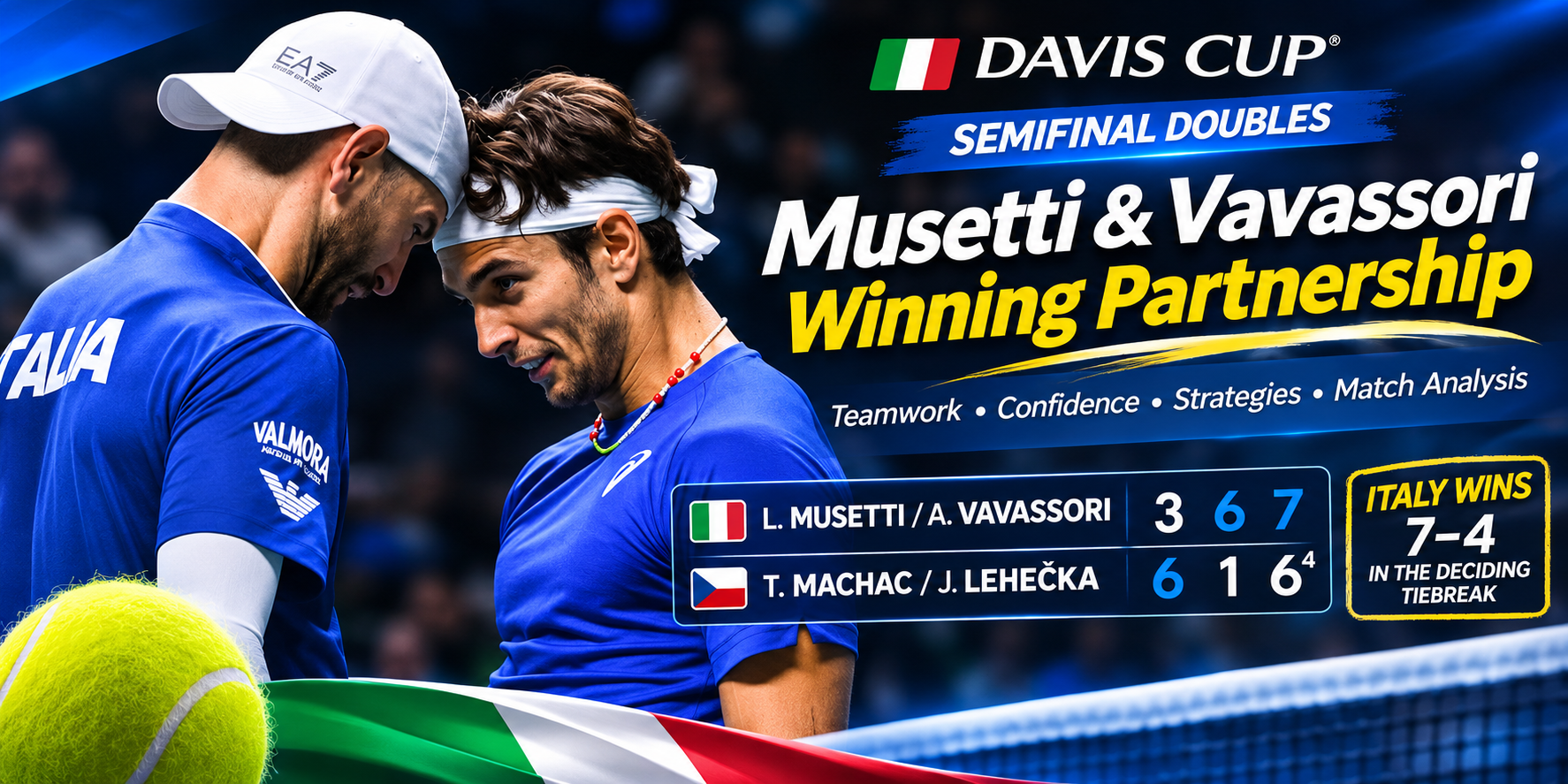
The Davis Cup semifinal doubles encounter between Italy's Lorenzo Musetti and Andrea Vavassori and the Czech Republic's Tomas Machac and Jiri Lehecka demonstrated the importance of teamwork, tactical intelligence, confidence, and mental resilience.
The Italian partnership delivered an impressive comeback, recovering from an opening-set defeat to secure a dramatic three-set victory.
Davis Cup Semifinal Doubles: Match Results
Italy: Lorenzo Musetti / Andrea Vavassori – 3, 6, 7
Czech Republic: Tomas Machac / Jiri Lehecka – 6, 1, 6
Italy won the deciding tiebreak 7–4.
1. The Power of a Strong Doubles Partnership
Two Players, One Tactical Objective
Doubles tennis requires a different mentality from singles competition. Individual talent is important, but coordination between partners often determines the outcome.
Lorenzo Musetti brings exceptional shot-making ability, creativity, and baseline variety. Andrea Vavassori contributes specialist doubles experience, net awareness, and tactical understanding.
Their complementary strengths demonstrate how two players can combine their individual abilities to create a more effective team.
Important Elements of Doubles Teamwork
- Baseline control: Maintain depth and create opportunities to attack.
- Net positioning: Pressure opponents and intercept vulnerable returns.
- Court communication: Establish clear responsibilities for middle balls.
- Tactical coordination: Recognize when to attack, defend, or change formations.
2. Game Analysis: How Italy Turned the Match Around
First Set: Czech Republic Establishes Control
The Czech partnership won the opening set 6–3. This gave Machac and Lehecka an early advantage and placed pressure on the Italian team.
In doubles tennis, early control can come from aggressive returns, effective serving, and attacking the middle of the court. Italy needed to adjust its strategy rather than simply increase shot power.
Second Set: Italy Responds with Authority
Italy answered with a convincing 6–1 second set. This turnaround highlighted the importance of tactical adaptation and mental strength.
The Italian partnership appeared to find a better rhythm and execute its game plan more effectively.
Important doubles principles include:
- Better return placement.
- More effective net positioning.
- Improved first-serve execution.
- Greater pressure on second serves.
- Better communication between partners.
Third Set: Confidence Under Pressure
The deciding set reached a 7–6 conclusion, with Italy winning the tiebreak 7–4.
This was the most important psychological phase of the encounter. Every return, volley, and serve carried additional significance.
The Italian partnership needed to remain composed, avoid unnecessary errors, and trust its tactical decisions.
3. The Psychology of Winning Doubles Tennis
Confidence Is a Shared Responsibility
One of the biggest challenges in doubles is maintaining confidence when a partner makes an error.
A successful partnership does not allow one missed volley or double fault to destroy the team's rhythm. Instead, both players must maintain positive communication.
Four Important Mental Habits
- Encouragement: Help your partner recover after mistakes.
- Trust: Support each other's decisions during difficult points.
- Emotional control: Avoid frustration and negative body language.
- Shared accountability: Accept responsibility as a team.
4. Five Strategies to Win More Doubles Matches
Strategy 1: Control the Middle of the Court
The middle is one of the most important tactical areas in doubles tennis. Attacking the space between opponents can create hesitation and communication problems.
However, partners must establish who takes responsibility for middle balls before the match begins.
Strategy 2: Develop a Strong First Serve
A reliable first serve gives the serving team an opportunity to control the next shot. It does not always need maximum speed. Placement, variation, and consistency can be more effective than power alone.
Strategy 3: Attack the Second Serve
Second serves often provide opportunities to apply pressure. The returner should look for a controlled aggressive return, targeting the middle or the feet of the approaching net player.
Strategy 4: Use Effective Net Positioning
The net player can change the direction and rhythm of a doubles exchange. Players should look for opportunities to intercept predictable crosscourt returns and pressure opponents into defensive positions.
Strategy 5: Play the Tiebreak with Discipline
Tiebreaks reward players who manage pressure and remain focused.
- Prioritize a high percentage of first serves.
- Avoid unnecessary low-percentage winners.
- Target weaker or less comfortable returns.
- Communicate before important points.
- Focus on one point at a time.
5. What Recreational Tennis Players Can Learn
Apply Professional Doubles Principles to Your Local Tennis Court
You do not need to compete in an international tournament to benefit from professional doubles strategies. Players at community tennis clubs can apply the same principles.
- Communication: Call the ball clearly.
- Court positioning: Avoid leaving open spaces.
- Tactical serving: Prioritize placement.
- Net aggression: Look for opportunities to volley.
- Mental resilience: Recover quickly after errors.
- Partnership trust: Encourage your partner.
Whether playing at Sandvillage Tennis Club, Pampanga Tennis Club, or another local court in Davao City, doubles teamwork can improve the quality of your game.
6. What Makes a Great Professional Doubles Partnership?
Talent Wins Points, but Partnership Wins Matches
Successful doubles partnerships are built around several essential qualities.
Technical ability: Players must serve, return, volley, and move effectively.
Tactical intelligence: Partners must understand formations, positioning, and opponents' weaknesses.
Mental resilience: They must recover from setbacks without losing concentration.
Communication: Clear signals and positive interaction reduce uncertainty.
Trust: Both players must believe in the partnership, especially during high-pressure situations.
Conclusion: Confidence, Cooperation, and the Will to Win
The Italian partnership's comeback from a 3–6 opening set to a 6–1 second set and a 7–6 deciding set demonstrates the importance of adaptability and composure.
Musetti and Vavassori showed the value of responding to adversity, maintaining competitive confidence, and executing as a team.
For every doubles player, the lesson is straightforward: Do not allow one lost set to define your match. Trust your partner, communicate clearly, adjust your tactics, and remain mentally strong until the final point.
In doubles tennis, two players can create something greater than individual talent. The strongest partnerships combine skill, trust, discipline, and confidence.
PLAY SMART. TRUST YOUR PARTNER. FIGHT FOR EVERY POINT.