
A Match of Momentum Swings and Championship Mindset
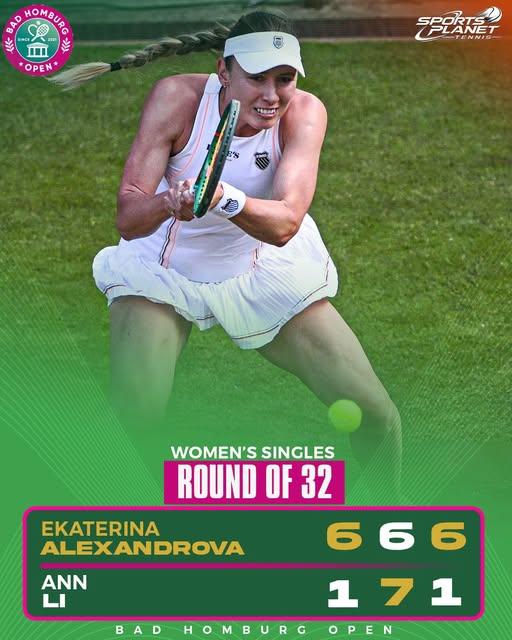
Grass-court tennis rewards players who can think quickly, strike decisively, and adapt under pressure. At the 2026 Bad Homburg Open, the Round of 32 clash between Ekaterina Alexandrova and Ann Li showcased all three elements.
At first glance, the scoreline appears unusual:
Ekaterina Alexandrova def. Ann Li 6-1, 6-7(5), 6-1
The first and third sets were dominated by Alexandrova, while the second set became a tense battle decided by a tiebreak.
This was not merely a contest of shot-making.
It became a test of:
- Tactical flexibility
- Emotional stability
- Serving quality
- Aggressive court positioning
- Competitive courage
The statistics reveal a fascinating story.
| Statistic | Alexandrova | Ann Li |
|---|---|---|
| Total Points Won | 112 | 90 |
| Aces | 11 | 11 |
| Double Faults | 4 | 3 |
| First Serve % | 68% | 62% |
| First Serve Points Won | 71% | 60% |
| Second Serve Points Won | 52% | 47% |
| Break Points Won | 5/8 | 1/3 |
| Service Games Won | 13 | 7 |
| Return Points Won | 42 | 40 |
Behind those numbers lies the story of an athlete who embraced an Alpha Game mindset and refused to allow one lost set to derail the bigger objective.
What Is the Alpha Game?
The Alpha Game in tennis is not about arrogance.
It is about identity.
An alpha competitor enters a match with a clear understanding of:
- Their strengths
- Their preferred patterns
- Their emotional triggers
- Their tactical solutions
The alpha player does not panic when adversity arrives.
The alpha player adapts.
The alpha player understands:
"Pressure is information, not danger."
Alexandrova embodied that philosophy throughout this match.
Despite losing the second set in a tiebreak, she immediately regained control in the third.
That ability separates elite competitors from average performers.
First Set: Alexandrova Establishes Authority
The opening set ended 6-1.
That score reflects complete control.
From the opening games, Alexandrova imposed her preferred tempo.
Several factors contributed to her dominance:
1. First Strike Tennis
Alexandrova excels when points remain short.
Her objective is simple:
- Strong serve
- Aggressive return
- Immediate court positioning
- Early ball contact
Ann Li struggled to establish rhythm because rallies were ending before they could develop.
2. Taking Time Away
One of Alexandrova's greatest strengths is her ability to rob opponents of preparation time.
She achieves this through:
- Flat groundstrokes
- Deep ball penetration
- Early contact points
On grass courts, this becomes even more effective.
The ball skids lower.
Reaction time decreases.
Opponents feel rushed.
Alexandrova immediately exploited these conditions.
3. Aggressive Return Position
Many players retreat behind the baseline.
Alexandrova frequently steps forward.
This tactic communicates confidence.
More importantly, it creates pressure.
Ann Li found herself immediately defending after serves rather than building offensive opportunities.
Ann Li’s Response in the Second Set
Elite athletes rarely disappear after losing a set.
Ann Li demonstrated remarkable resilience.
Instead of allowing frustration to grow, she made several key adjustments.
Improved First-Serve Placement
Although both players finished with 11 aces, Li improved her serve locations during the second set.
She began targeting:
- Wider angles
- Body serves
- Unexpected patterns
This prevented Alexandrova from attacking every return.
More Height Over the Net
Li also adjusted her rally structure.
Rather than matching Alexandrova's pace shot-for-shot, she occasionally introduced more margin.
This reduced unforced errors.
It forced Alexandrova to generate additional power.
The strategy helped extend rallies and create uncertainty.
Better Emotional Control
Many players collapse after a 6-1 opening set.
Li responded with courage.
She remained engaged.
She trusted her game.
That mental toughness allowed her to push the match into a tiebreak.
The Critical Tiebreak
The second-set tiebreak became the emotional center of the match.
Tiebreaks reveal mindset more clearly than any other situation.
There is nowhere to hide.
Every point matters.
Every mistake feels magnified.
Every decision carries weight.
Although Li captured the tiebreak 7-5, Alexandrova's behavior during this period would ultimately help determine the match's outcome.
She did not panic.
She did not argue.
She did not abandon her game plan.
Instead, she accepted the setback and prepared for the third set.
That is the essence of the Alpha Game.
Why Champions Recover Faster
The difference between elite players and average players is often not mistakes.
Everyone makes mistakes.
The difference is recovery speed.
After losing the second set, Alexandrova had two choices:
Option 1
Focus on frustration.
Think about missed opportunities.
Carry emotional baggage into the third set.
Option 2
Reset immediately.
Trust the process.
Attack the next set.
She chose Option 2.
The result was devastating for her opponent.
Third Set: Complete Reassertion of Control
The final set ended 6-1.
That score demonstrates something important.
Alexandrova did not merely recover.
She elevated.
Many players become cautious after losing a close set.
Alexandrova became more aggressive.
This reflects elite confidence.
The Statistical Story of Dominance
The match statistics reveal why Alexandrova ultimately prevailed.
Total Points Won
Alexandrova: 112
Ann Li: 90
A 22-point advantage across a three-set match is significant.
It indicates that even though the match contained a close tiebreak, Alexandrova controlled most of the overall action.
First Serve Performance
Alexandrova:
- 68% first serves
- 71% first-serve points won
Li:
- 62% first serves
- 60% first-serve points won
These numbers highlight one of the biggest differences.
Alexandrova consistently began points from advantageous positions.
A strong first serve creates easier second shots.
Easier second shots create offensive opportunities.
Offensive opportunities create scoreboard pressure.
Second Serve Success
Alexandrova won:
52% of second-serve points.
Li won:
47%.
That five-percent difference may appear small.
At the professional level, it is enormous.
Second serves often determine momentum.
Winning more than half of those points allowed Alexandrova to avoid vulnerability.
The Return Game Advantage
One underrated aspect of this victory was Alexandrova's returning.
She won:
42 return points.
This statistic demonstrates her ability to pressure service games.
Great returners create doubt.
Even when they don't break serve, they force servers to hit closer to the lines.
That pressure accumulates.
Eventually errors appear.
Alexandrova's return quality contributed heavily to her five successful breaks.
Break Point Efficiency
Alexandrova converted:
5 of 8 break opportunities.
Ann Li converted:
1 of 3.
This statistic often determines matches.
Elite competitors understand that break points are emotional moments.
The player who remains calmer usually wins.
Alexandrova repeatedly elevated her focus when opportunities emerged.
She demonstrated exceptional execution under pressure.
Stroke Analysis: Alexandrova’s Weapons
The Serve
The serve remains one of Alexandrova's greatest assets.
Her serving performance included:
- 11 aces
- High first-serve percentage
- Strong first-serve effectiveness
What makes her serve dangerous is unpredictability.
Opponents cannot simply anticipate power.
She combines pace with location.
The Forehand
Alexandrova's forehand serves as her primary offensive weapon.
Key characteristics include:
- Flat trajectory
- Deep penetration
- Ability to redirect pace
On grass courts, these qualities become even more dangerous.
The ball skids through the court quickly.
Opponents receive less reaction time.
The Backhand
Her backhand is equally important.
Unlike many players who rely heavily on one side, Alexandrova attacks confidently from both wings.
This balance prevents opponents from exploiting weaknesses.
Court Positioning
One of her most underrated strengths is court positioning.
She frequently stands:
- Close to baseline
- Inside baseline during returns
- Aggressively during transition points
This positioning creates constant pressure.
Tactical Adjustments That Won the Match
Elite tennis often comes down to adjustment quality.
Alexandrova made several key adjustments.
Adjustment #1: Increased Return Aggression
After the second set, she became more decisive on returns.
Rather than simply putting balls back into play, she attacked opportunities immediately.
Adjustment #2: Faster Court Positioning
She reduced recovery distance between shots.
This allowed her to take balls earlier.
Earlier contact increased pressure.
Adjustment #3: Commitment to Offensive Patterns
Many players become defensive after losing momentum.
Alexandrova doubled down on aggression.
This prevented Li from gaining confidence.
Adjustment #4: Better Target Selection
The third set featured more disciplined shot placement.
Rather than aiming for spectacular winners, she focused on high-percentage targets.
This produced cleaner execution.
The Psychology of Alpha Competitors
The greatest lesson from this match is psychological.
Alpha competitors possess unique internal dialogue.
During difficult moments they tell themselves:
"Stay aggressive."
"Trust the process."
"The next point matters most."
"Pressure creates opportunity."
This mindset enables rapid recovery.
Alexandrova demonstrated exactly that.
Lessons for Competitive Players
Every player can learn from this performance.
Lesson 1: Trust Your Identity
Do not abandon your strengths after setbacks.
Alexandrova continued playing her game.
Lesson 2: Adapt Without Panicking
Adjustments are necessary.
Panic is optional.
She adjusted tactics while maintaining confidence.
Lesson 3: Own the Baseline
Aggressive court positioning creates pressure.
Pressure creates mistakes.
Lesson 4: Serve With Purpose
A strong serve influences the entire match.
Alexandrova's serve established authority from the beginning.
Lesson 5: Reset Quickly
The faster you recover emotionally, the more dangerous you become.
Why Grass Rewards Alexandrova’s Style
Grass courts amplify her strengths.
They reward:
- Flat hitting
- Early contact
- Aggressive returns
- First-strike tennis
The Bad Homburg conditions allowed her game to flourish.
Her ability to attack immediately after the serve proved especially valuable.
The Champion’s Formula
Alexandrova's victory followed a clear blueprint:
Powerful Serving
11 aces and dominant first-serve numbers.
Aggressive Returning
Constant pressure on Li's service games.
Tactical Adaptation
Improved return positioning after the second set.
Emotional Stability
No panic after losing the tiebreak.
Alpha Confidence
Continued commitment to offensive tennis.
Final Thoughts: The Alpha Game in Action
Ekaterina Alexandrova's 6-1, 6-7(5), 6-1 victory over Ann Li was not simply a match won through power.
It was won through mindset.
The statistics tell the story:
- 112 total points won
- 11 aces
- 71% first-serve points won
- Five breaks converted
- Thirteen service games held
Yet the most important statistic cannot be measured.
It was her ability to remain mentally strong after losing a highly competitive second set.
That is the Alpha Game.
The Alpha Game is not perfection.
The Alpha Game is resilience.
It is the ability to absorb pressure, adjust intelligently, trust your strengths, and attack the next challenge with complete conviction.
Alexandrova demonstrated all of those qualities in Bad Homburg.
The result was a commanding victory, a valuable lesson in competitive tennis, and another reminder that the most dangerous players are not always those who hit the hardest—they are the ones whose belief never wavers when the match becomes difficult.