
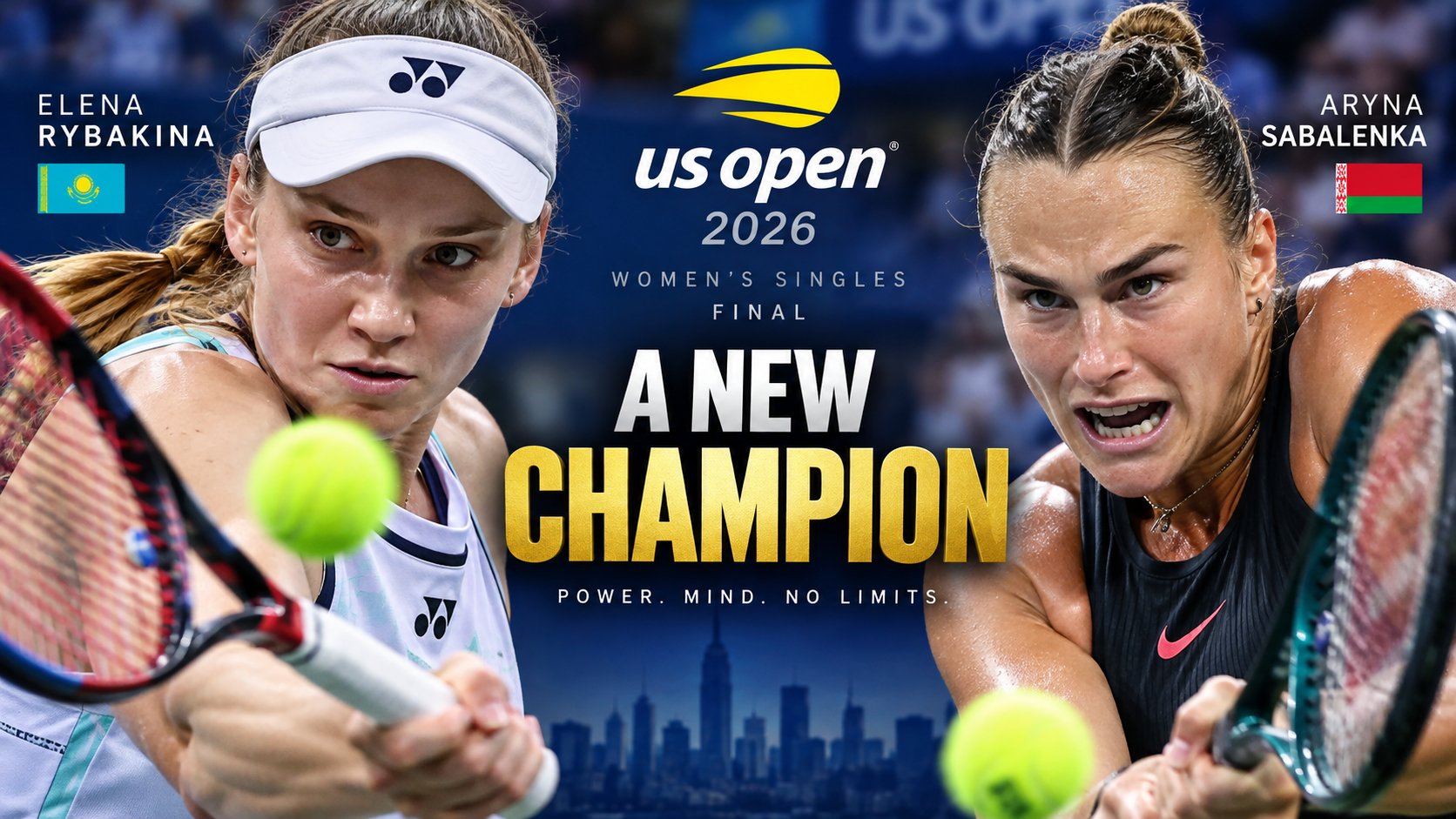
How a Grand Slam champion turns power, intelligence, and mental toughness into victory on the biggest stage.
A Grand Slam Masterclass in Winning Tennis
The 2026 US Open women’s singles final delivered a championship performance from Elena Rybakina, who defeated Aryna Sabalenka 6–4, 5–7, 6–2 to claim her maiden New York title and third career Grand Slam crown.
With this victory, Rybakina also captured the WTA world No. 1 ranking, becoming the first player from Kazakhstan to reach the top spot.
Her achievement represents the complete evolution of a tennis champion: powerful enough to dominate, intelligent enough to adapt, mentally strong enough to survive pressure, and physically prepared to perform when the match demands everything.
From a tennis expert’s perspective, Rybakina’s victory offers valuable lessons for every player who wants to improve their game.
1. Tennis IQ of the Champion: Winning With Intelligence
Tennis IQ is the ability to understand what is happening on the court and make the correct decision before the opponent can take control.
It is not simply about hitting the hardest forehand or serving the fastest ball. It is about recognizing patterns, identifying weaknesses, managing risk, and knowing when to attack or defend.
Elena Rybakina’s championship profile is built around the kind of aggressive baseline tennis that rewards intelligent shot selection.
Understanding the First Strike
Against a powerful opponent like Aryna Sabalenka, the first few shots of a rally are extremely important.
Both players possess the ability to generate enormous pace. That means the battle is not only about who hits harder. It is about who creates the better opportunity to attack.
A smart player asks:
- Where is my opponent standing?
- Is the opponent balanced or moving?
- Is the ball short enough to attack?
- Should I hit down the line or crosscourt?
- Can I finish the point, or should I build the rally?
Rybakina’s attacking style demonstrates the value of taking control early, especially when her serve and groundstrokes allow her to dictate the direction of the rally.
The Champion’s Tactical Lesson
Power creates opportunities. Tennis IQ decides when to use them.
A player who attacks every ball without thinking will eventually make unnecessary errors. A champion understands that aggressive tennis must still be intelligent tennis.
The goal is not to hit a winner on every shot. The goal is to create a situation where the winner becomes the highest-percentage option.
2. Mental Mindset: The Ability to Stay Calm Under Pressure
A Grand Slam final is not an ordinary tennis match.
The crowd is louder. The expectations are greater. Every important point carries emotional weight. The opponent is also fighting for a championship.
In the Rybakina–Sabalenka final, the second set went to Sabalenka 7–5 after Rybakina had taken the opening set 6–4.
From a mental-performance perspective, this is a critical moment.
A player can lose confidence after dropping a close set. Some players begin rushing, overhitting, or thinking about the scoreboard rather than the next ball.
The champion’s response is different.
Reset After Losing a Set
The most important mental skill in tennis is the ability to separate the previous point from the next point.
After losing the second set, the correct mindset is not:
“I was winning, and now everything is going wrong.”
The better mindset is:
“The match is still in front of me. I have another opportunity to execute my game.”
Rybakina’s third-set victory, 6–2, illustrates the importance of recovering from a setback and returning to competitive focus.
The Mental Reset Routine
A useful routine for tennis players:
1. Accept the result.
The previous set is finished. Do not waste emotional energy trying to change it.
2. Identify the adjustment.
Ask what needs to improve: serve placement, return position, footwork, rally tolerance, or shot selection.
3. Focus on the next game.
Do not mentally play the entire third set before it begins.
4. Trust your preparation.
Your training has already built the skills you need. The challenge is to execute them under pressure.
5. Compete one point at a time.
Championships are won through repeated good decisions.
Expert Insight
A strong tennis mind does not mean never feeling nervous.
It means learning how to perform while nervous.
Pressure is part of the sport. The champion learns to use pressure as a reason to become more focused rather than more emotional.
3. Stamina Booster: How Champions Maintain Energy
Tennis stamina is more than running for a long time.
A player needs several types of endurance:
- Aerobic endurance: The ability to recover between long rallies and games.
- Repeated-sprint ability: The ability to accelerate, stop, and change direction repeatedly.
- Muscular endurance: The ability to maintain quality groundstrokes and serves as fatigue increases.
- Mental endurance: The ability to make good decisions late in a match.
Rybakina’s victory in a three-set Grand Slam final highlights the importance of sustaining performance over the course of a demanding match.
The Real Stamina Advantage
A player with excellent stamina can continue to produce quality tennis when the opponent begins to slow down.
That does not mean simply running more. It means training the body to recover efficiently and training the mind to remain disciplined when tired.
For recreational and competitive tennis players, stamina improvement should include:
A. Court Movement Training
Practice short bursts of movement:
- Split step and first-step acceleration.
- Side-to-side defensive movement.
- Recovery to the center of the court.
- Short sprint followed by controlled deceleration.
Tennis movement is explosive and unpredictable. Training should reflect the actual demands of the sport.
B. Rally Endurance
Use structured drills that require sustained concentration and movement.
For example:
- Crosscourt forehand rallies.
- Backhand consistency drills.
- Two-direction movement patterns.
- Point construction under fatigue.
The goal is to preserve shot quality even after several demanding exchanges.
C. Strength and Stability
A tennis player needs strength in the legs, trunk, shoulders, and upper body.
Strength training can help support:
- Stable groundstrokes.
- Better balance during open-stance hitting.
- Stronger recovery movement.
- Improved control when defending.
- More efficient force production.
Strength training should be individualized and progressed safely, especially for younger players or athletes returning from injury.
D. Recovery Between Points
A simple but powerful stamina strategy is learning how to recover during the match.
Between points:
- Turn away from the previous rally.
- Take controlled breaths.
- Relax your shoulders and grip.
- Prepare for the next point.
- Return to your tactical plan.
The champion does not spend every second fighting at maximum intensity. She learns when to produce explosive effort and when to recover.
4. Rybakina’s Serve: The Foundation of Aggressive Tennis
One of Rybakina’s most recognized tennis weapons is her powerful serve.
A strong serve can create immediate advantages:
- Free points through aces.
- Weak returns.
- Shorter rallies.
- Opportunities to attack with the next shot.
- Greater pressure on the opponent’s service games.
However, the serve is not only about speed.
Serve Placement Is Tennis IQ
A smart server changes placement according to the opponent’s position and return tendencies.
Possible targets include:
- Wide serve to pull the opponent off the court.
- Body serve to reduce the returner’s swing space.
- T serve to challenge the opponent’s reaction time.
The best serving strategy combines speed, accuracy, disguise, and placement.
The Serve Plus One
The serve should be connected to the next shot.
A common championship pattern is:
Serve → Weak return → Aggressive first forehand → Control the rally.
This is called the serve-plus-one pattern.
A player who practices this sequence can turn a good serve into a complete attacking system.
Coaching Lesson
Do not practice serving only to hit aces.
Practice serving to create a predictable next ball.
That is how a strong server becomes a complete tactical player.
5. The Battle Against Aryna Sabalenka: Power Versus Power
The 2026 US Open final between Elena Rybakina and Aryna Sabalenka presented a fascinating matchup between two elite power players.
Both athletes are capable of producing heavy groundstrokes and aggressive attacking tennis.
When two powerful players meet, the match can be decided by subtle differences:
Return Quality
A strong return can immediately prevent the server from taking control.
The returner must balance aggression with accuracy. A return that is too passive may give the server an easy first attack. A return that is too ambitious may produce an unforced error.
Rally Direction
The crosscourt rally is often the safest way to maintain control, but changing direction at the right time can create an opening.
A player must recognize when the opponent is out of position before attempting the down-the-line attack.
Court Position
Standing too far behind the baseline may give the opponent more time and space.
Standing too close may increase the risk of rushed errors.
The correct position depends on the incoming ball, opponent’s pace, and tactical objective.
The Key Difference
In a power battle, the winner is not always the player who hits the hardest.
The winner may be the player who:
- Makes fewer rushed decisions.
- Returns more effectively.
- Maintains balance under pressure.
- Recognizes the correct moment to attack.
- Recovers faster after difficult points.
That is the difference between raw power and championship tennis.
6. The Third-Set Mentality: Where Champions Separate Themselves
Rybakina’s 6–2 third-set victory is the clearest turning point in the match result provided.
After a split first two sets, the deciding set becomes a test of physical and emotional control.
A player may feel fatigue. The opponent may increase aggression. The crowd may become more involved.
This is when a champion must return to the fundamentals.
The Third-Set Game Plan
First priority: Protect the serve.
Start the set with clear serving targets and avoid unnecessary double faults.
Second priority: Attack short balls.
Do not allow the opponent to recover after giving up a short ball.
Third priority: Stay patient in long rallies.
Aggression must be supported by balance and good spacing.
Fourth priority: Compete on break points.
Break points are pressure situations. The goal is to play the correct pattern rather than chase a spectacular winner.
Fifth priority: Finish with discipline.
When leading, do not assume the match is already finished. Continue playing each point with the same focus.
Expert Perspective
The ability to win the deciding set is one of the clearest signs of competitive maturity.
A champion knows how to maintain her identity even when the match becomes physically and emotionally difficult.
7. The Champion’s Training Formula
For players who want to develop a Rybakina-inspired championship mindset, the training plan should combine tennis skill, physical preparation, and mental discipline.
Tennis IQ Training
Spend time studying your own matches.
Ask:
- Which shots create my best opportunities?
- Where do I lose points?
- What happens when I face a powerful opponent?
- Do I attack too early?
- Can I recognize when to defend?
Match analysis is one of the most effective ways to improve tennis intelligence.
Mental Training
Practice routines for pressure:
- Play tie-breaks during training.
- Practice serving at 30–30.
- Use point-by-point goals.
- Train after moderate fatigue.
- Practice recovering after losing games.
The objective is to make pressure situations familiar.
Stamina Training
Build endurance progressively with qualified coaching support.
A balanced program can include:
- Tennis-specific movement.
- Aerobic conditioning.
- Strength training.
- Recovery sessions.
- Sleep and nutrition habits.
Training should be adjusted to the athlete’s age, fitness level, and competition schedule.
8. Nutrition and Recovery: The Hidden Side of Performance
A champion’s performance depends on more than what happens during the match.
Nutrition and recovery support the ability to train consistently and perform at a high level.
Before the Match
Players generally benefit from a familiar meal containing carbohydrates and moderate protein, with enough time to digest before competition.
Hydration should begin before stepping onto the court.
During the Match
Long tennis matches may require fluids and accessible carbohydrates, depending on conditions, duration, and individual needs.
Players should practice their nutrition strategy during training rather than experimenting for the first time in a final.
After the Match
Recovery should include:
- Rehydration.
- Carbohydrate replacement.
- Protein for muscle repair.
- Appropriate cooldown.
- Adequate sleep.
A champion’s body must recover before it can perform again.
Stamina is built through training, but preserved through recovery.
9. Lessons Every Tennis Player Can Learn From Rybakina
Elena Rybakina’s 2026 US Open victory offers important lessons beyond the professional tour.
Lesson 1: Power Needs Direction
A powerful shot is most effective when it has a tactical purpose.
Lesson 2: Losing a Set Is Not Losing the Match
A match can change quickly. Stay focused on the next opportunity.
Lesson 3: The Serve Is a Weapon, Not the Entire Game
Use the serve to build the point and create opportunities.
Lesson 4: Stamina Includes Decision-Making
Fatigue affects the body and the mind. Train both.
Lesson 5: Champions Adapt
The opponent will change tactics. Your ability to respond matters.
Lesson 6: Confidence Comes From Preparation
Confidence is stronger when it is supported by training, match experience, and a clear game plan.
Final Verdict: The Mind of a Champion
Elena Rybakina’s victory over Aryna Sabalenka in the 2026 US Open final, as described in the tournament result provided, represents the combination of elite tennis ability and championship resilience.
Her achievement is a reminder that tennis greatness is not built from power alone.
It is built from the ability to understand the game, remain composed under pressure, manage physical demands, and execute the right decisions when the match reaches its most important moments.
The champion’s formula is simple to describe but difficult to master:
Tennis IQ + Mental Toughness + Stamina + Execution = Championship Tennis.
For every player training on a local court, competing in a club tournament, or dreaming of a Grand Slam final, the lesson is clear:
You do not need to play every point perfectly.
You need to keep learning, keep adapting, and keep competing.
That is the mindset of a champion.
SEO Meta Description
Elena Rybakina’s 2026 US Open championship explained: discover her tennis IQ, mental toughness, stamina training, serve strategy, and lessons every tennis player can learn.
Suggested SEO Keywords
- Elena Rybakina 2026 US Open champion
- Elena Rybakina tennis IQ
- Elena Rybakina mental mindset
- Elena Rybakina stamina training
- Elena Rybakina vs Aryna Sabalenka final
- tennis champion mindset
- tennis mental toughness
- tennis stamina booster
- tennis strategy and match analysis
Suggested Article Tags
Elena Rybakina, US Open 2026, Aryna Sabalenka, Tennis IQ, Tennis Mental Toughness, Tennis Stamina, Grand Slam Tennis, Women’s Tennis, Tennis Training