
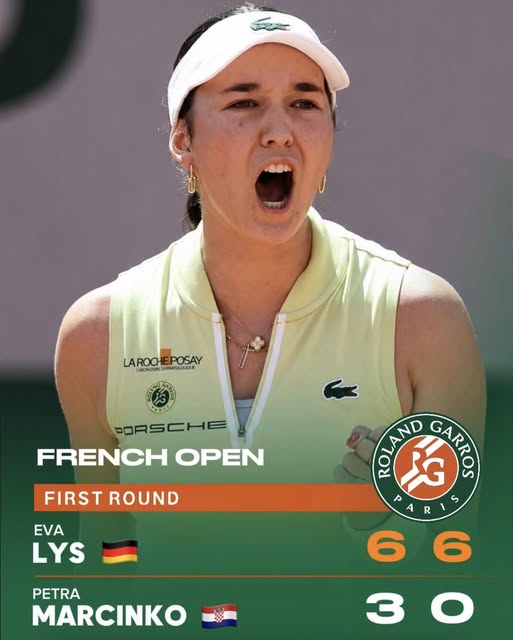
The opening round of the 2026 French Open produced several strong performances, but one of the most impressive came from Germany’s rising star Eva Lys. The current World No. 81 delivered a composed and highly disciplined victory over Croatia’s Petra Marcinko, winning 6-3, 6-0 in commanding fashion at French Open.
For many ATP and WTA analysts watching the match, this was not simply a routine first-round win. It was a tactical statement. Eva Lys showed maturity, emotional control, clay-court patience, and a deep understanding of point construction rarely seen from players outside the Top 50.
Now, an even bigger challenge awaits her against Romania’s experienced World No. 18 Sorana Cirstea in the second round.
This victory against Marcinko was more than a scoreline. It revealed how quickly Eva Lys is evolving into a dangerous player capable of disrupting established names on the biggest stages in tennis.
The Atmosphere at Roland Garros
Roland Garros is unlike any other Grand Slam event. Clay courts expose weaknesses brutally. There is nowhere to hide physically, mentally, or tactically. Players who rely purely on power often struggle because points become longer, movement becomes more demanding, and patience becomes essential.
From the opening games, Eva Lys looked completely comfortable in the Paris conditions. Her movement was balanced, her footwork remained efficient, and her body language projected calm confidence.
Meanwhile, Petra Marcinko entered the match with aggressive intentions. The Croatian attempted to dictate early rallies with pace and first-strike tennis. However, Eva Lys immediately disrupted that rhythm by varying height, depth, and tempo.
ATP-level coaches watching this match would immediately notice one thing:
Eva Lys never allowed Marcinko to settle into predictable patterns.
That became the turning point of the entire contest.
First Set Analysis: Eva Lys Controls the Rhythm
The opening set finished 6-3, but the score alone does not fully explain how strategically sharp Eva Lys played.
Early Tactical Pattern
Marcinko initially tried attacking crosscourt exchanges, especially on the backhand side. Her plan was clear:
- Push Eva Lys behind the baseline
- Open angles early
- Finish points aggressively
But Eva Lys adjusted brilliantly.
Instead of forcing winners too early, she focused on:
- Deep middle-ball control
- Heavy topspin neutralization
- Smart defensive recovery
- High-percentage rally construction
This frustrated Marcinko almost immediately.
Rather than trading reckless power, Eva Lys made Petra hit one extra shot repeatedly. On clay courts, that single extra shot changes everything psychologically.
ATP coaches often describe this as “stress accumulation tennis.”
The idea is simple:
You may not hit outright winners immediately, but you slowly increase mental pressure until the opponent begins forcing errors.
That is exactly what happened.
Eva Lys’ Footwork Was Elite-Level
One of the most underrated aspects of this match was Eva Lys’ movement.
Many younger players move reactively on clay. They slide late, recover slowly, or lose balance during directional changes.
Eva Lys did the opposite.
Key Footwork Strengths
1. Early Preparation
She prepared her body position extremely early before contact.
That allowed:
- Cleaner timing
- Better balance
- Controlled acceleration through the ball
2. Efficient Sliding
Her sliding mechanics on clay were smooth and controlled.
Instead of panicking into defensive stretches, she glided into position and recovered efficiently.
3. Recovery Discipline
After each shot, Eva returned to ideal court positioning quickly.
This prevented Marcinko from exploiting open spaces consistently.
ATP experts always say:
“Clay court tennis begins with the feet, not the racket.”
Eva Lys demonstrated this beautifully.
Petra Marcinko’s Main Problem
Petra Marcinko is talented and aggressive, but during this match she struggled with emotional patience.
That became increasingly visible after the middle of the first set.
Common Errors From Marcinko
Overhitting Under Pressure
Marcinko began aiming too close to the lines.
This usually happens when:
- A player feels rallies are becoming too long
- They lose confidence in neutral exchanges
- They want quick solutions
Eva Lys recognized this frustration immediately and extended rallies even further.
Poor Shot Selection
Marcinko occasionally attempted low-percentage down-the-line attacks from unstable positions.
Against elite clay-court defenders, those shots become extremely dangerous.
Mental Collapse After Momentum Shift
Once Eva Lys secured control late in the first set, Marcinko’s body language changed dramatically.
The confidence disappeared.
The second set became completely one-sided.
The Second Set: Total Domination
The 6-0 second set was not accidental.
It was the result of cumulative tactical pressure.
Eva Lys increased intensity in several important areas:
- More aggressive return positioning
- Deeper rally depth
- Better forehand acceleration
- Stronger inside-out combinations
Marcinko meanwhile looked mentally overwhelmed.
This is something ATP veterans often discuss:
On clay, frustration compounds faster because rallies are physically exhausting.
When confidence drops even slightly:
- Footwork slows
- Timing disappears
- Decision-making becomes rushed
That is exactly what happened.
Eva Lys sensed weakness and attacked intelligently without becoming reckless.
That balance is difficult to master.
ATP Expert Breakdown: Why Eva Lys Was So Effective
From an ATP coaching perspective, several advanced elements stood out in Eva Lys’ performance.
1. Depth Control
She consistently pushed Marcinko deep behind the baseline.
Deep balls on clay create:
- Late contact points
- Defensive court positioning
- Reduced offensive options
This prevented Marcinko from stepping inside the court comfortably.
2. Height Variation
Eva changed net clearance intelligently.
Some balls carried heavy topspin with higher bounce.
Others stayed flatter and lower.
This disrupted Marcinko’s rhythm continuously.
Elite clay-court players rarely hit every ball with identical trajectory.
Variation creates uncertainty.
3. Directional Discipline
Eva Lys avoided reckless line-hitting.
Instead, she used:
- High-percentage crosscourt patterns
- Controlled redirection
- Smart point patience
This is mature tennis.
Many younger players lose structure emotionally during matches. Eva remained tactically disciplined throughout.
4. Emotional Stability
Perhaps most impressive was her composure.
Even after winning important points, Eva Lys remained calm and focused.
No emotional overreaction.
No panic moments.
No visible frustration.
That mentality becomes critical during Grand Slam events.
The Importance of Momentum in Tennis
This match became a textbook example of momentum management.
Momentum in tennis is psychological energy.
Once Eva Lys established rhythm:
- Marcinko rushed points
- Errors increased
- Confidence dropped rapidly
Meanwhile Eva became more relaxed and confident.
ATP coaches often explain that tennis matches are not won only by shot quality.
They are won by:
- Emotional control
- Pattern discipline
- Stress management
- Momentum handling
Eva Lys excelled in all four areas.
Tactical Adjustments That Changed the Match
The best players adjust constantly.
Eva Lys made several excellent in-match adjustments.
Adjustment 1: Neutralizing Early Pace
At the start, Marcinko attacked aggressively.
Eva responded by:
- Adding more height to rallies
- Slowing tempo strategically
- Redirecting pace instead of matching it
This forced Marcinko to generate extra power herself.
Adjustment 2: Attacking the Backhand Movement
Eva began exposing Marcinko’s movement during backhand recovery.
She used:
- Wide crosscourt forehands
- Sudden redirection
- Deep middle pressure
This prevented Marcinko from planting comfortably.
Adjustment 3: More Aggressive Return Position
Late in the first set, Eva stepped slightly closer during returns.
This immediately increased pressure on Marcinko’s serve.
The Croatian began forcing first serves, leading to lower percentages and weaker second serves.
What Eva Lys Must Improve Against Sorana Cirstea
The next challenge becomes much tougher.
Sorana Cirstea brings far more experience, power, and tactical variety.
Cirstea is dangerous because she can:
- Take the ball early
- Redirect pace aggressively
- Flatten rallies quickly
- Attack short balls immediately
Eva Lys cannot rely on the same patterns exclusively.
She will need additional tactical layers.
ATP Expert Advice for Eva Lys vs Sorana Cirstea
1. Avoid Passive Court Positioning
Against Marcinko, deeper positioning worked well.
Against Cirstea, excessive defensive court position becomes dangerous.
Sorana thrives when opponents retreat too far.
Eva must:
- Hold baseline position
- Step inside when possible
- Take time away strategically
2. Improve First-Serve Percentage
Against Top 20 players, second serves become targets.
Eva must maintain:
- High first-serve consistency
- Smart placement
- Varied serving patterns
Cheap service games become critical.
3. Attack Short Balls Earlier
Cirstea punishes hesitation.
Eva cannot allow neutral short balls to remain neutral.
She must:
- Transition forward earlier
- Finish points decisively
- Apply offensive pressure when opportunities appear
4. Maintain Emotional Composure
This may become the most important factor.
Sorana Cirstea is experienced and knows how to create scoreboard pressure.
If the match becomes tight:
- Eva must avoid panic
- Stay disciplined
- Continue constructing points intelligently
Grand Slam second rounds often become mental battles.
Clay Court Tennis Rewards Intelligence
This match reminded fans of an important truth:
Clay courts reward thinkers.
Power alone rarely dominates consistently at Roland Garros.
The best clay-court players understand:
- Patience
- Movement
- Shot tolerance
- Tactical adaptation
Eva Lys displayed all these qualities against Marcinko.
That is why many ATP analysts were impressed beyond the final score.
Lessons Beginner Tennis Players Can Learn From Eva Lys
This match offers major lessons for developing players.
Do Not Rush Every Rally
Many beginners try winning points too quickly.
Eva Lys showed that patience creates errors naturally.
Sometimes the smartest attack is simply one more deep ball.
Footwork Creates Better Shots
Her balance and movement allowed cleaner contact consistently.
Players should focus on:
- Knee bend
- Recovery steps
- Early preparation
- Efficient movement
Without proper footwork, even strong strokes collapse under pressure.
Emotional Control Matters
Marcinko became emotionally frustrated.
Eva stayed calm.
That difference changed the match completely.
Tennis rewards emotional stability under stress.
High Percentage Tennis Wins Matches
Eva did not attempt reckless highlight shots constantly.
Instead she:
- Played smart margins
- Built points carefully
- Forced errors naturally
This is advanced match management.
Why Eva Lys Could Become Dangerous on Tour
Several factors suggest Eva Lys has strong long-term potential.
Tactical Intelligence
She already understands point construction better than many young players.
Clay-Court Comfort
Her movement and patience fit clay naturally.
Mental Maturity
She handled momentum professionally.
Physical Balance
Her movement efficiency reduces wasted energy.
That becomes critical during long tournaments.
ATP Coaches Love Players Who Solve Problems
The biggest difference between average professionals and elite competitors is adjustment ability.
When Plan A fails:
- Can the player adapt?
- Can they remain composed?
- Can they identify weaknesses quickly?
Eva Lys showed encouraging signs in all these areas.
That is why this victory felt larger than a normal first-round win.
The Psychological Danger of a 6-0 Set
A bagel set in Grand Slam tennis sends a message to the entire draw.
It shows:
- Physical dominance
- Tactical superiority
- Emotional control
Opponents notice these scorelines.
Confidence grows dramatically after such performances.
Eva Lys now enters the next round believing she belongs on this stage.
That belief matters enormously in professional tennis.
Could Eva Lys Upset Sorana Cirstea?
Absolutely.
But several conditions must happen.
Keys to the Upset
Strong Serving
She cannot allow easy returns.
Early Rally Discipline
Avoid giving Sorana short attackable balls.
Physical Intensity
Maintain movement quality throughout long exchanges.
Emotional Patience
Do not panic if momentum shifts.
If Eva Lys executes these areas effectively, the match could become extremely competitive.
Final Thoughts: A Performance That Deserves Attention
Eva Lys did far more than simply win a first-round match at French Open.
She demonstrated:
- Tactical maturity
- Clay-court intelligence
- Emotional composure
- High-level movement
- Strong in-match adjustments
Her dominant victory over Petra Marcinko showed a player beginning to understand how to win professionally — not just hit beautifully.
Now the spotlight turns toward her upcoming showdown against Sorana Cirstea.
If Eva Lys maintains this level of discipline and tactical clarity, Roland Garros may become the tournament where the tennis world truly begins taking notice.
Congratulations and good luck, Eva Lys. The next chapter at Roland Garros could become even bigger.