Quick Overview
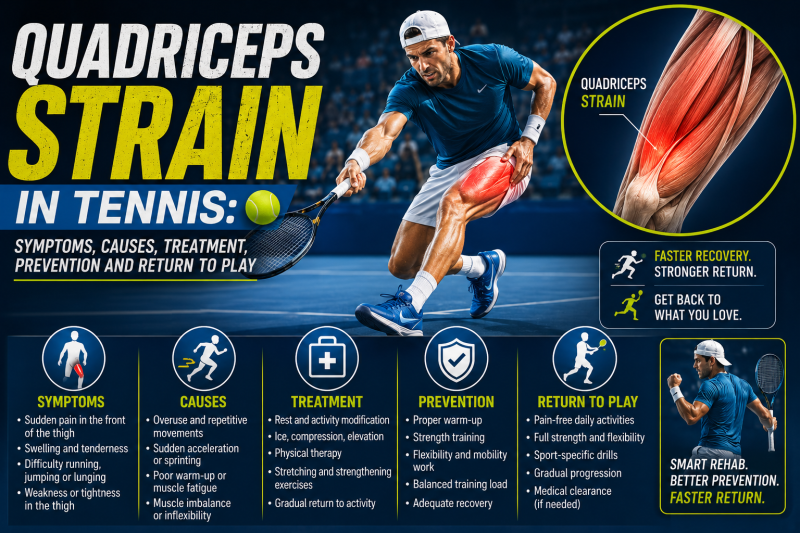
A quadriceps strain is an overstretching or tearing of one or more muscles at the front of the thigh. In tennis, the rectus femoris is particularly important because it crosses both the hip and knee and is exposed to high forces during sprinting, lunging, braking, jumping, and rapid changes of direction.
For competitive and professional players, quadriceps strains can range from a mild muscle injury to a significant partial tear involving the muscle-tendon junction or central aponeurosis.
The injury is particularly relevant to tennis because players repeatedly transition between explosive acceleration and sudden deceleration.
Symptoms
Common symptoms of a quadriceps strain include:
- Sudden or sharp pain in the front of the thigh
- Pain during sprinting, lunging, jumping or changing direction
- Localized tenderness when pressing the injured area
- Swelling or bruising in moderate or severe injuries
- Muscle tightness or weakness
- Pain during resisted knee extension
- Pain when stretching the quadriceps by extending the hip while bending the knee
- Difficulty accelerating, stopping or pushing off
- Reduced range of motion
- A noticeable limp in more significant injuries
A severe tear may produce an obvious loss of strength or a palpable defect in the muscle.
Causes
Quadriceps strains in tennis are usually associated with high-force eccentric and concentric loading.
1. Sudden Acceleration
Explosive first-step acceleration requires rapid force production from the quadriceps and other lower-limb muscles.
2. Aggressive Deceleration
A player sprinting toward a short ball must rapidly absorb momentum. The quadriceps act eccentrically to control knee flexion and braking forces.
3. Wide Defensive Lunges
An extreme defensive lunge can place the rectus femoris under substantial lengthening tension, particularly when the hip is extended while the knee is flexed.
4. Rapid Direction Changes
Hard cuts and recovery movements create repeated high-load contractions through the quadriceps.
5. Fatigue
Muscle fatigue can reduce force absorption and coordination, increasing mechanical stress during explosive movements.
6. Inadequate Preparation
Insufficient warm-up, poor load progression, or an abrupt increase in training intensity can contribute to muscle injury.
7. Previous Injury
A previous quadriceps strain may increase the risk of reinjury if strength, flexibility, neuromuscular control, and sport-specific capacity have not been fully restored.
Diagnosis
Diagnosis begins with a detailed history and physical examination.
A sports physician or physiotherapist will assess:
- Location and severity of pain
- Injury mechanism
- Walking and running pattern
- Quadriceps strength
- Hip and knee range of motion
- Local tenderness
- Pain during resisted knee extension
- Pain during quadriceps stretching
- Functional movements such as squatting, lunging and hopping
Clinical Testing
Tests such as a straight-leg raise and resisted knee extension can reproduce symptoms. Deep palpation may identify a focal area of tenderness or, in a significant tear, a palpable defect.
The examination also helps distinguish a quadriceps strain from other causes of anterior thigh pain, including:
- Direct muscle contusion
- Delayed-onset muscle soreness
- Tendon injury
- Hip pathology
- Referred lumbar pain
- Femoral nerve-related symptoms
MRI and Ultrasound
Imaging may be appropriate when a significant tear is suspected, symptoms are severe, or the diagnosis is uncertain.
MRI can identify the location and extent of muscle damage, including involvement of the rectus femoris muscle-tendon junction or central aponeurosis.
Treatment
Treatment depends on the severity and location of the injury.
Phase 1: Acute Management — Days 1–7
The initial objective is to protect the injured tissue while controlling pain and allowing normal healing to begin.
Management may include:
- Relative rest
- Compression
- Pain-limited walking
- Temporary crutch use if the player cannot walk normally
- Gentle pain-free quadriceps isometrics
- Carefully controlled range-of-motion exercises
Aggressive stretching or high-force strengthening should generally be avoided during the early stage if it increases symptoms.
The exact rehabilitation program should be determined by the treating medical team based on the injury grade and clinical findings.
Phase 2: Early Loading — Weeks 2–4
Once pain and irritability have decreased, progressive loading becomes important.
Typical exercises may include:
- Stationary cycling with minimal resistance
- Controlled knee range-of-motion work
- Low-load leg press
- Isometric quadriceps contractions
- Bridging exercises
- Controlled wall-sit variations
The goal is to restore movement while gradually exposing the healing muscle to mechanical tension.
Phase 3: Strength Development — Weeks 5–8
The rehabilitation program progresses toward restoring strength and muscle capacity.
Exercises can include:
- Split squats
- Step-ups
- Bulgarian split squats
- Progressive leg press
- Controlled leg extensions
- Squatting variations
- Eccentric quadriceps loading
- Progressive single-leg exercises
Slow, controlled eccentric loading becomes increasingly important because the quadriceps must absorb substantial forces during tennis deceleration.
Strength testing can help compare the injured and uninjured limbs. Rather than relying exclusively on a predetermined percentage or timeline, progression should be based on objective testing and the player's symptoms.
Phase 4: High-Velocity and Tennis-Specific Training — Weeks 9–12+
A professional tennis player cannot safely return simply because everyday activities are pain-free.
The quadriceps must tolerate the speed and forces of actual tennis.
Rehabilitation can progress through:
- Linear acceleration
- Controlled deceleration
- Lateral shuffling
- Direction changes
- Figure-eight running
- Court-covering drills
- Progressive sliding
- Single-leg hopping
- Plyometric exercises
- Split-stance jumps
- Tennis-specific movement patterns
The player can then progress from controlled hitting to increasingly demanding live-ball sessions and match simulation.
The 9–12+ week timeframe is an example rehabilitation framework, not a guaranteed recovery period. A significant partial tear can require longer depending on its location, severity, symptoms and response to loading.
Prevention
Quadriceps injury prevention should focus on preparing the entire lower limb for the demands of tennis.
Strength Training
Develop balanced strength in:
- Quadriceps
- Hamstrings
- Gluteal muscles
- Calves
- Hip stabilizers
- Trunk musculature
Progressive Eccentric Loading
Players should regularly train the muscles to absorb force, not just produce it.
Sprint and Deceleration Training
Tennis requires repeated acceleration and braking. These qualities should be progressively trained rather than introduced suddenly.
Movement Quality
Good control during:
- Lunges
- Split steps
- Direction changes
- Landing
- Court recovery
can help manage mechanical stress.
Training Load Management
Sudden increases in match volume, sprinting, court intensity or conditioning should be avoided whenever possible.
Warm-Up
A progressive tennis warm-up should prepare the player for the specific movements and intensities expected during training or competition.
Return to Tennis
Returning to tennis should be based on function rather than the calendar alone.
A player with a significant quadriceps strain should generally demonstrate:
Clinical Criteria
- No significant pain during daily activities
- No meaningful tenderness over the injured muscle
- Full or near-full hip and knee range of motion
- No significant swelling
- No apprehension with quadriceps stretching
Strength Criteria
The injured leg should demonstrate near-symmetrical strength compared with the opposite side.
For an elite player, objective dynamometry can provide a much more useful assessment than subjective strength alone.
Functional Criteria
The player should tolerate:
- Maximal or near-maximal acceleration
- High-speed deceleration
- Deep lunges
- Lateral movement
- Direction changes
- Court-covering movements
- Tennis-specific sliding
- Repeated explosive efforts
without pain, weakness or loss of movement quality.
Final Tennis Progression
A practical progression is:
Controlled hitting → movement with feeds → live-ball drills → full-court movement → high-intensity practice → match simulation → competitive return
The player should demonstrate that the quadriceps can repeatedly tolerate the demands of tennis rather than merely completing one isolated high-intensity test.
Clinical Profile: Quadriceps Strain in an Elite ATP Tour Player
Case Overview
Consider an elite professional male ATP-ranked tennis player who develops an acute anterior-thigh injury during a high-intensity defensive movement on a hard court.
The case illustrates how a substantial rectus femoris injury can be managed through a structured return-to-competition program.
Injury Mechanism
The player experiences sudden sharp pain in the anterior thigh while performing an aggressive sliding defensive lunge.
The movement combines:
- High eccentric quadriceps loading
- Rapid deceleration
- Hip and knee positional changes
- Explosive subsequent recovery requirements
The rectus femoris, because it crosses both the hip and knee, can experience substantial strain under these combined demands.
Case Presentation
Immediately following the injury, the player reports localized anterior-thigh pain.
Clinical examination reveals:
- Localized tenderness over the middle-to-distal rectus femoris
- Mild-to-moderate swelling
- Pain with active knee extension
- Pain when the quadriceps is placed under stretch
- Reduced ability to perform explosive movements
A straight-leg raise and resisted knee extension reproduce localized symptoms.
In a substantial injury, palpation may reveal a focal defect within the muscle.
Diagnostic Imaging
MRI can be used to determine the severity and anatomical location of the injury.
In this clinical scenario, MRI demonstrates a moderate-to-high-grade partial tear involving the rectus femoris musculotendinous region and central aponeurosis, with localized fluid and disruption of muscle architecture.
The precise MRI grading terminology can vary between classification systems, so the imaging findings should be interpreted alongside the clinical examination rather than treated as a standalone prediction of recovery time.
Elite ATP Return-to-Competition Framework
Phase 1 — Protection and Symptom Control
Days 1–7
Primary goals:
- Protect the injured tissue
- Control pain
- Maintain safe mobility
- Minimize unnecessary deconditioning
- Introduce gentle activation
The player begins carefully controlled isometric quadriceps work within a pain-free or pain-limited range.
Phase 2 — Controlled Loading
Approximately Weeks 2–4
The athlete progresses toward:
- Full functional range of motion
- Cycling
- Progressive closed-chain strengthening
- Controlled bilateral exercises
- Gradual unilateral loading
The emphasis is on restoring tolerance to mechanical loading.
Phase 3 — Strength and Capacity
Approximately Weeks 5–8
The program becomes progressively more demanding.
Exercises may include:
- Bulgarian split squats
- Step-ups
- Leg press
- Leg extensions
- Squatting patterns
- Eccentric quadriceps exercises
- Single-leg strength work
Objective strength testing helps determine whether the injured limb is ready to progress.
Phase 4 — High-Speed Tennis Preparation
Approximately Week 9 onward
The player progresses through:
Jogging → acceleration → deceleration → lateral movement → change of direction → sliding → plyometrics → tennis-specific drills → full practice → match simulation
At the professional level, the final stage is particularly important because ATP competition requires repeated maximal or near-maximal efforts rather than a single explosive movement.
Return-to-Play Criteria
Before returning to official competition, the player should demonstrate:
- Clinical recovery — no significant tenderness or pain with relevant examination.
- Restored range of motion — functional hip and knee movement without meaningful symptoms.
- Near-symmetrical strength — objective testing demonstrates minimal deficit compared with the opposite limb.
- High-speed tolerance — acceleration and maximal-effort running are symptom-free.
- Deceleration capacity — the player can repeatedly brake and change direction without pain or apprehension.
- Tennis-specific tolerance — aggressive lunges, recovery steps, sliding and multidirectional court coverage are completed successfully.
- Match readiness — the player tolerates a full training load and realistic match simulation without deterioration.
Key Takeaway
A quadriceps strain in tennis is more than a simple thigh muscle injury. For an elite player, the rehabilitation challenge is restoring the muscle's ability to repeatedly absorb and produce force at high velocity.
The rectus femoris is particularly important because its biarticular anatomy exposes it to demanding combinations of hip extension, knee flexion, acceleration, deceleration and explosive court movement.
The safest return is therefore not based solely on a number of weeks. It should be determined by pain, clinical examination, strength, movement quality, high-speed loading capacity and successful completion of tennis-specific demands.
Important: This article is educational and does not replace assessment by a sports physician, physiotherapist, or other qualified clinician. A suspected significant muscle tear should be professionally evaluated, particularly when there is substantial weakness, swelling, bruising, a palpable defect, or difficulty walking.