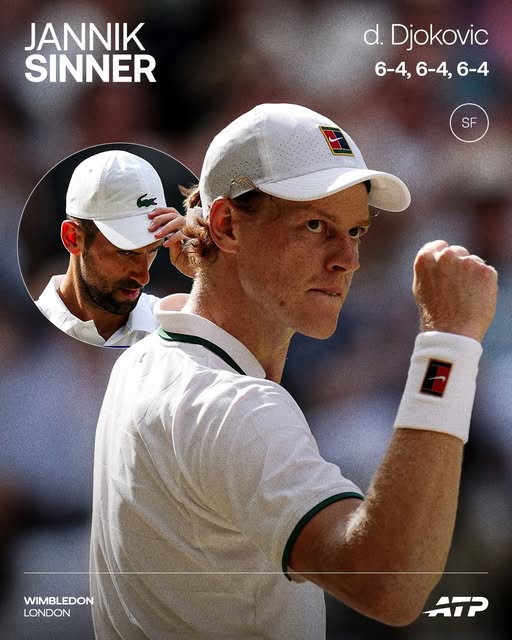
Jannik Sinner's straight-set victory over Novak Djokovic (6-4, 6-4, 6-4) was more than just a semifinal win—it was a statement that men's tennis has entered a new era. Defeating one of the greatest champions in history without dropping a set requires more than power. It requires tactical intelligence, emotional maturity, physical endurance, and unwavering confidence.
For years, Djokovic has built his legacy by forcing opponents into uncomfortable positions, exposing their weaknesses, and thriving under pressure. Against Sinner, however, those familiar advantages never materialized.
Sinner's Game Has Reached a New Level
Earlier in his career, Sinner possessed exceptional ball-striking ability but occasionally struggled with patience, tactical variation, and handling the biggest moments. Today, those weaknesses have largely disappeared.
His game has evolved into one of the most complete packages in professional tennis.
Controlled Aggression
Sinner no longer attacks recklessly. Instead, he waits for the right ball before accelerating the pace.
His decision-making has become one of his greatest strengths.
Rather than attempting low-percentage winners, he builds points patiently before finishing them with precision.
This maturity dramatically reduces unforced errors while keeping constant pressure on his opponents.
The Backhand Is World-Class
Perhaps no player currently strikes a cleaner two-handed backhand than Sinner.
Against Djokovic, his backhand consistently:
- Redirected pace effortlessly
- Neutralized Djokovic's crosscourt exchanges
- Created immediate offensive opportunities
- Changed direction with incredible accuracy
Instead of defending against Djokovic's backhand patterns, Sinner often controlled them.
That represents a remarkable tactical shift.
The Forehand Has Become a Weapon
Several seasons ago, Sinner's forehand occasionally broke down under sustained pressure.
That is no longer the case.
His forehand now combines:
- Heavy topspin
- Exceptional pace
- Deep court penetration
- Reliable consistency
Because he can generate pace from both wings, opponents cannot simply attack one side.
Superior Movement
Although Djokovic remains one of the greatest movers in tennis history, Sinner now covers the court with extraordinary efficiency.
His movement has become:
- Faster
- More balanced
- Better timed
- More explosive into offensive positions
Instead of simply retrieving balls, Sinner transitions immediately from defense into attack.
That ability constantly kept Djokovic under pressure.
Outstanding Serve Efficiency
One overlooked reason for Sinner's dominance was his serving.
He consistently earned:
- Free points
- Short returns
- Easy first-ball attacks
Holding serve comfortably prevented Djokovic from building scoreboard pressure.
In Grand Slam tennis, that is invaluable.
Mental Maturity
The biggest transformation in Sinner's game may not be technical.
It is psychological.
Against one of the greatest competitors in history, Sinner remained remarkably calm.
He showed:
- No panic
- No emotional swings
- No frustration after missed opportunities
- Complete confidence during pressure moments
Grand Slam matches are often decided mentally as much as physically.
Sinner demonstrated championship composure throughout the match.
Why Djokovic Could Not Win a Set
Djokovic's traditional strengths include extending rallies, absorbing pace, and forcing opponents into mistakes.
Against Sinner, those strategies were largely ineffective.
Several factors contributed:
1. Relentless Depth
Sinner repeatedly drove the ball deep near the baseline.
Djokovic had fewer opportunities to step inside the court and dictate play.
2. Faster Ball Speed
The pace coming from Sinner's racket consistently rushed Djokovic.
Even one of tennis's greatest returners found it difficult to reset points.
3. Minimal Free Points
Sinner kept his unforced error count under control.
Djokovic had to earn almost every point rather than waiting for mistakes.
4. Physical Pressure
Every rally demanded maximum movement.
Sinner continually stretched Djokovic from corner to corner before finishing points with authority.
Tactical Chess at the Highest Level
Elite tennis resembles a chess match played at extraordinary speed.
Sinner repeatedly anticipated Djokovic's patterns and adjusted accordingly.
His tactical execution included:
- Mixing crosscourt and down-the-line attacks
- Taking the ball early
- Changing rally direction unexpectedly
- Attacking short balls without hesitation
- Applying continuous scoreboard pressure
Rather than reacting to Djokovic, Sinner dictated the match from the opening game.
A Champion's Evolution
What makes Sinner especially dangerous is that his game has no obvious weakness.
He now combines:
- Elite serving
- World-class groundstrokes
- Outstanding movement
- Tactical intelligence
- Emotional stability
- Physical endurance
That combination is the hallmark of Grand Slam champions.
The Future of Men's Tennis
Every generation experiences a passing of the torch.
Roger Federer, Rafael Nadal, and Novak Djokovic defined one of the greatest eras in sports history. Now, players like Jannik Sinner are establishing themselves as the new standard.
This victory was not simply about defeating Djokovic. It demonstrated that Sinner possesses the complete game, maturity, and championship mindset required to dominate the sport for years to come.
His evolution has been remarkable. Against one of the greatest players ever to step onto Centre Court, Jannik Sinner didn't merely win—he controlled the match from start to finish, leaving no opportunity for Djokovic to claim even a single set. That performance reflects the arrival of a player whose game has truly exploded into one of the finest in modern tennis.