
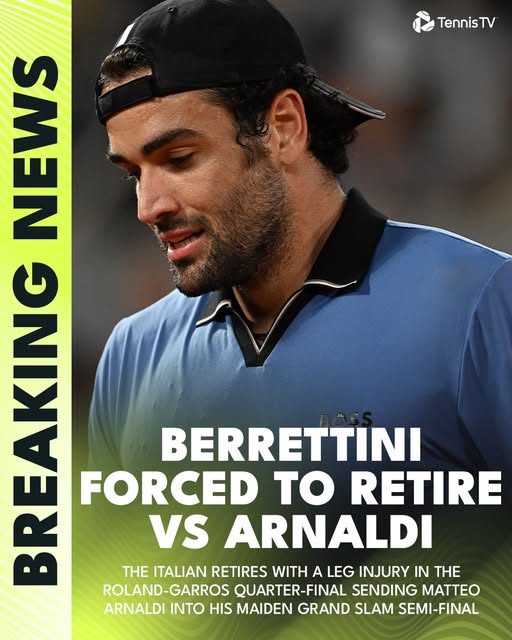
Matteo Arnaldi Reaches His First Grand Slam Semifinal as Berrettini Is Forced to Retire
Roland Garros 2026 delivered one of the tournament's most emotional moments when Matteo Berrettini was forced to retire during his quarterfinal match against fellow Italian Matteo Arnaldi due to a leg injury.
The retirement immediately sent Arnaldi into the first Grand Slam semifinal of his professional career, a milestone every tennis player dreams about from childhood.
Yet while Arnaldi celebrated a historic achievement, the tennis world also paused to acknowledge the disappointment and heartbreak surrounding Berrettini's departure.
In many ways, the match symbolized two powerful realities of professional tennis:
- The arrival of a new generation.
- The physical challenges faced by experienced veterans.
The scene was emotional because both players represent important chapters in Italian tennis history.
Berrettini helped carry Italian tennis onto the global stage.
Arnaldi now appears ready to continue that journey.
Sometimes sports remind us that careers are not only built through victories but are also shaped by injuries, resilience, adaptation, and the unavoidable passage of time.
The Match Before the Retirement
Before the injury became impossible to manage, the contest had already shown signs of becoming a fascinating all-Italian battle.
The matchup featured contrasting styles:
Matteo Berrettini
- Massive first serve
- Explosive forehand
- Offensive mindset
- Experience under pressure
- Grand Slam finalist pedigree
Matteo Arnaldi
- Superior movement
- Tactical flexibility
- Strong defense
- Youthful energy
- Increasing confidence
The clash represented experience versus emerging ambition.
Throughout the early exchanges, both players sought to establish control through their strengths.
Berrettini attempted to shorten points and dictate.
Arnaldi looked to extend rallies and force physical exchanges.
The Physical Reality of Professional Tennis
One unfortunate truth exists in every sport:
Aging affects everyone.
No athlete is immune.
Not even champions.
Not even legends.
Professional tennis places extraordinary stress on the body.
Players repeatedly perform:
- Explosive sprints
- Sudden directional changes
- Violent rotational movements
- Continuous jumping and landing
- Long matches lasting multiple hours
Over time, these demands accumulate.
The body remembers every mile.
Every match.
Every injury.
Every recovery.
Berrettini has battled physical challenges throughout several stages of his career, and Roland Garros 2026 became another difficult chapter.
Understanding the Injury Situation
Leg injuries are particularly devastating in modern tennis.
Movement forms the foundation of everything.
Without full confidence in movement, players struggle to:
- Defend wide balls
- Recover position
- Generate power
- Maintain balance
- Execute aggressive patterns
Even small reductions in mobility create enormous disadvantages against elite opponents.
When facing a player like Arnaldi, whose game thrives on movement and physical pressure, compromised mobility becomes even more difficult to overcome.
Eventually, Berrettini made the difficult but responsible decision to retire.
Why Retirement Is One of the Hardest Decisions in Tennis
Many fans assume players retire immediately after feeling pain.
The reality is very different.
Elite competitors often attempt to continue.
They try:
- Stretching
- Treatment
- Movement adjustments
- Tactical modifications
Athletes spend their entire lives fighting through adversity.
Retirement goes against their competitive instincts.
For a player like Berrettini, who has represented Italy with pride throughout his career, walking off the court likely became one of the hardest decisions of the season.
But protecting long-term health must always come first.
Matteo Arnaldi's Professional Response
One aspect that impressed observers was Arnaldi's professionalism.
He understood the circumstances.
There was no excessive celebration.
No unnecessary emotion.
Instead, there was respect.
Professional athletes recognize how painful injury retirements can be.
Arnaldi accepted advancement while acknowledging the disappointment felt by his countryman.
That maturity reflects his growing status within the ATP Tour.
Matteo Berrettini's Legacy Is Already Secure
Sometimes injury retirement creates unfair narratives.
A single match does not define a career.
Berrettini's achievements remain extraordinary.
His accomplishments include:
- Grand Slam final appearances
- ATP titles
- Davis Cup contributions
- Multiple victories over elite opponents
- Years among the world's best players
He helped elevate Italian tennis during a transformative period.
Many younger Italian players grew up watching Berrettini compete on the biggest stages.
His influence extends beyond rankings and trophies.
The Mental Challenge of Aging in Professional Sports
Physical decline receives attention.
Mental adaptation receives less.
Yet psychological adjustment may be equally difficult.
Athletes spend decades believing their bodies can solve every problem.
Then eventually they discover recovery requires more time.
Minor injuries become major concerns.
Training plans change.
Scheduling becomes more cautious.
This transition challenges even the strongest competitors.
ATP Expert Voices: Understanding the Veteran Experience
Many ATP analysts in the United States have discussed how modern tennis careers continue getting longer.
However, longevity requires adaptation.
According to many ATP experts:
"The players who survive longest are often those who evolve physically and mentally."
As careers progress, athletes must become smarter.
Recovery becomes more important than training volume.
Efficiency becomes more valuable than brute force.
Berrettini has consistently demonstrated this professionalism throughout his career.
Dynamic Analysis: What Was Happening Tactically?
Before the retirement, several interesting tactical patterns emerged.
Berrettini's Objective
His primary goals included:
- Dominating with the serve
- Controlling forehand exchanges
- Finishing points quickly
- Conserving physical energy
This strategy has defined many of his greatest victories.
Arnaldi's Objective
Arnaldi's plan appeared different.
He aimed to:
- Extend rallies
- Increase movement demands
- Create physical pressure
- Force repeated directional changes
These patterns naturally favor younger legs and fresher energy.
Why Arnaldi's Style Is Built for Modern Clay
Modern clay-court tennis increasingly rewards players who combine:
- Athletic movement
- Consistency
- Tactical adaptability
- Endurance
Arnaldi possesses each of these traits.
His game is not dependent on a single weapon.
Instead, it relies upon:
- Court coverage
- Rally tolerance
- Intelligent point construction
These characteristics become increasingly dangerous in Grand Slam formats.
The Rise of the New Generation
One of the major stories emerging from Roland Garros 2026 is generational transition.
Every era experiences this process.
Past generations eventually pass the torch.
New stars emerge.
New rivalries develop.
New champions arrive.
Arnaldi represents part of this transition.
His semifinal appearance signals that Italy's future remains exceptionally bright.
Lessons Young Players Can Learn From Berrettini
Even younger athletes can learn valuable lessons from veterans.
Resilience
Berrettini repeatedly returned from injuries throughout his career.
That resilience remains inspirational.
Professionalism
He consistently represented himself and Italian tennis with class.
Competitive Courage
He never feared major stages.
Big moments often brought out his best tennis.
Work Ethic
Elite careers are built through years of discipline.
Young players hoping to reach the top can study this example.
Mental Game Analysis
One fascinating aspect of professional tennis involves psychological endurance.
Physical stamina matters.
Mental stamina often matters more.
Berrettini's Mental Strength
Throughout his career, Berrettini became known for:
- Composure
- Self-belief
- Competitive courage
- Leadership qualities
These traits helped him succeed despite repeated injury setbacks.
Arnaldi's Mental Development
Arnaldi's growth is equally impressive.
His recent performances reveal:
- Increased confidence
- Better emotional control
- Improved focus
- Greater tactical discipline
These qualities become essential during Grand Slam tournaments.
Focus Under Pressure
Grand Slam quarterfinals create unique challenges.
Players face:
- Media attention
- National expectations
- Ranking implications
- Historic opportunities
Arnaldi handled these pressures remarkably well throughout the event.
His focus remained stable.
His decision-making remained disciplined.
Those signs suggest growing maturity.
Breathing and Stamina Management
Elite players increasingly emphasize breathing techniques.
Proper breathing improves:
- Oxygen delivery
- Recovery
- Concentration
- Emotional control
Top professionals often regulate breathing intentionally between points.
This habit helps maintain consistency during long matches.
The Evolution of Recovery in Modern Tennis
Recovery science has transformed professional tennis.
Today's players use:
- Physiotherapy
- Advanced nutrition
- Recovery monitoring
- Sleep optimization
- Mobility programs
Despite these advancements, aging remains undefeated.
Eventually every athlete confronts physical limitations.
That reality does not diminish achievement.
Instead, it makes achievement more impressive.
Why Arnaldi's Semifinal Matters
This breakthrough could represent a turning point.
Many future champions experience one defining tournament before becoming consistent contenders.
A first Grand Slam semifinal often creates:
- Confidence
- Belief
- Experience
- Recognition
Arnaldi now understands he belongs among elite competitors.
That realization can change an entire career.
What Comes Next for Berrettini?
The immediate focus becomes recovery.
Veteran players understand the importance of patience.
The priority should be:
- Accurate diagnosis
- Complete rehabilitation
- Gradual return
- Long-term health
Rushing recovery rarely produces positive outcomes.
What Comes Next for Arnaldi?
A Grand Slam semifinal introduces entirely new challenges.
He must now prepare for:
- Bigger pressure
- Stronger opponents
- Greater expectations
The key will be maintaining the same mindset that brought him success.
One match at a time.
One point at a time.
ATP USA Expert Assessment
Many ATP analysts believe Arnaldi's rise reflects a broader trend in men's tennis.
The modern game increasingly rewards:
- Athletic versatility
- Consistency
- Mental discipline
- Tactical intelligence
Arnaldi possesses these attributes.
His progress appears sustainable rather than temporary.
Meanwhile, Berrettini's career continues to demonstrate the value of perseverance and professionalism despite recurring physical setbacks.
Aging Is Not Defeat
One important distinction deserves emphasis.
Aging is not failure.
Injuries are not failure.
Retirement from a match is not failure.
They are realities faced by every athlete eventually.
Great champions are remembered not because they avoided adversity.
They are remembered because of how they responded to adversity.
Berrettini's career remains a powerful example of resilience.
A Symbolic Passing of the Torch
Whether intentional or not, this quarterfinal felt symbolic.
One player represented established excellence.
The other represented emerging possibility.
One fought through years of professional battles.
The other now prepares for new ones.
Italian tennis remains fortunate to have both stories.
Final Thoughts: One Chapter Ends, Another Begins
Matteo Berrettini's retirement from the Roland Garros quarterfinal was heartbreaking for players, fans, and Italian tennis supporters around the world.
No competitor wants to leave a major tournament because of injury.
Yet sports often produce moments that remind us of life's realities.
Time moves forward.
Generations change.
New opportunities emerge.
Berrettini leaves Roland Garros with disappointment but also with a legacy that remains secure.
Arnaldi leaves with the biggest opportunity of his career and a place in his first Grand Slam semifinal.
One story reflects endurance.
The other reflects emergence.
Together, they tell the story of tennis itself—a sport where experience, resilience, ambition, and renewal constantly intersect.
As one generation continues its battle against time, another rises toward the future.
And for Italian tennis, the future has rarely looked brighter.