
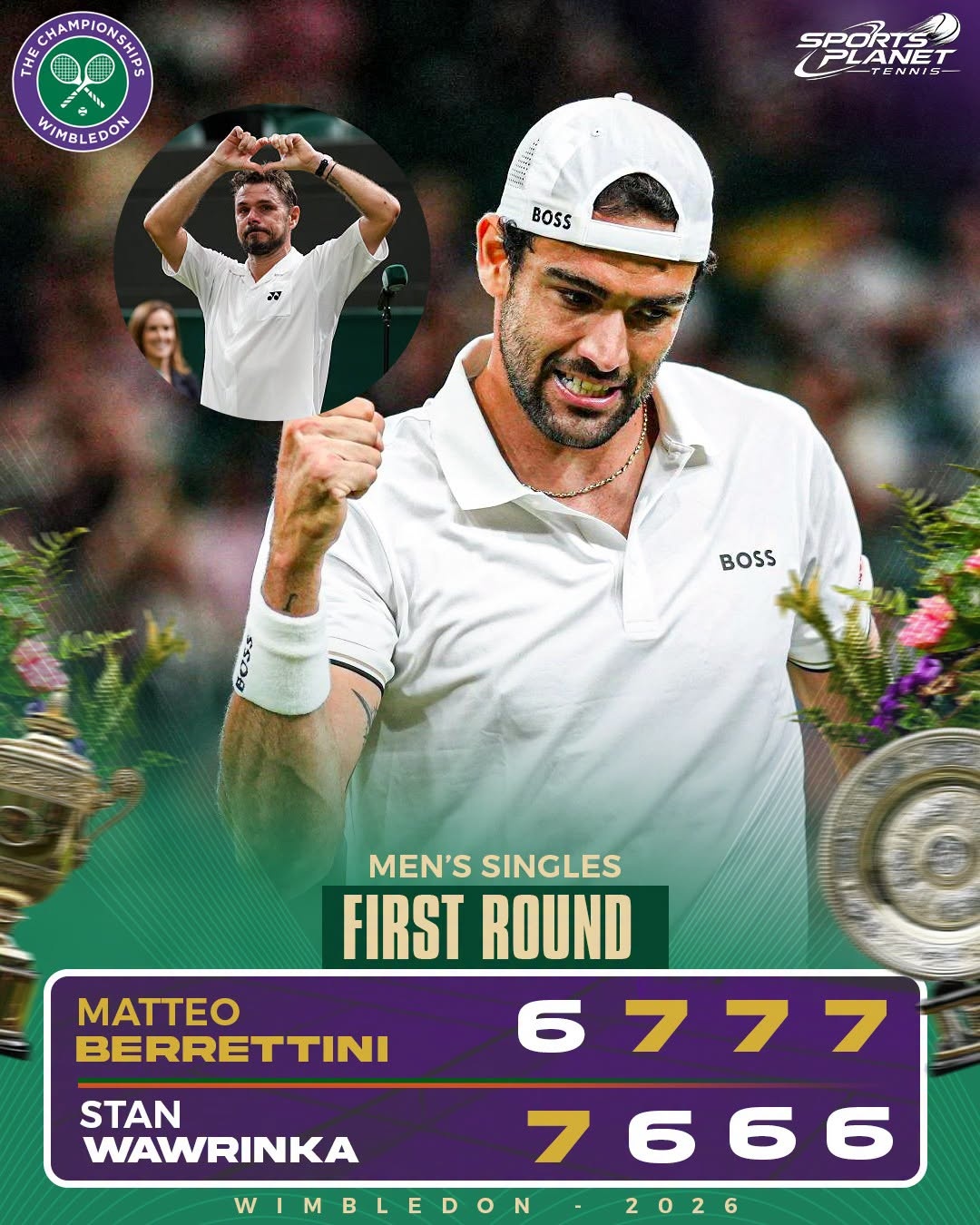
Alpha vs. Alpha at Wimbledon: How Matteo Berrettini Survived Stan Wawrinka's Relentless Attack in a Four-Set Grass-Court Classic — An ATP Coach's Tactical Analysis of Mental Toughness, Match Adjustments, and Peak Performance
When two fearless shot-makers step onto Wimbledon's grass courts, spectators expect fireworks. They expect blistering forehands, fearless backhands, emotional momentum swings, and points decided by inches rather than feet. Matteo Berrettini and Stan Wawrinka delivered exactly that in one of the most entertaining first-round battles of Wimbledon 2026. Although the scoreboard read 6-7, 7-6, 7-6, 7-6 in favor of Berrettini, the final score tells only part of the story.
This was not simply a match between two accomplished professionals. It was a collision of two Alpha competitors—players who refuse to retreat, who embrace pressure, and who seek to dictate rallies instead of merely surviving them. Every set featured momentum shifts, tactical adjustments, and moments where either player could have seized complete control. Ultimately, Berrettini's composure in the biggest moments, superior serving under pressure, and disciplined execution in four tiebreak-quality sets proved to be the difference.
From the perspective of an American ATP high-performance coach, this match provides an outstanding case study in championship-level tennis. It highlights how elite players manage emotions, adapt tactically, trust their strengths, and maintain aggressive identities even when facing an opponent capable of producing world-class winners from virtually every position on the court.
Two Alpha Competitors Refuse to Blink
The defining characteristic of this match was mindset.
Neither Berrettini nor Wawrinka entered Centre Court looking to play safe tennis.
Both players accepted the risks that accompany aggressive shot-making.
Both sought to impose their strengths immediately.
This is what ATP coaches describe as an Alpha vs. Alpha matchup.
Unlike matches where one player naturally becomes defensive, these contests become battles for court position, initiative, and psychological dominance.
Every rally carries hidden questions:
- Who controls the center of the baseline?
- Who attacks first?
- Who owns the forehand exchange?
- Who remains fearless under pressure?
Those questions shaped every game.
Berrettini's Identity Never Changed
Great players trust their identity.
Matteo Berrettini has always built his game around several elite weapons:
- One of the biggest serves on tour
- Heavy topspin forehand
- Aggressive first-strike tennis
- Excellent slice backhand
- Strong transition game
- Calm body language during pressure moments
Rather than abandoning this identity after losing the opening set, Berrettini doubled down on it.
That decision ultimately changed the outcome.
Stan Wawrinka Remains One of Tennis' Greatest Ball Strikers
Despite being one of the most experienced players on tour, Stan Wawrinka continues to possess extraordinary shot-making ability.
His legendary one-handed backhand remains capable of producing winners from virtually anywhere.
His willingness to attack short balls forces opponents into uncomfortable defensive positions.
Throughout the match, Wawrinka demonstrated why he has earned multiple Grand Slam titles.
His ball striking was clean.
His timing remained exceptional.
His confidence never disappeared.
That forced Berrettini to earn every single set.
Grass Court Rewards First Strike Tennis
Wimbledon remains unique because grass rewards decisive players.
The surface produces:
- Lower bounce
- Faster court speed
- Shorter rallies
- Greater importance on serving
- Faster transitions
Both competitors embraced these conditions.
Instead of grinding endlessly from behind the baseline, they attacked immediately.
Every short ball became an opportunity.
Every second serve became a target.
Every forehand became an invitation to attack.
First Set: Wawrinka Lands the Opening Blow
The opening set perfectly illustrated why momentum can be misleading.
Neither player gave many opportunities on serve.
Games moved quickly.
Pressure steadily increased.
Eventually, the set reached a tiebreak, where Wawrinka displayed remarkable composure to edge ahead 7–6.
For many players, losing such a tight opener creates doubt.
For Alpha competitors, it creates motivation.
Berrettini walked to his chair showing little visible frustration.
That emotional stability became one of the match's defining factors.
Emotional Discipline Wins Grand Slam Matches
One of the greatest coaching lessons from this contest is that emotional control often determines who survives long matches.
Berrettini never chased spectacular winners simply because he had fallen behind.
He stayed patient.
He trusted his serve.
He trusted his forehand.
He trusted his tactical plan.
ATP coaches constantly remind players:
"Do not let one lost point change your identity."
Berrettini lived by that principle throughout the contest.
Small Adjustments Created Big Results
Championship matches rarely require dramatic tactical overhauls.
Instead, elite coaches search for adjustments measured in inches rather than meters.
As the match progressed, Berrettini subtly improved several areas:
- Higher first-serve percentage
- Better forehand depth
- More effective use of the slice backhand
- Smarter approach-shot selection
- Improved positioning on second-serve returns
These changes slowly shifted momentum.
Rather than attempting to overwhelm Wawrinka with raw power, Berrettini became more selective.
His aggression became disciplined rather than rushed.
Why Wawrinka Continued to Threaten
Even as Berrettini found his rhythm, Wawrinka remained extraordinarily dangerous.
His one-handed backhand repeatedly opened impossible angles.
His willingness to strike winners from neutral positions prevented Berrettini from relaxing.
Every service game demanded complete concentration.
This is what made the match so compelling.
Neither player ever gained complete tactical control.
Instead, both continually forced each other to solve new problems.
Serving Under Pressure
The serve ultimately became Berrettini's greatest advantage.
While both players served effectively, Berrettini consistently produced his biggest deliveries at the biggest moments.
On break points.
At 30-all.
Inside tiebreaks.
Late in each set.
Championship serving is not measured only by aces.
It is measured by timing.
Berrettini repeatedly delivered first serves exactly when pressure peaked.
That prevented Wawrinka from building sustained scoreboard momentum.
Winning the Mental Battle
Perhaps the greatest difference between the two players appeared during the final stages of each set.
Both competitors remained physically capable.
Both continued producing high-level tennis.
The difference came from mental resilience.
Berrettini accepted pressure instead of fearing it.
Rather than protecting the score, he continued playing to win.
That Alpha mentality allowed him to capture three consecutive close sets after dropping the opener.