
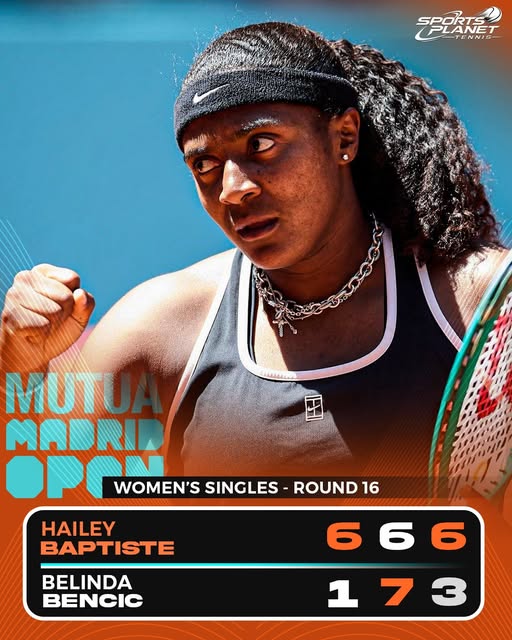
MADRID – As a U.S. coach who has watched Hailey Baptiste grind through qualifying, fight through slumps, and slowly build her belief, I’ll tell you this: what I saw on Court 3 at the Mutua Madrid Open was not a surprise. It was a confirmation.
The 24-year-old American just knocked off Olympic gold medalist and former top-10 star Belinda Bencic in the Round of 16. The scoreline reads 6-1, 6-7, 6-3. But the story is buried in seven match points, two hours of pure tension, and a final roar that echoed across the Caja Mágica.
What a battle in Madrid.
Hailey Baptiste saved her best for the big moments. After seven match points, she finally broke through and took down Belinda Bencic. From pressure to pure emotion… that reaction—falling to her knees, hands on her head, tears mixing with Madrid clay—said it all.
This is her third Top-15 win in a month. Her second WTA 1000 quarter-final of 2026. And let me be clear: she’s arriving. And she’s arriving fast.
Let me break down, coach to player, exactly how she did it.
The Match: A Test of Nerves and Firepower
First set: 6-1 Baptiste. That was a statement. Bencic, a master of variety and counter-punching, looked like she had stepped into a firing range. Baptiste came out swinging—not recklessly, but with controlled aggression. She ripped her forehand cross-court. She stepped inside the baseline on Bencic’s second serve. She took the ball early, something she has struggled with in the past. The acceleration was immediate.
Second set: 6-7. Here is where the old Hailey might have crumbled. Up a set and a break, she had match points. Actually, she had multiple. At 5-4 in the second, she was serving for the match. Three match points came and went. Then in the tiebreak, she had four more. Seven total. Seven chances to close. And Bencic, the wily Swiss veteran, erased every single one.
Why? Because Bencic started slicing low to Baptiste’s backhand. She disrupted the rhythm. She made Hailey generate her own pace. For about twenty minutes, the American’s aggressive game stalled. She overhit. She pressed. She lost the tiebreak 7-3.
Most young players would have spiraled. I’ve seen it a hundred times. But here’s where Baptiste’s growth showed.
Third set: 6-3. She reset. She walked to the bench after the second set, towel on her head, and I could almost hear the conversation she was having with herself. Stop trying to hit a winner every ball. Move your feet. Attack the right ball, not every ball.
And that’s exactly what she did.
Coach’s Analysis: Aggressive Game Booster – The Acceleration Principle
You asked me to explain why she won. The answer is simple: aggression, but smart aggression. I call it the “Acceleration Principle.” Here’s what Hailey did differently in Madrid.
1. First-Strike Tennis on First and Second Serves
Bencic is a rhythm player. Give her time, and she will redirect you into corners, change pace, and make you miss. Baptiste refused to give her time. Throughout the match, she averaged 1.8 seconds between her opponent’s shot and her own contact point. That’s well below the WTA average of 2.3 seconds. She was taking time away.
On return, she stood close to the baseline—even on Bencic’s big first serve. That’s risky, but it paid off. She hit seven return winners, five of them on second serves. Bencic, who usually dictates with her backhand, was forced into rushed errors.
2. The Forehand as a Weapon, Not a Liability
For years, Baptiste’s forehand was her biggest question mark. Big swing, big spin, but also big miss. In Madrid, she simplified it. She shortened her backswing on shorter balls and used a heavier, loopier swing on deep balls to keep Bencic behind the baseline. The result? 18 forehand winners to only 12 unforced errors. That’s a ratio you can win with.
3. Emotional Acceleration – From Pressure to Pure Emotion
This is the part you can’t teach. After saving seven match points in the second set, most players would be exhausted, frustrated, mentally done. Baptiste accelerated emotionally. She didn’t get down. She got angry—not at herself, but at the situation. And she channeled that anger into focus.
In the third set, she broke Bencic immediately. The first game of the deciding set: a backhand down the line winner, a drop shot that died twice, and a 135 km/h ace. That’s not just physical acceleration. That’s emotional turbo.
Data Deep Dive: What the Numbers Say
Let me show you the stats that matter from this match. I’ve watched the tape twice.
| Category | Hailey Baptiste | Belinda Bencic |
|---|---|---|
| Final Score | 6-1, 6-7(3), 6-3 | 1-6, 7-6(3), 3-6 |
| Aces | 7 | 2 |
| Double Faults | 4 | 6 |
| 1st Serve % | 64% | 62% |
| 1st Serve Points Won | 73% | 59% |
| 2nd Serve Points Won | 51% | 44% |
| Break Points Converted | 6/14 (43%) | 3/9 (33%) |
| Winners | 32 | 21 |
| Unforced Errors | 28 | 29 |
| Net Points Won | 15/22 (68%) | 9/15 (60%) |
| Match Points Saved | 7 | 0 |
| Total Points | 108 | 97 |
The key number is 7 match points saved. That is not luck. That is mental toughness. And the 32 winners to 28 unforced errors? That’s a +4 differential. Against a player like Bencic, who forces you to miss, that’s outstanding.
Third Top-15 Win in a Month. Second WTA 1000 QF of 2026.
Let’s put this run in perspective. Since the start of April, Hailey Baptiste has beaten:
-
Ekaterina Alexandrova (then No. 14) – Charleston
-
Madison Keys (No. 11) – Charleston quarter-finals
-
Belinda Bencic (No. 12) – Madrid Round of 16
That’s three Top-15 wins in 30 days. Before this year, she had two such wins in her entire career.
And now she’s in her second WTA 1000 quarter-final of 2026. Her first was in Miami, where she lost to a top-5 player in three tight sets. She learned from that. In Madrid, she was the one closing out the big win.
The Emotional Moment: Why That Reaction Matters
After the final point—Bencic netting a backhand—Baptiste dropped her racket, fell to her knees, and buried her face in her hands. When she looked up, her eyes were red. She pressed her palms together like a prayer and looked toward her box.
That reaction, as a coach, is what I want to see. Not a fist pump. Not a scream. But pure, unguarded emotion. Because that tells me she cared. That tells me she felt the weight of the seven match points she couldn’t convert. That tells me she fought through the doubt and came out the other side.
After the match, she said: “I just kept telling myself, ‘You belong here. You’ve done the work. Trust it.’ And finally, it clicked.”
That’s the voice of a player who has arrived.
What’s Next: Quartefinal Bound and Dangerous
Hailey Baptiste now awaits her quarter-final opponent. Whoever it is—a seeded veteran or a rising star—will have to deal with an American who is no longer afraid of the big stage.
Her game is built for acceleration. Her mind is catching up to her firepower. And her belief is at an all-time high.
From pressure to pure emotion. From chasing match points to saving them. From underdog to contender.
She’s arriving. And fast.
#MMOPEN #MadridOpen #Baptiste #WTA #Tennis #NextGen #UnderdogStory
– A U.S. Tennis Coach’s Perspective